Sunday, May 20, 2012

Christiaan van der Klaauw Aquarius Planetarium


In an extravagant and bold segue from his Planetarium watch, touted as the world’s smallest functioning planetarium, Dutch watchmaker Christiaan Van Der Klaauw has combined with master-engraver Kees Engelbarts for a mashup of astrology with astronomy, resulting in the first of twelve pièce unique, the Aquarius Planetarium.

Based on the Planetarium, but really not resembling it at all, the Aquarius’ dial is dominated by an amazingly intricate depiction of this astrological sign in white gold. At 12 o’clock is the well-known planetarium, showing the cycles around the sun of the revolving Mercury, Venus, Earth, Mars, Jupiter and Saturn.

On the outer most ring of the planetarium are the astrological positions marked in black on a metallic finish base. At 5 o’clock is a matte finished sub dial identifying the month and the position of the sun. The time (hours, minutes, seconds) hands are carry on the matte theme, which means that they blend somewhat into the engraving work.


The 40mm platinum case has an open case back which reveals the 18k rotor hand-engraved by Jochen Benzinger. Each of the watches in the series will use the automatic CK1196 calibre movement with a built in planetarium module.

In total, there will be twelve of these timepieces, one for each zodiac sign. They come at a hefty €79,500 each (including taxes, if that makes a difference for you), and the remaining eleven will be made to order.  Will all twelve be ordered? It wouldn’t surprise me if they were.

Oh, and if you’re wondering about the price of the ‘regular’ Planetarium, the current list price for the KPT1126 model is € 31.500.


[AP]

Thursday, May 17, 2012

A look at a rare Fifty Fathoms


Are there sounds in the sea
Fifty Fathoms deep?

Sea Music : W. J. Turner  (1884 – 1946)


In 1952, the French government created an elite team within the Navy called the ‘Nageurs de combat’ (combat swimmers). Headed by Captain Bob Maloubier, the new team’s missions included underwater intelligence, sabotage operations and clandestine port attacks.

Underwater diving was still in its infancy at this point, so Maloubier and his team had to design their diving equipment from scratch. This took two years, and involved new diving suits, fins, goggles, and a watch. The team was equipped with diving watches, but Maloubier was not satisfied, so in conjunction with Lieutenant Claude Riffaud, he set about designing a better one. Their design was first submitted to Lip, whose ambivalence was summarised by their comment that his design was "a portable clock without any future".

The irony of this decision by Lip was not too far away.

Undeterred, Maloubier and Riffaud convinced Jehan-Jacques Fiechter at Blancpain, himself a keen diver, to produce the watch, which they named the ‘Fifty Fathoms’. A fathom is a unit of length used as a depth measurement in English-speaking countries, corresponding to a depth of 1.829 metres. Fifty Fathoms equates to 91.45 metres, the depth one can reach with traditional diving equipment. Jehan-Jacques was the nephew of Betty Fiechter who, with André Leal, had purchased Blancpain in June 1933. Betty had assisted in running Blancpain since 1915, and under the Fiechters, the Manufacture flourished.

The final Fifty Fathoms that went into production was not the exact design that Maloubier and Riffaud had presented, as Fiechter used his own diving experience to make some adaptations. These included a screw-down caseback with a double ‘O-ring’ system, and a humidity indicator at 6 o’clock (blue if the air in the case was dry, pink if water had penetrated the watch case).

Blancpain were unable to sell their watches directly to the French navy, and had to make their way to the Nageurs de combat via Spirotechnique, who were the official suppliers of scuba diving equipment to the French armed forces. Established in 1946, La Spirotechnique, which later became ‘Aqua Lung’, had its origins in 1942-43, when Jacques Yves Cousteau and engineer Emille Gagnan, who was working for L'air Liquide, a French company specialising in compressed gas, created the first scuba regulator. 

Now we come to the (amusingly) ironic part. At the time, Lip was a dominant player in the French watch market. Blancpain was an unknown. This meant that Blancpain and Lip had to sign a marketing and distribution deal to get an foothold in the French market. In 1954 the Fifty Fathoms watches were launched, with both Lip and Blancpain markings on the dial. One wonders whether there were any animated discussions at this time at Lip about opportunities lost. 


Within a decade of its launch, Blancpain's Fifty Fathoms had been adopted by a few specialist oceanographic exploration and research organisations. Most famously, Jacques Cousteau selected the Fifty Fathoms as the dive watch of choice for his 1956 Cannes Film Festival Palme d'Or winning ‘Le monde du silence’ (The Silent World). 
  
From the early 1950s through the 1970s, the Fifty Fathoms became popular amongst the military, and used by the armed forces of Israel, Germany, Sweden, Norway, Denmark, Poland, Finland and the U.S. When the Americans were looking for a dive watch, there was a ‘Buy American’ policy, whereby American manufacturers were given a 25% price advantage over non-American competitors. Fortunately for Blancpain, Allen Tornek, who had met Jehan-Jacques Fiechter through their common interest in diving, took an interest in helping out. To get around the various restrictions, the Tornek-Rayville company took the Fifty Fathoms and rebranded it for the U.S. military under two names “Blancpain Tornek” and “Rayville Tornek” (‘Rayville’, a phonetic anagram of Villeret, was the name used by Fiechter for some of Blancpain’s production). About 1000 Tornek-Rayville Fifty Fathoms were produced, most of which were destroyed by the Navy at the end of the commission, so they are particularly sought after nowadays. 


To understand the history of Fifty Fathoms is arguably a lifetime’s worth of work given the list of companies involved, the number of iterations (estimated at around 100) of design/ movements/ size, and the fact that there have been both military and civilian versions.

In late 2010 and through to 2011, Blancpain launched a travelling worldwide exhibition of the history of the Fifty Fathoms. Starting at their boutique at Place Vendôme, Paris, it was a Fifty Fathoms/ dive watch enthusiasts’ dream, an incredible exhibition over sixty watches retracing its history and a truly once-in-a-lifetime chance to see such a group together.

Mostly consisting of historical models owned by collectors but also covering the latest models, this beauty, belonging to a distinguished collector friend of JPVFX’s, formed part of this important exhibition.


A rare early Fifty Fathoms Rotomatic Incabloc from 1954-1955 (possibly pre-dating the Rolex Submariner), this watch is 41mm with a thickness of 12mm. In a stainless steel case with a screw down case back, it is anti-magnetic and has a bi-directional bezel. The dial is a glossy gilt, and the indices and baton hands are radium-coated. The movement is Cal A. Schild 1361N, rhodium-plated with 17 jewels, line lever escapement, monometallic balance, shock-absorber and self-compensating flat balance-spring.


Invented in 1934 and manufactured by Incabloc S.A., the Incabloc shock protection system is the trade name for a spring-loaded mounting system for the jewel bearings that support the balance wheel in a mechanical watch, to protect the wheel's delicate pivots from damage in the event of physical shock.

The early Fifty Fathoms watches are very difficult to find nowadays, and poor condition is often an issue. There is really something particularly amazing about vintage tool watches like this one that somehow, after over half a century, manage to still have a brightness and clarity to them.

I admit that I’ve wanted a vintage Fifty Fathoms for little while. I really wouldn’t mind this one … 


 Yes you read correctly - a note signed for the 50 Fathoms owner by Captain Bob Maloubier himself


Call me old fashioned, but I’ve never managed to get my head around rose gold Fifty Fathoms, tourbillon Fifty Fathoms etc etc etc. I understand the desire to develop and innovate models that have become synonymous with your brand, but when a watch was created as a proudly utilitarian dive watch, I can’t help but think that something is lost when it is turned into an unnecessarily elaborate timepiece.   


[AP]

Tuesday, May 15, 2012

Hands-on with an unusual enamel & gold vein dialled Longines


As you know, we love our vintage watches, and today we have another rare horological beast for you. This one is particularly unusual. No, it’s not a Longines with a cracked dial which has had the cracks filled with gold. Meet the enamel and gold vein dialled Longines Flagship.


Launched in 1957, the Longines Flagship collection focused on classic slim cases, designed to be waterproof, and seen as a rival to Omega’s Seamaster at the time. This example is circa 1966. Measuring 35 x 39 mm (not including the crown), it has the original enamel dial with gold veins running through it, giving it a ‘cracked’ look. This is an intriguing and striking dress watch whose nuances are best viewed through a loupe; it is only then that you get the full effect of the gilt and enamel, and it's just stunning.


Interestingly, despite this being a 1960s model, the hands are Art Deco in style, and almost architectural. It’s an unusual combination, the veining with the hands, and it works.

The watch is signed on the dial, case (signed ‘Longines-Wittnauer') and crown, its movement a Longines calibre 285 manual wind with 17 jewels. The bezel is 14 K gold, as are the lug caps, but the back is stainless steel.


Owned by a collector of vintage Longines who has not seen another one like this before, if you have come across another one in your horological travels, please tell us, as he’d love to learn more about this watch.


Oh and just in case you’re wondering about the importance of the Flagship collection to Longines, their Heritage Collection, which honours the brand’s most iconic watches by recreating them anew, contains some Flagship models that hark back to the early days of the model line.


[AP]

Saturday, May 12, 2012

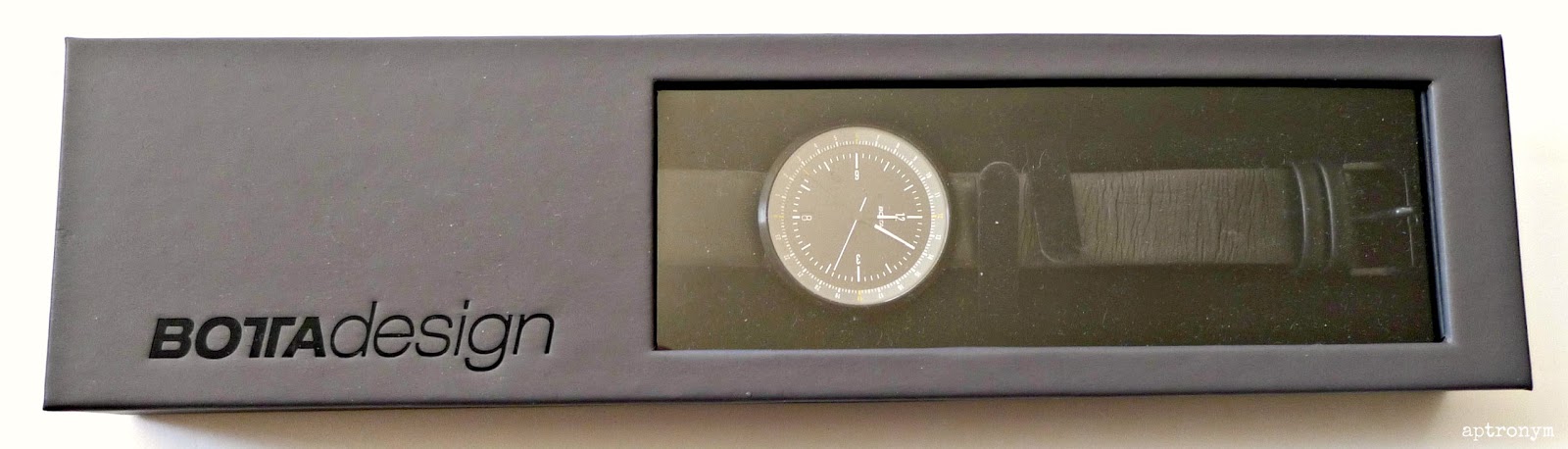
Hands-on with the Botta MONDO dual time zone


Sometimes, you end up with a watch unexpectedly. The Black Edition Botta Mondo Dual Timer is one of those watches. The reasons why it turned out to be unsuitable for its original owner (and thus how I became its new owner) were a classic example of how a watch can appear to be what you wish for in pictures, but turn out to be something quite different ‘in the metal’.

With a design ethos claimed by Botta to be rooted in the simple lines of 1970s Braun watches, this is a fairly inexpensive good looking dual time zone watch. The typeface, clarity and minimalist approach is very appealing in photos.

Although it is not anything new, one of th aethetically pleasing things about this watch is its use of angles. It is not just about the way the 24-hour second time zone outer ring slopes quite sharply downwards towards the time indices, but also about the use of contrasting grey and black that gives it a stylish edge. You’ll also notice the artificial ‘horizon’ that divides the 24-hour ring into two differently coloured halves, one for day and one for night. Exactitude isn’t the key point here with this feature, but it is useful at a glance if you want to quickly ascertain whether it’s day or night in your second time zone.


At a comfortable 40mm, this is a slim (7.5mm) stainless steel watch that weighs only 43g. Inside is a Ronda 515.24H quartz movement. The strap is a vegetable tanned leather strap (available in three lengths), but there are bracelet and rubber strap options available as well for the Black Edition. The regular edition only offers leather and bracelet options.


As an inexpensive dual timer, if you’re not bothered by quartz, this is a pretty good option from an aesthetic point of view, so what were problems that came up for its original owner which lead to its transfer to me?

The first issue was that of size. Although it’s a decent 40mm, it’s a slim watch, and not for those who are used to wearing something with more heft.

The second problem was that of clarity.


One of the very things that appealed about this watch turned out to be one of its shortcomings for the original owner. The slim markers and hands were not a problem, but the second time zone marker, with a very discreet orange tip, is not as legible at first glance as it could be. If you wish to be able to rapidly identify your second time zone, this is not the watch for you. It’s not illegible, but it’s not recommended for people who need something bold and clear, and the photos on the Botta website don’t really give a good ‘working’ level indication of this hand’s legibility.

I like this watch and am happy to be its new owner but even for me, there is one small problem – the strap. It creases and marks easily, and doesn’t feel very sturdy.


The Mondo is priced from € 348.00 and you can order it direct from Botta here.

Oh and if you visit their website you'll notie that Botta have a single-handed watch called the Uno which is remarkably similar to MeisterSinger ... as is their wall clock.


[AP]

Thursday, May 10, 2012

Just because ... a Grande Sonnerie


What is a Grande Sonnerie? 

It means ‘grand strike’ in French, and is a complication in a mechanical watch or clock which combines a passing quarter striking mechanism with a repeater. That is, on the quarter-hour it strikes the number of hours audibly on a gong, and then the number of quarter-hours since the hour on a second gong. The hour and quarter strikes can also be activated on demand at the push of a button. The hours and quarters chime 'en passant', or as they pass. In contrast, a petite sonnerie strikes the hours and quarters in passing without repeating the hours at each quarter.


This is a Grande et Petite Sonnerie from Audemars Piguet’s Jules Audemars line. An almost old-fashioned 39mm in size, it’s a lovely warm rose gold and one of a limited edition of 50 watches. This watch was part of the first series of Grande Sonneries made by Audemars Piguet in 1995. The rose gold case is 39mm, polished and brushed, with the slide at 2 for the Grand Sonnerie, Petit Sonnerie or silent functions, and a push-button at 10. The Cal. 2868 has 51 jewels, straight line level escapement, shock absorber, self-compensating flat balance-spring,and Côtes de Genève. The sonnerie strikes are via two polished steel hammers onto two gongs. 

Stunning. 


 [AP]

Monday, May 7, 2012

A look at a 1939 Longines Lindbergh


In March, I wrote about a rare Longines Wittnauer Second Setting watch. Thanks to a distinguished collector friend of JPVFX, we now have a follow-up post of an even more well known and rare Longines aeronatical beast - the Longines Hour Angle watch, known as the 'Longines Lindbergh'. 

Designed by Longines and Lindbergh based on the Weems design, this was a continuation of Longines’ relationship with pilots; the brand was the official supplier of time instruments to the International Aeronautical Federation (IAF) from 1919. 

The Lindbergh Hour Angle Watch was designed by Col. Charles A. Lindbergh as a navigational aid for pilots and was, in fact, used by renowned aviators such as Amelia Earhart and Amy Johnson. Used in conjunction with a sextant, nautical almanac and a radio to receive a time signal, it made allowed for the calculation of the ‘Greenwich hour angle’ i.e. longitude.

So, what is an ‘hour angle’? 

From the aviation point of view, it is the angular distance west of the Greenwich meridian. The earth’s full rotation is 360° – an hour, therefore, is an ‘hour angle’ of 15°. This means that a 60° hour angle, for example, equates to 4 hours with respect to the Greenwich meridian. 

Here are some pages from the Longines website about the modern ‘heritage’ version of the Hour Angle that they released a few years ago, with an explanation of its use. Click on each screenshot to get a larger image.


This stunning example dates from 1939. A 47mm sized steel case with an onion crown, the main dial is white enamel with black Roman numerals. The revolving bezel is silver inlaid with enamel nu, the 15 degree intervals as mentioned above are on a rotating bezel. The crown at 2 o’clock turns the inner dial, which is calibrated for 60 seconds and 15 degrees.


The Lindbergh and the Weems actually came out with two movements. 

Firstly, the Cal.18.69N, which allows the time to be pin set by pressing the pin down and then rotate the crown to set the time, whilst when you pull the crown out, it rotates the central disc to offset the time. 

Secondly, it also came with the Cal. 37.9, which has a small wheel under the crown. The wheel rotates the central disc and the time set in the traditional way by pulling out the crown.

Inside this Lindbergh is the Cal. 18.69N movement. This calibre was produced by Longines from 1895 onwards. It has a nickel-finished lever movement, 15 jewels, bimetallic compensation balance, and hinged stainless steel cuvette. Cal 18.69N allows the time to be pin set (you press the pin down and then rotate the crown to set the time) while when you pull the crown out, it rotates the central disc to offset the time.

This Lindbergh is in remarkable condition. The enamel dial and Breguet-styled blued hands are bright, the numerals clear, the bezel showing the fabulous patina of its age but with the numbers still clearly visible. As is the case with the Second Setting watch, it sits comfortably on the wrist in spite of its size.


As mentioned above, the Longines Heritage line, along with producing a homage to the Weems Second Setting, also resurrected the Lindbergh Hour Angle Watch with similar faithfulness to the original, but with the added bonus of a caseback that opens to reveal the L699 automatic movement. 

The brand’s Heritage watches are very well received and to my mind, their best models. In some ways it’s interesting that designs which hark back to their past are so well regarded, but then again, it just proves the old adage about good design (I’ll spare you the ‘time’ pun). 


[AP]

Wednesday, May 2, 2012

China's most popular online brands : how do watches fare?


The Luxury Society and Digital Luxury Group has released their new index of the top 50 ‘most searched’ luxury brands in China. The first instalment of the World Luxury Index, the ranking covers more than 400 brands within six key segments (fashion, beauty, jewellery, cars, watches and hospitality). Indexing based on over 150 million searches from China's most popular search engines, Google and Baidu. 


According to the study, 18 of the top 50 'most searched for' luxury brands in China (36% of total searches), are auto brands, and car related searches make up 54% of total online searches. In contrast, watches only amount to 3% of searches, with the most-searched for watch brand is Longines, followed by Omega and Rolex.


If you want to see some of the other findings of this report, you can view the slideshow here.


[AP]