Showing posts with label Watch Profile. Show all posts

Tuesday, June 5, 2012

Hands-on with the Sothis Horus chronograph


Wolfgang Steinkrüger, the creative mind behind the watch brand Sothis, died recently, his legacy a series of highly recognisable and playful watches with an Egyptian influence. Although the brand started under another name, its founders Wolfgang and Karina Steinkrüger changed its name to Sothis, the Egyptian name for the star Sirius, in 1999. 

In this post we look at one of his most well-known models, the Horus.

Horus was the ancient Egyptians’ patron god, usually depicted as a falcon-headed man wearing a red and white crown. The Horus chronograph was produced in three versions – with an ivory/ silver dial, a matte black/ anthracite, and silver guilloche, each in a limited (numbered) edition of 200.

This is one of the ivory/ silvered dialled iterations (featured on the cover of Wristwatch Annual 2007). The black/ anthracite and silver guilloche versions are slightly more dressy. 

With the time indicated via a single 24-hour hand tipped at the ends with a sun and a star, the Horus has a quirky way of indicating both time and day/ night. The hand indicates the time and the star or sun indicates night or day. Time is shown in 5 minute increments and it takes 24 hours to do one complete revolution.

In addition, the star on the dial rotates with the running seconds.


The crown has a distinctive engraved hieroglyph for ‘Sothis’. 

Unlike the hours and minutes display, the chronograph is more traditional.


As you can tell from the specs below, this is a watch with a decent amount of height to it. With the bracelet, it weighs 175g. It’s not uncomfortable, but with the thickness, you can definitely feel every bit of its 44mm size.


TECHNICAL SPECIFICATIONS

Reference: 026001-W 
Movement: Automatic Valjous ETA 7750, customised by SOTHIS, engraved gold plated rotor 
Functions: hours, minutes, date, chronograph
Case: Stainless steel L 316 
Crystal : sapphire on both sides 
Water resistance : 5 atm 
Size: 44 mm.
Height : 13.9 mm 
Dial: matte black/ anthracite, ivory/ silver or silver guilloche 
Strap: leather strap with deployment buckle, stainless steel bracelet or set 
Limited edition: 200 pieces 


With its distinctive design, this watch may not be to everyone’s taste, but if you’re looking for a fun quirky chronograph from a brand that likes to do something different design-wise, it is still possible to find some of these, even in Australia, where they have an AD. 
 
The future of Sothis is still uncertain; Karina issued a press release about it that you can view here


[AP]

Thursday, May 24, 2012

The Rolex Ref. 5513 Mk IV


Having already blogged about the Ref. 5510 and the Double Red Sea-Dweller (Ref. 1665), today’s classic Rolex is the Ref. 5513 Mark IV. To read about the beginnings of the Rolex Submariners, go to the Ref. 5510 link above, but as was mentioned there by TonyC the 5510, which had a short production run (est. third-quarter of 1958 until late 1960), was replaced by a larger cased 5512/ 5513 (COSC/ non-COSC). 


The 5512 and 5513 were both fitted with the oversized crown which became a standard feature of the Submariner line, and came initially with a pointed crown guard, but later changed to the more rounded crown guard. Sometime in the early 1960s, Rolex discontinued the use of radium paint for the indices, switching to the safer Tritium. 


The 5513 was produced from 1962 through until approximately June 1990. It used Calibres 1520 and 1530, and the latter appeared in both the 5513 and 5512 for a time. Early dials from the 5512 and 5513 had what is called a ‘gilt’ dial, referring to the fact that the colour of the text was gold. Around 1965 or 1966 Rolex discontinued the use of gilt dials on the Submariner watches and switched to white printing. 


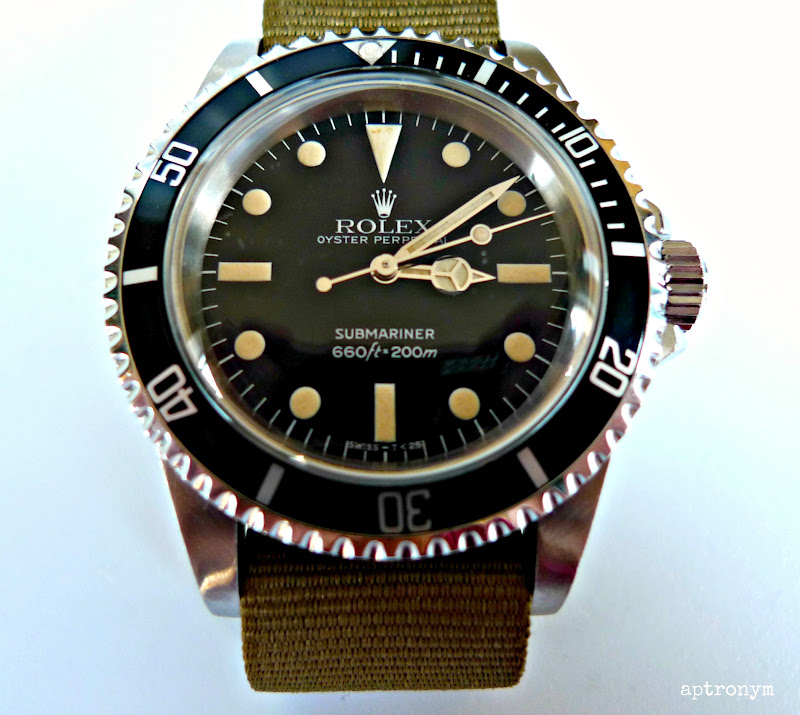
This is 5513 MK IV ‘maxi dial’ with a 7.9mil serial, from about 1983. The bezel is sharp, the dial and indices in remarkable condition.

What is a ‘maxi dial’? Well the term was first used by Rolex at Baselworld 2003 to describe the larger luminous dots on the Reference 16610LV. It was then appropriated retrospectively by vintage Rolex collectors for vintage Royal Navy Submariners, and then taken back even further, chronologically, to refer to older Submariner models. A close examination shows that the post-1975 maxi dials share two characteristics: larger lume dots and generally bolder text, especially for the depth rating and 'Submariner'. 


The Type IV shown in these photos is the second-to-last known style of matte dial for the 551x reference, showing up on Subs with high 6 million case serials until around about the late 7 millions. 

Even if you're not an old-school Rolex fan, you have to admit that this is in pretty damn good condition, and a classic versatile watch.

So … have we turned you into a possible vintage Rolex sports watch enthusiast yet? 


[AP - with thanks to TonyC and initialjh]

Thursday, May 17, 2012

A look at a rare Fifty Fathoms


Are there sounds in the sea
Fifty Fathoms deep?

Sea Music : W. J. Turner  (1884 – 1946)


In 1952, the French government created an elite team within the Navy called the ‘Nageurs de combat’ (combat swimmers). Headed by Captain Bob Maloubier, the new team’s missions included underwater intelligence, sabotage operations and clandestine port attacks.

Underwater diving was still in its infancy at this point, so Maloubier and his team had to design their diving equipment from scratch. This took two years, and involved new diving suits, fins, goggles, and a watch. The team was equipped with diving watches, but Maloubier was not satisfied, so in conjunction with Lieutenant Claude Riffaud, he set about designing a better one. Their design was first submitted to Lip, whose ambivalence was summarised by their comment that his design was "a portable clock without any future".

The irony of this decision by Lip was not too far away.

Undeterred, Maloubier and Riffaud convinced Jehan-Jacques Fiechter at Blancpain, himself a keen diver, to produce the watch, which they named the ‘Fifty Fathoms’. A fathom is a unit of length used as a depth measurement in English-speaking countries, corresponding to a depth of 1.829 metres. Fifty Fathoms equates to 91.45 metres, the depth one can reach with traditional diving equipment. Jehan-Jacques was the nephew of Betty Fiechter who, with André Leal, had purchased Blancpain in June 1933. Betty had assisted in running Blancpain since 1915, and under the Fiechters, the Manufacture flourished.

The final Fifty Fathoms that went into production was not the exact design that Maloubier and Riffaud had presented, as Fiechter used his own diving experience to make some adaptations. These included a screw-down caseback with a double ‘O-ring’ system, and a humidity indicator at 6 o’clock (blue if the air in the case was dry, pink if water had penetrated the watch case).

Blancpain were unable to sell their watches directly to the French navy, and had to make their way to the Nageurs de combat via Spirotechnique, who were the official suppliers of scuba diving equipment to the French armed forces. Established in 1946, La Spirotechnique, which later became ‘Aqua Lung’, had its origins in 1942-43, when Jacques Yves Cousteau and engineer Emille Gagnan, who was working for L'air Liquide, a French company specialising in compressed gas, created the first scuba regulator. 

Now we come to the (amusingly) ironic part. At the time, Lip was a dominant player in the French watch market. Blancpain was an unknown. This meant that Blancpain and Lip had to sign a marketing and distribution deal to get an foothold in the French market. In 1954 the Fifty Fathoms watches were launched, with both Lip and Blancpain markings on the dial. One wonders whether there were any animated discussions at this time at Lip about opportunities lost. 


Within a decade of its launch, Blancpain's Fifty Fathoms had been adopted by a few specialist oceanographic exploration and research organisations. Most famously, Jacques Cousteau selected the Fifty Fathoms as the dive watch of choice for his 1956 Cannes Film Festival Palme d'Or winning ‘Le monde du silence’ (The Silent World). 
  
From the early 1950s through the 1970s, the Fifty Fathoms became popular amongst the military, and used by the armed forces of Israel, Germany, Sweden, Norway, Denmark, Poland, Finland and the U.S. When the Americans were looking for a dive watch, there was a ‘Buy American’ policy, whereby American manufacturers were given a 25% price advantage over non-American competitors. Fortunately for Blancpain, Allen Tornek, who had met Jehan-Jacques Fiechter through their common interest in diving, took an interest in helping out. To get around the various restrictions, the Tornek-Rayville company took the Fifty Fathoms and rebranded it for the U.S. military under two names “Blancpain Tornek” and “Rayville Tornek” (‘Rayville’, a phonetic anagram of Villeret, was the name used by Fiechter for some of Blancpain’s production). About 1000 Tornek-Rayville Fifty Fathoms were produced, most of which were destroyed by the Navy at the end of the commission, so they are particularly sought after nowadays. 


To understand the history of Fifty Fathoms is arguably a lifetime’s worth of work given the list of companies involved, the number of iterations (estimated at around 100) of design/ movements/ size, and the fact that there have been both military and civilian versions.

In late 2010 and through to 2011, Blancpain launched a travelling worldwide exhibition of the history of the Fifty Fathoms. Starting at their boutique at Place Vendôme, Paris, it was a Fifty Fathoms/ dive watch enthusiasts’ dream, an incredible exhibition over sixty watches retracing its history and a truly once-in-a-lifetime chance to see such a group together.

Mostly consisting of historical models owned by collectors but also covering the latest models, this beauty, belonging to a distinguished collector friend of JPVFX’s, formed part of this important exhibition.


A rare early Fifty Fathoms Rotomatic Incabloc from 1954-1955 (possibly pre-dating the Rolex Submariner), this watch is 41mm with a thickness of 12mm. In a stainless steel case with a screw down case back, it is anti-magnetic and has a bi-directional bezel. The dial is a glossy gilt, and the indices and baton hands are radium-coated. The movement is Cal A. Schild 1361N, rhodium-plated with 17 jewels, line lever escapement, monometallic balance, shock-absorber and self-compensating flat balance-spring.


Invented in 1934 and manufactured by Incabloc S.A., the Incabloc shock protection system is the trade name for a spring-loaded mounting system for the jewel bearings that support the balance wheel in a mechanical watch, to protect the wheel's delicate pivots from damage in the event of physical shock.

The early Fifty Fathoms watches are very difficult to find nowadays, and poor condition is often an issue. There is really something particularly amazing about vintage tool watches like this one that somehow, after over half a century, manage to still have a brightness and clarity to them.

I admit that I’ve wanted a vintage Fifty Fathoms for little while. I really wouldn’t mind this one … 


 Yes you read correctly - a note signed for the 50 Fathoms owner by Captain Bob Maloubier himself


Call me old fashioned, but I’ve never managed to get my head around rose gold Fifty Fathoms, tourbillon Fifty Fathoms etc etc etc. I understand the desire to develop and innovate models that have become synonymous with your brand, but when a watch was created as a proudly utilitarian dive watch, I can’t help but think that something is lost when it is turned into an unnecessarily elaborate timepiece.   


[AP]

Tuesday, May 15, 2012

Hands-on with an unusual enamel & gold vein dialled Longines


As you know, we love our vintage watches, and today we have another rare horological beast for you. This one is particularly unusual. No, it’s not a Longines with a cracked dial which has had the cracks filled with gold. Meet the enamel and gold vein dialled Longines Flagship.


Launched in 1957, the Longines Flagship collection focused on classic slim cases, designed to be waterproof, and seen as a rival to Omega’s Seamaster at the time. This example is circa 1966. Measuring 35 x 39 mm (not including the crown), it has the original enamel dial with gold veins running through it, giving it a ‘cracked’ look. This is an intriguing and striking dress watch whose nuances are best viewed through a loupe; it is only then that you get the full effect of the gilt and enamel, and it's just stunning.


Interestingly, despite this being a 1960s model, the hands are Art Deco in style, and almost architectural. It’s an unusual combination, the veining with the hands, and it works.

The watch is signed on the dial, case (signed ‘Longines-Wittnauer') and crown, its movement a Longines calibre 285 manual wind with 17 jewels. The bezel is 14 K gold, as are the lug caps, but the back is stainless steel.


Owned by a collector of vintage Longines who has not seen another one like this before, if you have come across another one in your horological travels, please tell us, as he’d love to learn more about this watch.


Oh and just in case you’re wondering about the importance of the Flagship collection to Longines, their Heritage Collection, which honours the brand’s most iconic watches by recreating them anew, contains some Flagship models that hark back to the early days of the model line.


[AP]

Saturday, May 12, 2012

Hands-on with the Botta MONDO dual time zone


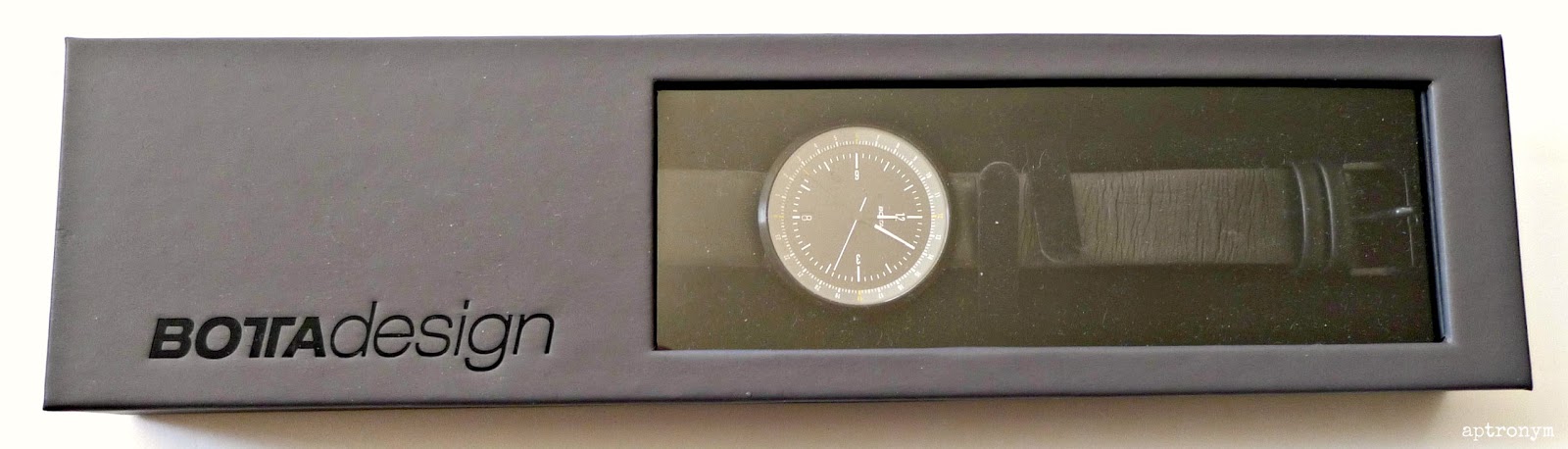
Sometimes, you end up with a watch unexpectedly. The Black Edition Botta Mondo Dual Timer is one of those watches. The reasons why it turned out to be unsuitable for its original owner (and thus how I became its new owner) were a classic example of how a watch can appear to be what you wish for in pictures, but turn out to be something quite different ‘in the metal’.

With a design ethos claimed by Botta to be rooted in the simple lines of 1970s Braun watches, this is a fairly inexpensive good looking dual time zone watch. The typeface, clarity and minimalist approach is very appealing in photos.

Although it is not anything new, one of th aethetically pleasing things about this watch is its use of angles. It is not just about the way the 24-hour second time zone outer ring slopes quite sharply downwards towards the time indices, but also about the use of contrasting grey and black that gives it a stylish edge. You’ll also notice the artificial ‘horizon’ that divides the 24-hour ring into two differently coloured halves, one for day and one for night. Exactitude isn’t the key point here with this feature, but it is useful at a glance if you want to quickly ascertain whether it’s day or night in your second time zone.


At a comfortable 40mm, this is a slim (7.5mm) stainless steel watch that weighs only 43g. Inside is a Ronda 515.24H quartz movement. The strap is a vegetable tanned leather strap (available in three lengths), but there are bracelet and rubber strap options available as well for the Black Edition. The regular edition only offers leather and bracelet options.


As an inexpensive dual timer, if you’re not bothered by quartz, this is a pretty good option from an aesthetic point of view, so what were problems that came up for its original owner which lead to its transfer to me?

The first issue was that of size. Although it’s a decent 40mm, it’s a slim watch, and not for those who are used to wearing something with more heft.

The second problem was that of clarity.


One of the very things that appealed about this watch turned out to be one of its shortcomings for the original owner. The slim markers and hands were not a problem, but the second time zone marker, with a very discreet orange tip, is not as legible at first glance as it could be. If you wish to be able to rapidly identify your second time zone, this is not the watch for you. It’s not illegible, but it’s not recommended for people who need something bold and clear, and the photos on the Botta website don’t really give a good ‘working’ level indication of this hand’s legibility.

I like this watch and am happy to be its new owner but even for me, there is one small problem – the strap. It creases and marks easily, and doesn’t feel very sturdy.


The Mondo is priced from € 348.00 and you can order it direct from Botta here.

Oh and if you visit their website you'll notie that Botta have a single-handed watch called the Uno which is remarkably similar to MeisterSinger ... as is their wall clock.


[AP]

Thursday, May 10, 2012

Just because ... a Grande Sonnerie


What is a Grande Sonnerie? 

It means ‘grand strike’ in French, and is a complication in a mechanical watch or clock which combines a passing quarter striking mechanism with a repeater. That is, on the quarter-hour it strikes the number of hours audibly on a gong, and then the number of quarter-hours since the hour on a second gong. The hour and quarter strikes can also be activated on demand at the push of a button. The hours and quarters chime 'en passant', or as they pass. In contrast, a petite sonnerie strikes the hours and quarters in passing without repeating the hours at each quarter.


This is a Grande et Petite Sonnerie from Audemars Piguet’s Jules Audemars line. An almost old-fashioned 39mm in size, it’s a lovely warm rose gold and one of a limited edition of 50 watches. This watch was part of the first series of Grande Sonneries made by Audemars Piguet in 1995. The rose gold case is 39mm, polished and brushed, with the slide at 2 for the Grand Sonnerie, Petit Sonnerie or silent functions, and a push-button at 10. The Cal. 2868 has 51 jewels, straight line level escapement, shock absorber, self-compensating flat balance-spring,and Côtes de Genève. The sonnerie strikes are via two polished steel hammers onto two gongs. 

Stunning. 


 [AP]

Monday, May 7, 2012

A look at a 1939 Longines Lindbergh


In March, I wrote about a rare Longines Wittnauer Second Setting watch. Thanks to a distinguished collector friend of JPVFX, we now have a follow-up post of an even more well known and rare Longines aeronatical beast - the Longines Hour Angle watch, known as the 'Longines Lindbergh'. 

Designed by Longines and Lindbergh based on the Weems design, this was a continuation of Longines’ relationship with pilots; the brand was the official supplier of time instruments to the International Aeronautical Federation (IAF) from 1919. 

The Lindbergh Hour Angle Watch was designed by Col. Charles A. Lindbergh as a navigational aid for pilots and was, in fact, used by renowned aviators such as Amelia Earhart and Amy Johnson. Used in conjunction with a sextant, nautical almanac and a radio to receive a time signal, it made allowed for the calculation of the ‘Greenwich hour angle’ i.e. longitude.

So, what is an ‘hour angle’? 

From the aviation point of view, it is the angular distance west of the Greenwich meridian. The earth’s full rotation is 360° – an hour, therefore, is an ‘hour angle’ of 15°. This means that a 60° hour angle, for example, equates to 4 hours with respect to the Greenwich meridian. 

Here are some pages from the Longines website about the modern ‘heritage’ version of the Hour Angle that they released a few years ago, with an explanation of its use. Click on each screenshot to get a larger image.


This stunning example dates from 1939. A 47mm sized steel case with an onion crown, the main dial is white enamel with black Roman numerals. The revolving bezel is silver inlaid with enamel nu, the 15 degree intervals as mentioned above are on a rotating bezel. The crown at 2 o’clock turns the inner dial, which is calibrated for 60 seconds and 15 degrees.


The Lindbergh and the Weems actually came out with two movements. 

Firstly, the Cal.18.69N, which allows the time to be pin set by pressing the pin down and then rotate the crown to set the time, whilst when you pull the crown out, it rotates the central disc to offset the time. 

Secondly, it also came with the Cal. 37.9, which has a small wheel under the crown. The wheel rotates the central disc and the time set in the traditional way by pulling out the crown.

Inside this Lindbergh is the Cal. 18.69N movement. This calibre was produced by Longines from 1895 onwards. It has a nickel-finished lever movement, 15 jewels, bimetallic compensation balance, and hinged stainless steel cuvette. Cal 18.69N allows the time to be pin set (you press the pin down and then rotate the crown to set the time) while when you pull the crown out, it rotates the central disc to offset the time.

This Lindbergh is in remarkable condition. The enamel dial and Breguet-styled blued hands are bright, the numerals clear, the bezel showing the fabulous patina of its age but with the numbers still clearly visible. As is the case with the Second Setting watch, it sits comfortably on the wrist in spite of its size.


As mentioned above, the Longines Heritage line, along with producing a homage to the Weems Second Setting, also resurrected the Lindbergh Hour Angle Watch with similar faithfulness to the original, but with the added bonus of a caseback that opens to reveal the L699 automatic movement. 

The brand’s Heritage watches are very well received and to my mind, their best models. In some ways it’s interesting that designs which hark back to their past are so well regarded, but then again, it just proves the old adage about good design (I’ll spare you the ‘time’ pun). 


[AP]

Wednesday, April 25, 2012

Jaeger-LeCoultre's Duomètre à Quantième Lunaire LE


Sometimes, you don’t realise that there’s a beautiful watch that you’ve read about floating tantalisingly nearby. Then someone offers you the chance to take a look at it.

Firstly, what are the ‘Duomètre’ watches?

Introduced in 2007, the basic idea is to separate the normal time keeping function of the watch (hours, minutes, and seconds) from the other function, hence ‘duo’. Traditionally, in a watch with a complication the latter makes the watch’s rate deviate upon its activation e.g. a chronograph as it is switched on, a repeater as it rings, or even a calendar function ticking over. The functions share a common power source - the activation of the complication will lead a reduction in the time function of the watch, due to the use of power, and affect accuracy.


To bypass this, JLC’s Duomètre models feature two independent watch mechanisms within one calibre: one spring barrel for the time function, and another for the operation of the complication. In the case of this Duomètre à Quantième Lunaire, these two are the time, and a moon phase function. Each ‘wing’ of the movement has its own barrel with a power reserve of 50 hours.

Monday, April 23, 2012

A look at a Galante Spring Drive


Seiko has many watch lines at all price points, many of which don’t make it to Australia, and some which do, but only in a very limited form. Launched in 2009, the Galante line/ sub-brand is, like their Spring Drive series, one of the brand’s upmarket lines and, in fact, uses Spring Drive movements as well as mechanical ones. Only sold at a limited number of retailers and Seiko boutiques, there is, in fact, a retailer in Sydney (Sydney Vintage Watches, in the Strand Arcade).

You can read more about the Spring Drive movement here but this movement, introduced in 2005 was viewed by Seiko as their technically most significant development since the quartz Astron.


The Galante watches are immediately recognisable from their very distinctive case design. There are four large mounting screws which connect the round case to a tonneau open case back; out of the ordinary, unexpected, and whether it works or not (especially the use of two shapes) is a very subjective assessment. Does it work for me? I don’t mind the quirkiness, and can admire the thought and skill that went into this, but I don’t know whether the novelty value would wear off quickly.

This is the Galante Spring Drive SBLA037J. It has a large case, quite thick and heavy, and it is not a watch that can be worn by everyone. For many, it is liable to become a ding magnet as they become accustomed to the unusual case design.

Thursday, March 8, 2012

The rare Longines-Wittnauer Second Setting watch


One of the reasons I take a camera along to our weekly GTGs is because I never know whether an unexpected visitor, or a new acquisition, might pop up. This watch was one of the former.

Firstly, a bit of history.

The relationship between Wittnauer and Longines goes back a long way. Up to the 1890s, all of the Longines watches had been brought into the U.S. and Canada through J. Eugene Robert & Co., NY., which was taken over by Roberts’ brother-in-law Albert Wittnauer in 1890. Thus, all Longines watches imported to North America during this tenure have ‘Wittnauer’ on the dial. In 1936, the Wittnauer family sold A.Wittnauer Co., and a re-organised arrangement with Longines lead to the creation of the Longines-Wittnauer Watch Co.

What eventually became a longstanding relationship with aviation began in 1907, when Wittnauer supplied a pair of watches to the Navy, which was testing its aviation capabilities. During WWI, Wittnauer supplied military wristwatches and navigational devices to American Expeditionary Forces and an aircraft clock to the forerunner of the U.S. Army Air Corps.

In 1927, Wittnauer and Longines collaborated with Captain Philip van Horn Weems, a pioneering aviator who taught navigation to Charles Lindberg. This lead to Weems registering a patent for a ‘Second Setting Watch’ in 1929. Seen by many to be the first pilot’s watch, the Second Setting watch was intended to complement on-board compasses, flight charts and chronometers.

During flights, navigational adjustments were necessary for time errors, as small deviations in the accuracy of time measurement could lead to errors in flight calculations (fuel consumption, position and time to destination). Pilots would listen to the minute by minute radio beeps (e.g. GMT) to accurately adjust the centre seconds dial. This would indicate the time error on their watch so they could do calculations more accurately.

To make these watch adjustments easier, Weems put in a movable inner dial, which adjusted the dial to the hand. The aviator would move the dial in accordance with the radio time signal, noting any deviations from Greenwich Mean Time.


Throughout its life, there have been numerous iterations of the Weems Second Setting watch, including later versions with a rotating seconds-register. The first series, the A3, was produced between 1929 – 1936, the second (A12) between 1936 – 1946, a series for the Japanese Imperial Navy between 1936 – 1946 (IJNAS), the A11 between 1938 – 1948, a 26mm version, the A12, for the period of 1936 – 1948, plus a couple of other variations.

This example is an early model. In sterling silver 47mm case (55mm lug to lug) with an onion crown, it has a double-hinged case back which, unfortunately, I couldn’t open.

Tuesday, January 17, 2012

Hands-on with the Rolex Explorer II


One of Rolex’s most talked about announcements at Basel World 2011 was an updated Explorer II (Ref. 216570), with a 24-hour arrow hand in orange, harking back to the original 1971 Ref.1655 Explorer II, which was an addition to the Explorer model released in 1953.


After the release of the Ref. 1655, it wasn’t until 1984 that Rolex introduced a new Explorer II, Ref.16550. Changes included the sapphire crystal, the calibre 3085 movement, the shape of the hands (the 24 hour hand changed from a small red-orange arrow shaped hand to a long red 24 hour hand with a white arrow at the end), and a new white dial version. The 16550 is also referred to as a transitional model, transitional to the Ref. 16570 introduced in 1989.

Recently, I got to have some hands-on time with the latest Explorer II.

Wednesday, December 14, 2011

An early Omega Bumper


Amongst many vintage watch enthusiasts, Omega has a strong hold both aesthetically, and because of the mechanical innovations made by the brand. One of these is the calibre 28.10. Introduced in 1943, it was Omega's first commercialised automatic moment, and is considered to be one of Omega’s legendary calibres.

The term “bumper” refers to the automatic winding movements from Omega (but not exclusive to the brand) which were very popular in the from the 1930 to 1950s. 


When the weighted hammer to wind the mainspring (swinging in a pendulum fashion), reaches the end of the distance it can travel it bumps into a spring and stops. This bumping can be felt by the person wearing the watch, thus these watches are often referred to as "bumper automatics". Beginning with the 28.10, the “bumpers” went through to the cal.355.


This is a 1946 (10M service number) 18kt solid gold Omega with bumper automatic movement Calibre 28.10. There is a watch identical to this one in the Omegamania catalogue, called the "Ambassador" model.


This as-pristine-as-you’ll-ever-find-a-watch-from-1946 was purchased from the original owner with case, movement and dial in amazing condition and totally untouched, which is quite rare for this age of watch. Bumpers may be fairly easy to get, but ones of this vintage and this little worn, are not.


The calibre 28.10 was renamed cal.340 in 1949 and became the basis of of the cal 34x and 35x bumper movement. There were different iteration of the 20.10, with 28.10 SC being the centre second. Calibre 28.10 was unidirectional wind whereas the cal 34x and 35x had bi-directional wind. Interestingly, the cal.35x had a swan-neck regulator not found on the calibre 28.10 or cal.34x, and I believe these swan neck regulator movements were certified chronometres.

A prototype self-winding rose-gilt movement with triple-calendar developed in 1944/ 1945 but never commercialised. This movement was based on calibre 28.10 (340). Had production of this movement gone ahead it would have been the world’s first automatic wristwatch with triple-calendar.

Apart from being used in the vintage automatic line, the first Constellation in 1952 also used the 28.10 movement.


[AP & initialjh]

Friday, December 9, 2011

Jaeger-LeCoultre Master Compressor Diving Alarm Navy SEAL


In 1959, Jaeger-LeCoultre launched the Memovox Deep Sea, the first diving watch to be fitted with an alarm that would alert the diver when the oxygen level was low, so that the diver would know when it was necessary to go back to the surface. Approximately 1,000 of these were made between 1959 and 1962.

This historical relationship with the Navy SEALs was affirmed when, in 2008, a partnership was announced between the SEALs and Jaeger-LeCoultre, with the unveiling of the Master Compressor Diving Navy SEALs collection.

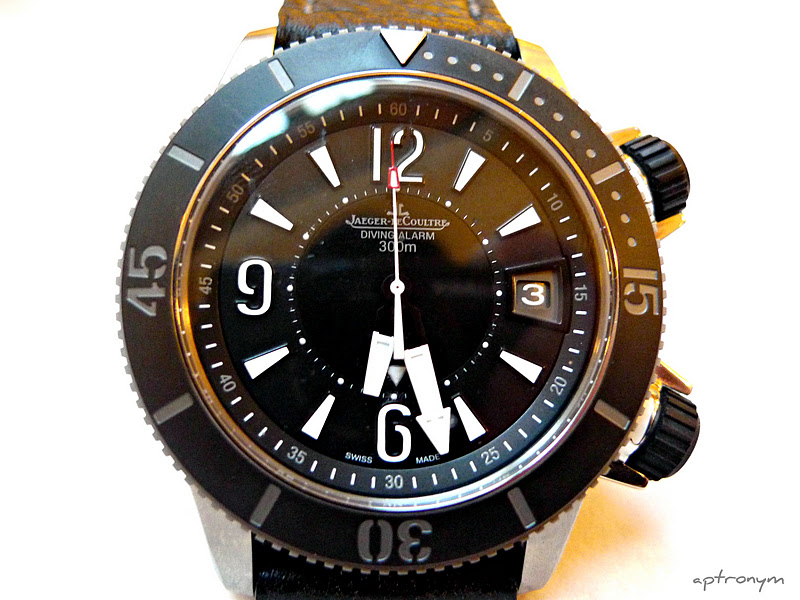
The Master Compressor Diving Alarm Navy SEALs was made in a total limited edition of 1,500. As well as the largest ‘quota’ of those in titanium such as this Ref. 183T470 that I was recently fortunate enough to see, there are other variants, namely two Beverly Hills boutique iterations, and 30 made for Spain. The Beverly Hills Incursion Editions consisted of 19 pieces in black titanium (with yellow) and 62 models in gray PVD titanium (with orange) - 1962, the year of the Navy SEALs’ creation.


Encased in grade 5 titanium, this timepiece has a fabulously textured micro-beaded ceramic bezel. The titanium/ ceramic combination really works for me. I find they flow well together, making the watch understated and almost stealthy. I don’t really understand the pink gold option for some of the Master Compressor Navy SEAL models. Why would you want a diving watch in pink gold? Obviously, JLC aren’t the only perpetrators of this bewildering metal/ watch-purpose combination, the pink gold Blancpain Fifty Fathoms models just do my head in.

Tuesday, November 22, 2011

A day (or four) at the beach with a Bronzo


In a nutshell, bronze is a metal alloy consisting primarily of copper, usually with tin as the other ingredient, though the balance varies, thus rendering the term ‘bronze’ a bit difficult to pin down exactly. It’s a favoured medium for artwork, especially sculptures, for boat/ ship fittings, and of course there was the Bronze Age.

In the last year or so, it has become one of the most talked-about materials for watches, and one of the most talked-about bronze watches has been the LE (1,000 pieces) Panerai PAM 382, otherwise known as the Panerai Luminor Submersible 1950 3 Days Automatic, or “Bronzo”. The bronze chosen by OP for the case of the PAM 382 is CuSn8.

Bronze develops a darker brown patina, over time, because of the effects of oxidation. Panerai’s use of untreated bronze means these surface changes will start occurring relatively early in the watch’s use. Once the surface layer of the bronze has oxidised (eventually becoming copper carbonate), it will form a protective layer for the rest of the watch.

Fittingly, with bronze having a superior resistance to corrosion and salt water compared to steel, one Bronzo owner often takes his to the beach. In this case, the beach at Hamilton Island during Paneristi.com’s 10th P-Day.

Here are some ‘before’ and ‘after’ shots of a Bronzo after a day at the beach. 

(Photo credit : Gaz)

 (Photo credit : Volker)

Over the course of the four days, the case’s colour and ‘mottling’ changed every single day. Even if you’re not a fan of bronze watches, or of green dials (or you can’t wear a 47mm watch, for that matter), is still fascinating, and it means that every Bronzo ends up having a highly personalised character, perhaps making it harder to part with ...?


SPECIFICATIONS

Movement: Automatic mechanical, Panerai P.9000 caliber, executed entirely by Panerai, 13¾ lignes, 7.9 mm thick, 28 jewels, Glucydur balance, 28,800vph. Incabloc anti-shock device. Power reserve 3 days, two barrels. 197 components.

Functions: Hours, minutes, small seconds, date, calculation of immersion time.

Case: Diameter 47 mm, brushed bronze. Brushed bronze bezel with anti-clockwise unidirectional rotating bezel with graduated scale for calculating the time of immersion, ratchet click at minute intervals.

Dial: Green with luminous hour markers. Date at 3 o’clock, small seconds at 9 o’clock.

Crystal: Sapphire, made from corundum, 4 mm thick. Anti-reflective coating.

Water-resistance: 30 bar (300 meters).


[AP]