Showing posts with label pocket watches. Show all posts

Thursday, June 7, 2012

"The Elephant and the Snake" - a 19th century Bovet pocket watch


 Photo from Antiquorum


Born in Fleurier, Switzerland, Edouard Bovet (1797–1849) was the son of the watchmaker Jean- Frédéric Bovet. He One of five brothers and a sister, he studied art with his father. In 1814, as a consequence of his stance against Neuchâtel's return to Prussian rule after the fall of Napoleon, he left, with his brothers Frédéric and Alphonse, for London to study watchmaking

After studying in London for a few years, his employer Magniac sent him to what was then Canton, China, in 1818. Almost as soon as he arrived he was able to sell four watches for the equivalent of USD 1 million in 2008 currency. 

Clearly he took to living in the port city; in 1822 he founded, with Alphonse and Frédéric (still in London) and Gustave, who was a watchmaker in Fleurier, a company for the express purpose of selling timepieces to the Chinese market. The company was based in London and production soon transferred back to Fleurier. 

Five changes of ownership after its birth, the current manifestation of Bovet is quite a different beast, but the occasional appearance of an early Bovet timepiece at auction is always a good reminder both of the history of the brand, and the fact that ‘the Chinese market’ is not a new one, horologically speaking.


 Photos from Antiquorum


Coming up at Antiquorum’s “Important Modern & Vintage Timepieces” auction on Tuesday June 12, 2012 in New York is one of Bovet’s beautiful pocket watches made for the Chinese market, from circa 1870. “The Elephant and the Snake”, contains an intricate and gloriously colourful enamel painting attributed to P.-Amédée Champod (1834-1913) who specialised in hunting scenes and was awarded a silver medal at the Paris Exhibition of 1900. The pocket watch is 62mm, gilt brass with painted on enamel back, pearl-set bezel, pendant and bow. The dial is white enamel with Roman numerals and Arabic numerals at each 15-minute marker. The hands are blued steel. The movement is described as “M. 54 mm, fully engraved gilt Chinese caliber, free-standing barrel, Jacot duplex escapement, three-arm steel balance with gold screws, blued steel fl at balance spring, index regulator” and both the case and movement are signed ‘Bovet’ in Chinese characters, with the movement signed Bovet Fleurier. 

Oh and yes, it has its key. 

Estimate: 20,000 USD - 30,000 USD.

Happy bidding. 


 [AP]

Tuesday, January 10, 2012

Breguet acquires important Turkish pocket watch at auction


The Breguet Museum at Place Vendôme has acquired a historically important watch made in 1808 for a dignitary of the Ottoman Empire for CHF 650,000 (approx US$695,000), a record for a Turkish-style Breguet watch, and also a record for a pocket watch auctioned in mainland China.

This pocket watch was ordered in 1807 by His Excellency Esseid Ali Effendi, a former ambassador to Paris and personal friend of Abraham-Louis Breguet.


The Breguet N° 2090 Grande Complication watch is a quarter-repeater with independent grande and petite sonnerie functions in a double-case with a Turkish influenced enamel design and an Arabic numbered dial.


There is a rich history between Breguet and the Ottoman Empire. An exhibition at the Topkapi Palace Museum was held in 2010 of fifteen timepieces made for the Turkish market in the 19th century, featuring pieces from the collections of Breguet and the Topkapi, including the Sympathique clock made for Mahmud II and letters exchanged between Breguet and the Turkish ambassador Esseid Ali Effendi.


[AP]

Sunday, December 25, 2011

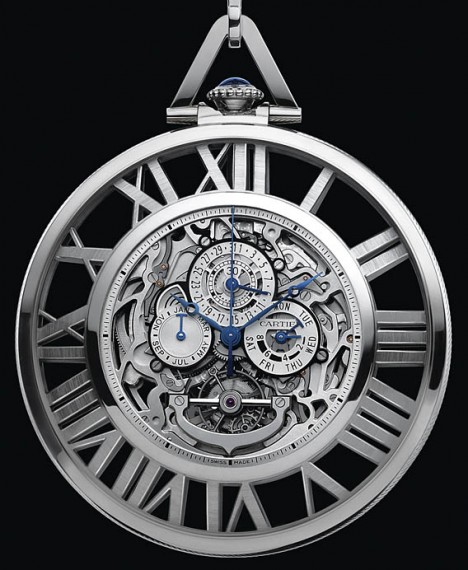
Cartier Grand Complication Skeleton pocket watch


In recent years Cartier has unveiled a “grande complication” for each SIHH, featuring a tourbillon, perpetual calendar and monopusher chrono. In 2012, Cartier’s piece won’t be a wristwatch, but a pocket watch.

Visually similar to both the caliber 9362 MC Rotonde Grand Complication Skeleton (LE of 30) and the Calibre de Cartier case platinum Rotonde Grande Complication (LE of 25) but with the cut-out Roman numerals used in other models in Cartier's “Fine Watchmaking” collection, this utterly extravagant 59mm pocket watch powered by the hand-wound Calibre 9436 MC is white gold and will be made in a limited edition of ten pieces (five diamond versions will also be produced later next year).

The pocket watch uses the same movement that was used in the (45mm) Calibre de Cartier Rotonde Grand Complication. The Calibre 9436MC movement by Renaud & Papi consists of 457 parts, requiring around 212 hours of work to complete. The C-shaped tourbillon bridge is, of course, the Cartier signature.


The Roman numerals are machined from a single block of white gold then hand finished, with over 300 edges of the numerals bevelled by hand. Reportedly, it takes a staggering three weeks to complete them.

If you don't feel able to pull off a pocket watch, or feel that at 155.05 grams, it's too heavy for you, it comes with an obsidian and rock crystal stand.


Oh, and if you’re wondering about what the outlay might be to own this pocket watch, the calibre 9362 MC Rotonde has a price of USD510,000, the Calibre de Cartier version, USD490,000.

The white gold grande complication pocket watch? Well this will set you back EUR500,000 - that makes it around USD652,100 as I write this.


[AP]

Friday, December 2, 2011

flour and stone : when baking meets horology


I've become a fan of flour and stone, and have visited them a few times since these two visits. One of the reasons behind one of these subsequent visits was to put in a special order - pocket watch gingerbread.

My only requests were black Roman numerals, white dial, blued hands, and 10:10. Nadine did some research online, and this is was the fabulous result.


A dozen of these travelled with me down to Melbourne, where they were given out to my watch friends at a GTG. Needless to say, they were a hit.

Many thanks to Nadine and the Cookie Couture/ flour and stone folks for some very cool gingerbread. 

Oh and yes, I did keep one or two for myself.


[AP]

Flour and Stone on Urbanspoon

Thursday, April 21, 2011

George Tyler 'clock watch' presented by Queen Anne to the Earl of Cromarty


I have already blogged about one interesting 'watch' that is up for auction at Heritage Auctions. Here is another item from the same collection. It could not be more different to the spy watch, but it is also historically interesting, albeit in a completely different (and definitely more horological) way.

The description of the lot is as follows :

"LOT 60222

George Tyler London Rare and Unique Gold Clock Watch Presented by Queen Anne to the Earl of Cromarty, circa 1702

Case: 58 mm, pierced 20k gold outer, inscribed on the back “The gift of Anne Stuart Queen of Great Britain and Ireland to the Earl of Cromarty,” outer case with makers mark of WI, five profile repoussé figures on the back, five raised cherubs around the bezel, five piece side box hinge, gilt inner case (tests low karat in content), inner steel bell, inner case pierced with star shapes, silent - strike lever positioned near ten o’clock, bulls eye glass crystal.

Dial: white enamel with Roman hour numerals, black minute track, outer five minute numerals, gold heart shaped hands.

Movement: fire gilt pinned full plate, verge escapement and fusee, one hour strike on steel bell, winged single footed pierced and masked cock, pierced Egyptian pillars, tapered cylindrical pillars near the clock strike train, silver disc regulator, engraved clock spring barrel, leaf engraving around the dial plate.

Signed: George Tyler London on the movement.

George Tyler is listed as having apprenticed in 1692, becoming a master in the Clockmaker Company from 1699 to 1723.

Anne was crowned Queen on April 23, 1702 after the death of William III. George Mackenzie was viscount, tarbat and the first Earl of Cromarty. He was born in 1624. He was clerk of the privy council and a senator in the college of justice. James II also made him a baron and viscount. Queen Anne appointed him as secretary of state and the Earl of Cromarty. He died in 1714 at the age of eighty-eight. He was a highly learned nobleman and the author of a “Vindication of Robert III, the King of Scotland from the charge of bastardy.” He also wrote the Synopsis Apocalyptica and an explication of the Revelations."


The Heritage catalogue notes that this watch was left un-numbered by the maker, since it was a specially commissioned piece by the Queen.

The Clockmakers’ Company is an active City of London craft guild, founded under a Royal Charter of King Charles I in 1631. Its original purpose was to regulate and encourage watch and clock making and its related skills such as engraving, sundial making and mathematical instrument making. The Company took particular interest in quality control, training (through apprenticeships) and the welfare of its members.

In theory at least, no-one could make, buy or sell clocks or watches or any part of them within the City unless they first became a freeman of the Company. This was achieved through apprenticeship to a free Clockmaker, through redemption (purchase) or patrimony (the right of a child to follow a parent into the Company).

Interestingly, whilst trying to find out more about Tyler I found this list of apprentices who were bound in the Worshipful Company of Clockmakers to George Tyler and his wife Lucy :

5 Jan 1714/15 Mary Darby
28 April 1716 Rebeckah Fisher
3 April 1718 Eleanor Mosely
5 Jan 1719/20 Catherine Jackson
5 June 1722 Hannah Campleshon
4 June 1725 Elizabeth Newton

Sources: London Guildhall (hereafter LG): The Company of Clockmakers' Register of Apprentices 1631-1931, compiled by C.E. Atkins, London, 1931, and LG: AHS Pam 51, Female Apprentices in the London Clockmakers' Company; LG: Ms 2711/5, Clockmakers' Company Rough Minute Book, 1719-31. 

Eleanor Moseley (sometimes appearing in records as “Elinor Mosely”) seems to have been significant enough to appear in a number of papers and specialist works relating to women watchmakers. The daughter of a prosperous York apothecary, she was seventeen years old when she was bound as an apprentice in London to George Tyler and his wife, Lucy, who was a milliner. Her indenture was registered with the Worshipful Company of Clockmakers, of which George was a freeman. 

In 1726, Eleanor took the freedom of the Clockmakers' Company and her first apprentice: her fifteen year old sister, Catherine Mosley. She took on a further apprentice, Mary Bate, the same year, followed by Katherine Capon in 1737, Mary Newton in 1732, and Elizabeth Askell in 1734.

Sixty seven women were listed as having been apprenticed in the clock making trade in the period of the mid seventeenth to late eighteenth century (p.81, All men and both sexes: gender, politics, and the false universal in England, 1640-1832 by Hilda L. Smith, Penn State Press, 2002) but there seems to be some confusion as to whether some of these women, like Moseley herself, were in fact  actually clockmakers or milliners. Louise Erickson states that in fact Moseley was the latter, and that she must have been in training with George’s wife Lucy.

I found it rather fascinating to learn that there were women watchmakers during that period, I had no idea, regardless of whether or not some of the recorded female watchmakers were in fact as such, or in fact milliners.


The estimate for this elegant 'piece unique' with its beautifully decorated caseback is: $30,000-$40,000, with a reserve price of $20,000. You can now bid online for it here as an absentee bid. Absentee Bidding Ends: May 2, 2011 at 10:00 PM CT (U.S.)


[AP]

Sunday, April 3, 2011

Vintage Jump Hours at Sotheby's


Those who know me well know of my fondness for alternative time displays, particularly direct read and jump hour watches. I don’t understand why they aren’t more popular, but a couple of interesting  jump hour pocket watches are coming up for auction at Sotheby's in the next two weeks, so I thought I’d share them and perhaps introduce non-watch folks to these time displays. Catalogue descriptions are taken directly from Sotheby's. My additional notes are in square brackets.


Important Watches
Hong Kong Convention and Exhibition Centre (New Wing) 
7 Apr 2011, 10:00 AM & 2:00 PM | Sale HK0352


LOT 2174

ATTRIBUTED TO VACHERON CONSTANTIN - A YELLOW GOLD AND ENAMEL JUMP HOUR QUARTER REPEATING OPEN-FACED WATCH.  
CIRCA 1830.


Gilt movement with cylinder escapement, flat three-armed balance. Silvered engine-turned dial, aperture at 12 o'clock for jump hour display, subsidiary seconds. Yellow gold case, front and reverse decorated with black and white enamel foliate motif, with aperture for jump hour display at 12 o'clock on front case. Cuvette signed, case and cuvette numbered. Diameter 48 mm.

ESTIMATE 55,000 - 70,000 HKD

[Vacheron Constantin have a long history with this form of time telling, as this history of them by Alex Ghotbi shows]


LOT 38

SWISS.
A GOLD AND ENAMEL JUMP HOUR WATCH, MADE FOR THE TURKISH MARKET.
CIRCA 1840.


Cylinder movement, gold cuvette enhanced by flowering vines in gold and opaque powder blue enamel, against a guilloche ground with translucent peach enamel. White enamel dial with Turkish numerals, aperture for jumping hours, eccentric chapter ring, subsidiary seconds. Case with apertures displaying hours and seconds, each framed in lobed cartouches depicting bursts of spring flowers, the background with opaque blue enamel and flowering vines, the reverse with polychrome enamel painting of ships within a seascape in scalloped frame. Case and cuvette numbered. Diameter 48 mm.

ESTIMATE 8,000 - 12,000 USD


Important Watches and Clocks
New York | 13 Apr 2011, 10:00 AM | Sale N08739


LOT 55

TOUCHON - AN 18K WHITE GOLD OPEN-FACED JUMP HOUR WATCH.
CIRCA 1920.


Movement marked Extra, 19 jewels, silvered dial, Arabic minutes tracking, aperture for jump hour, subsidiary seconds, coin-edge band and pendant, monogram to case back. Case, dial and movement signed. Diameter 41 mm.

ESTIMATE 4,000 - 6,000 USD

[Touchon & Co. was established around 1907 and ceased in 1921 as an independent entity before being incorporated into Wittnauer. According to this site, Touchon mainly supplied watches (complete or otherwise) to other companies such as Tiffany & Co (their major client) or various American jewellers. As such, much of their work was unsigned]


LOT 60

CARTIER/ EUROPEAN WATCH & CLOCK CO., INC. - PLATINUM OPEN-FACED JUMP HOUR WATCH.
CIRCA 1920.


19 jewels, ssilvered guilloché dial, Arabic minute tracking, aperture for jump hour. Monogram to case back. Case with handstamped Cartier reference numbers, dial signed Cartier, movement signed European Watch & Clock Co., Inc. Diameter 45 mm

ESTIMATE 5,000 - 7,000 USD


If nothing takes your fancy amongst these, you can check out the rest of the items (including other vintage pocket watches) at both of these auctions via their online catalogues here and here.


[AP]