Showing posts with label watch movements. Show all posts

Friday, August 23, 2013

LeJour Valjoux 7734 Chrono - 2 Years On...


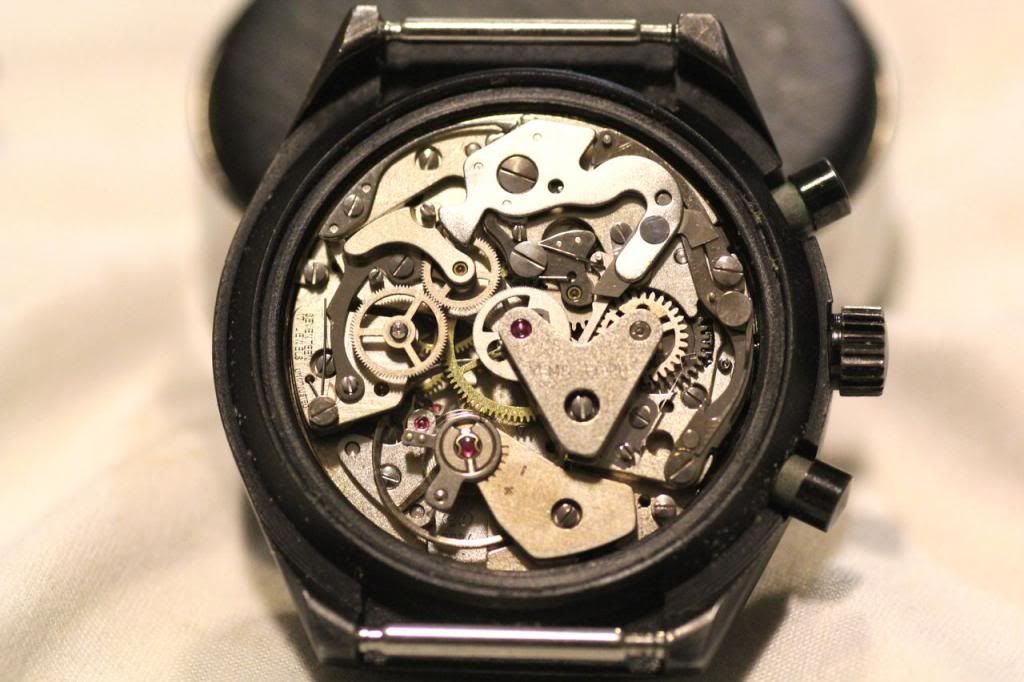
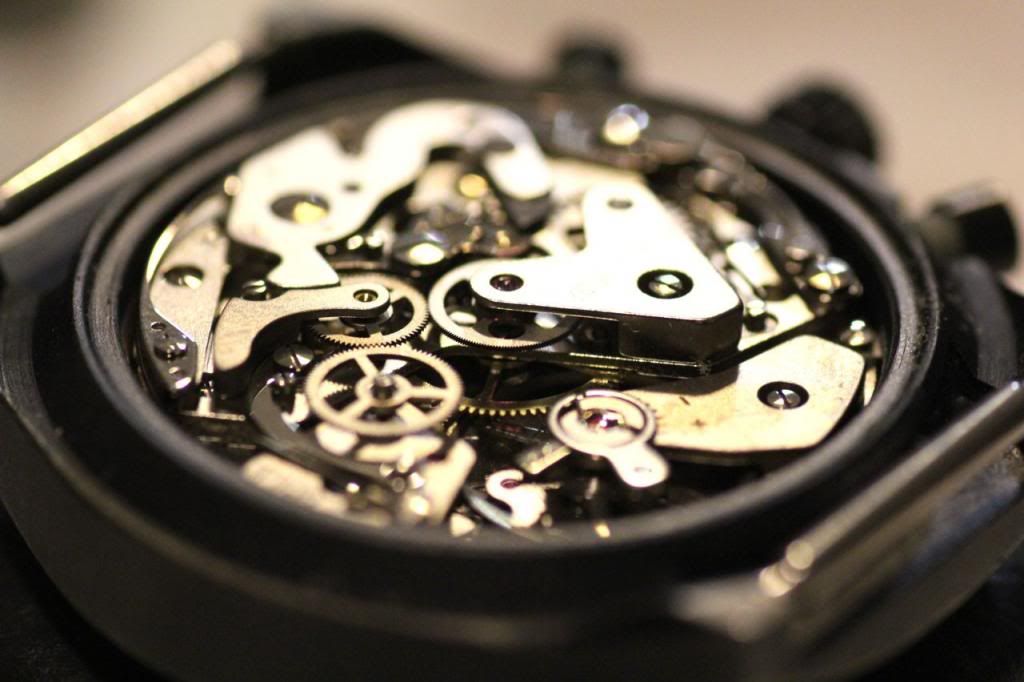
So I thought I'd open up the LeJour to see the Valjoux 7734 movement within. It's not the prettiest movement - far from it. but there's something quite honest about it. it's not pretending to be something it's not. Just an honest, workhorse of a movement that endeavours to provide relatively reliable timekeeping for many many years. It is surprisingly refreshing to see something like this after we've been spoilt by the glamourous sapphire crystal case back, bevelled edges, geneva stripes and blued screws. It's the basic white tee and jeans of movements.


The watch has been on rotation for the past 2 years. You can see the first post here. Opening the watch up wasn't my intention. I'd just wanted to change the strap but thought I might as well have a look at the movement while I was at it. I haven't worn this watch all that much, but I do still like it as much as the day I first acquired it. It has a certain charm and warmth that always brings a smile to my face when I see it. I still haven't bothered with checking its accuracy. To be honest there are only 2 hands so it's not like I'll notice any deviation (unless it's something like a minute a day).


Thanks to the shortish lugs the watch wears quite well on my wrist. It is tall, but not unmanageable. Having swapped it onto regular straps it is actually very comfortable.


I'm happy to report that in the two years under my care the watch has remained more or less in the same condition. The case back seal looks to have seen better days when I opened the watch up. I might get around to having the glass and back seal replaced one of these days, but that would be more to keep the dust out than making the watch water resistant. Other than that it was just a good excuse for me to practice my macro photography skills...


Wednesday, February 22, 2012

Arnold & Son True Beat 88


British watchmakers Arnold & Son have just released a watch with a rarely seen complication. As the name indicates, the new Arnold & Son True Beat 88 features a ‘dead beat’ seconds. Another ‘dead beat seconds’ we’ve looked at is the Grönefeld One Hertz. The '88' in the name is a nod to John Arnold’s earliest known pocket watch, of which the original case bears the number ‘88’.

A wristwatch with deadbeat seconds shows a second hand that ‘jumps’ in one second steps instead of an apparently smooth sweeping action (which is in fact several rapid jumps). You see the second ‘jump’ in quartz watches (and if you want to see a really smooth seconds hand, look at Seiko's Spring Drives), but as a feature of mechanical watches, its popularity has waned.

To backtrack a bit, the number of hourly vibrations corresponds to the frequency of a watch movement. Frequency is a measurement of the number of times that a repeated event occurs per second. The number of vibrations per hour (vph) of a timepiece determines the breaking up of time (the ‘steps’ of a second hand). For instance, 18,000 vph (2.5 Hertz) equals a vibration duration of 1/5 second (i.e. five jumps a second); 21,600 vph = 1/6 second; 28,800 vph (4 Hertz) = 1/8 second; 36,000 vph (5 Hertz) = 1/10 second. Until the 1950s, wristwatches worked mostly at a frequency of 18,000 vph. Today, the most common frequency adopted is 28,800 vph.

The term ‘dead-beat seconds’ is said to derive from the fact that the hand remains dead, or motionless, for as long as the second has not actually elapsed. Thus, the hand indicates that same second even though its exact time has actually passed.


The ‘true beat’ complication in this watch is via the new Arnold & Son 5003 hand-wound movement. Developed for the brand, the movement is 38mm diameter and 6mm thick, and the calibre has an ‘inside-out’ design, meaning that elements which are usually hidden behind the main are now in front, and visible through the skeletonised dial.

Cased in a rather large 46mm case, the size of which will rule it out for most people, True Beat 88’s dial is nicely symmetrical, with the dead beat display at 7 o’clock balanced by a power reserve indicator. The two barrels which generate the power reserve are at the top.

Monday, December 5, 2011

Universal Genève Polerouters - Cal.69 and Cal.138


Polerouter Date cal.69

UG was founded in 1894 as "Universal Watch" by Numa-Emile Descombes and Ulysse Georges Perret for the "production of watch-cases, domes, watch dials, movement, fitted boxes and packaging for watches". Descombes died at age 34 in 1897, and Louis-Edouard Berthoud joined Perret, briefly trading as Perret & Berthoud until Perret died in 1933. The name of "Universal Watch Co. was registered in 1934 and "Universal", in 1935.

Shortly after the inauguration of the new factory in Geneva in 1954, the model "Polarouter" (with a Cal.138SS Bumper movement), later on renamed to "Polerouter" in 1958, was launched. The watch became renowned for being used by the SAS pilots during their polar flights. The Polarouter/ Polerouter was designed by the late Gérald Genta at the youthful age of 24.

The movement used in the early Polarouter model was the cal.138 SS. It was introduced by UG in 1948, first as cal.138 with a subsidiary seconds and then with a central second as cal.138SS. The cal. 138 SS measures 28.2 mm in diameter and is 5.55 mm thick.

Cal.138 Polarouter

On the second of March 1955 Universal Genève patented the calibre 215 "Microtor", a new form of an automatic calibre with the rotor mass incorporated in the movement.

 Cal.138

UG first introduced the micro-rotor movement in 1955 in the guise of cal.215 in the renamed "Polerouter". This innovation was to create an automatic movement with a thinner profile. Interestingly, the Buren watch company was working on a similar concept around the same period.

The cal.215 was superseded by the cal.218 in 1960. As the winding mass is off axis, winding efficiency is decreased. This necessitated using a heavier winding mass and more efficient winding system.

Monday, September 26, 2011

Made in China : Sea-Gull


Founded in January 1955 by the PRC government, Tianjin Sea-Gull Corporation (天津海鸥) was originally called the Tianjin Sea-Gull Watch Factory, with only four watchmakers at its inception. By 2005, Sea-Gull were making more than 25% of the world's mechanical movements. Today, they are the second largest producer of mechanical movements in the world, coming only after ETA.

It wasn’t until 1992 that the company became the Tianjin Sea-Gull Corporation. That same year, a decision was made to discontinue the production of mechanical watches in favour of quartz watches, but five years later, the company reversed its decision.

As a consequence of the Chinese watch industry becoming overcrowded with basic mechanical watches, in 2003 Sea-Gull decided to introduce chronographs into their range, bringing in the ST19 movement, which has been used both for their own and other brands.

Since then, Sea-Gull has focused on mechanical watches, and become known for their price-accessible (insofar as tourbillons are 'accessible') and solid quality tourbillons. Sea-Gull currently have seventeen calibre families, including their version of the ETA 2824 (ST21) and 2892 (ST18).

Sea-Gull’s first tourbillon movement, the ST80, was released in 2005. The next year, the brand released their first Double Tourbillon, the ST8080, featuring one carrousel and one common axis tourbillon from their new calibre ST82 (a 'flying' tourbillon) geared together. It is available in a skeletonised version, as is the ST80. They also created a luxury version, the ST8080G, in 18k rose gold. Sea-Gull's ST84 is currently China's smallest tourbillon movement, intended for women's watches. 


This model is an ‘earlier’ tourbillon from Sea-Gull, circa 2006, with the ST82 movement.


Quite a simple conservative design, even down to its blued 'Breguet style' hands, with a nice aesthetically balanced dial and, at 38mm, a comfortably flexible size. Their current tourbillons come in either 38mm or 40mm.


Sea-Gull also introduced both a quarter-repeater (ST90) and minute-repeater (ST91), and a minute repeater that also has a perpetual calendar (ST9150). In 2011 Sea-Gull prototyped China's first microrotor automatic.

Their current range – tourbillons start from 3,865 € | 3,050 £ | 29,000 DKK for a 40mm time only tourbillon, going up to a 38.5mm 18k rose gold one with power reserve and 24-hour day/ night indicator for 10,950 € | 8,650 £ | 82,000 DKK.


Yes, many people will no doubt be commenting on how they wouldn’t spend that amount of watch on a “Made in China” watch, but Sea-Gull have gained recognition for their tourbillons, and this is a brand with history and credibility that is gaining more non-Chinese and non-watchnerd traction. They have  expanded to the U.S., Europe, and have even opened brand boutiques in Hong Kong and Singapore in recent years.

Oh and for those of you who still need some convincing, don’t forget that the Sea-Gull ST19 manual wind column wheel chronograph movement was developed from the Venus 175. In 1961 “Project 304” was initiated by the PRC government to develop chronographs for the People’s Liberation Army Air Force based on the cal.175, the tooling of which had been sold off by the Swiss brand. Venus had wanted to offload the cal.175 tooling to raise capital for development of their calibre 188. The USSR were not interested, but the Chinese were. The ST19 now has seven variants.


[AP]

Monday, August 8, 2011

LeJour Chronograph - Valjoux 7734


It really is amazing what you can find on the internet these days. And the ease of finding said wanted information. It never cease to amaze me just how quickly the term “google” has entered the lexicon replacing the more traditional term “search”.

However, this is not a post about the ever-changing nature of modern language.

Wanting to take advantage of the strong Aussie dollar, (not just in the ways of importing books and dvds on the cheap) I've been scouring the online for sale ads for watches. Since the difference (read: savings) will be greater. I do have an ongoing wishlist, which is also ever-changing, as my taste changes. However, I came upon something that I didn't know I've always wanted (to plagiarise the line from Peugeot). It was cheap too, and cheap enough for it to be a 5 minute impulse purchase. (Thanks to the wonders of google, the internet, online funds transfer services, and fast-ish connection)

A quick cursory search around the internet didn't net me much the first time around, but I gained enough information for me to make a kind of a informed decision on what I was getting. (Prior watch/movement knowledge does help a bit) All's I know is that it was something rare-ish, but not likely to gain much in terms of price. But for what it is, the price was reasonable.

So here it is: LeJour Chronograph manual wind, powered by Valjoux 7734

The Brand:


LeJour appears to have been the OEM company for Heuer back in those days for a few models. This was one of them. The Heuer version is badged "Heuer" and it costs a bit more than the version badged "LeJour". That is apparently the only difference between the 2 models and LeJour is often referred to as the poor man's Heuer. The only information I can find online about this one is that the Heuer version is referred to as Ref. 12, and even the Ref 12 is a much rarer bird than the more (in)famous Heuer Pasadena, which is housed in a similar case. This LeJour, then, is even rarer than the Ref 12, making it highly collectable (in my humble opinion).


The reason why all this is quite patchy is due to Heuer being in a state of turmoil and great upheaval, with changes in ownership making record keeping haphazard at best. (A bit like Panerai, eh?)

Unfortunately it would seem that the brand "LeJour" has subsequently been sold to a Asian company, now making el cheapo watches under that brand, at the same time, but still using the "history" of the brand to help sell watches?


Saturday, December 5, 2009

Part II - The passing of the Portuguese… to something else.

This love affair didn’t last long. Actually, that’s not entirely true. I still love the Portuguese Chrono, and I do fully intend to buy it back one day when I have too much money. I blame my increasing knowledge in haute horlogerie, and becoming a movement snob of sorts.

Realising the tough, reliable workhorse of a Valjoux 7750 was cheaply available in watches costing almost 10 times less than the IWC, it began to bug me a little. There were also rumours at the time that IWC would bring out their in-house chronograph movement and that when it does, it was sure to go into the Portuguese chrono, making mine worth less. (With hindsight, yes, IWC did bring out their in-house chrono, but not till a lot later, and no, they didn’t put it into the Portuguese case… at least not yet and thus, the resale value wasn’t affected, and the IW3714 is still in range as I write this).

The IWC version of the 7750 in pieces- Obviously not the movement from my watch. 

Parting with it was a lot harder than I thought it would be, emotionally, but I had to listen to my head and not my heart and needed to let it go while I could still get good money for it.  So it was with a heavy heart that I put the watch up for sale, and not long after, it was on its way home - back to Switzerland. This would’ve been back in 2005. However, I retained the extra folding clasp as I thought it would come in handy on future IWCs.

This one of the "for sale" pictures I took of the watch

Now, before I depart fully from my first IWC, I should mention that this lil ol’ watch played an important part in bringing about the early days of The Sydney Tarts, although we’re not known by that name at the time. Head Tart had posted a question on the TZ forum asking if anyone was going to the IWC event All About Time in the Maritime Museum and that he had a question about the difference in the feel of the pushers between a chronograph that has a cam and lever versus one that uses the column wheel.  As I had the Portuguese which has the cam/lever operating system, and since I was going to the IWC event, we decided to meet up so we could test out the pushers. One thing led to another and the very beginning of The Sydney Tarts was born.

The need to have at least one IWC in my collection was strangely strong, and as I have mentioned before, I’d become somewhat a movement snob, so I looked out for an IWC that had… shall we say… a movement with a pedigree, but affordable at the same time. And lo and behold, something was brought to my attention which matched the criteria I had- a movement with a pedigree, a classic-styled watch, rarity, and at a good price. Too good to be true, I might add. And there was a reason for this.


I took delivery of the IWC Mark XII, which came to me all the way from Taiwan, of all places. And immediately it went in to Richemont for a full service. However, as the purchase price was low enough below the market value, I was able to afford the full service, plus a new buffalo strap and still come out on top. So I did.


The Mark XII (1993-99) – an understated classic pilot’s watch with tritium as the luminescent material on the dial, powered by a version of the Jaeger-LeCoultre calibre 889/2 - (see review here), didn’t last long on my wrist.

I was in danger of becoming a flipper. I liked the classic pilot watch style, but this was the period when big watches were becoming the fashion, and 36mm case diameter just didn’t sit right with me. I felt it was too small, and… gasp… a little too girly. Had the Mark XII been produced in a 38mm case, I might still have it today. The wrist time was all the more reduced as it spent about 2 months in the service centre.


So in the end I decided to let go of the Mark XII, and ended up trading it for a Mark XV with someone I’d subsequently become quite good friends with. The Mark XV looks exactly like the Mark XII, except in a larger case (at 38mm) and with a more run-of-the-mill movement in the form of ETA 2892-A2. Ok, there’s absolutely nothing wrong with the ETA movement. Far from it. It is a very refined movement, and one of the thinnest automatic movements in production today. Obviously it’s not as exclusive as perhaps the JLC based movement, but nevertheless it does the job and does it well.


The bigger sized case suited my wrist much better (this is of course, a very subjective opinion) and it’s a great looking watch. But you know something? It must not have left a deep impression on me, as I really can’t remember much about it. All I know is that I did have it, and had pictures taken of it, and then as soon as it came, it was gone. I believe this one went to a good home in Germany.


Stay tuned for Part III - where I flirt with one that's much older than me....


[Onomatopia]

Friday, November 13, 2009


Breitling BO1 Launch Event
Hong Kong


Hosting provided by FotoTime

An undercover Sydney Tart was lucky enough to be invited to the launch of Breitling's new in-house chronograph movement, the B01. It was a dinner event held at the Island Shangri-La on Hong Kong Island.  The Global Financial Crisis has struck luxury brands worse than I thought.  Penny pinching strategies now include cutting back on the number of letters they have on their display cabinets.  Besides saving money, Breitling can now purport to be the oldest watch manufacture in the history of the world.

Hosting provided by FotoTime


The new chronograph movement represents the first in-house movement for Breitling, which has traditionally modified Valjoux 7750 and other ebauche modules it buys from ETA.

So what is so special about the B01?  Well, firstly it is a fully integrated columned wheel vertical clutching chronograph movement with over 70 hours power reserve.  For those of you who visit this blog for its food post, bear with me (or just scroll down till you see food pictures).  

Secondly, the movement is modular, which means that Breitling can add other complications to this.  Given its vertical clutching mechanism, the movement is rather thick allowing ample space for additional components.  Besides, Breitling is not known for having slim watches.  

Thirdly, the movement is structurally designed for easy maintenance and assembly, meaning lower cost of manufacturing and servicing.  How this is considered an end benefit to the consumer is a mystery to me but it seems like a big selling point for Breitling.

Finally, this investment makes Breitling a little more independent from the Swatch Group, in particular their reliance on ETA for the Valjoux 7750 ebauche.

But how does this stack up?  

The vertical clutching column wheel design is probably its greatest feature, since it removes the occasional second "jump" inherent in horizontal clutching chronographs.  This is an important consideration given that Breitling is a tool watch used by pilots.

The thickness of the movement should not be an issue for Breitling given their bias towards larger time piece.  And as mentioned earlier, leaves also leaves a lot of room for additional complications.


Aesthetically, it is not the prettiest of movements, but this works for Breitling since they do not offer display backs and it does save on additional costs associated with decoration and finishing.  

However, the activation of the chronograph was a very tactile experience as the pushers for every B01 I tried was super stiff.  The Valjoux 7750 versions felt creamy smooth in comparison.


Hosting provided by FotoTime


Besides the B01, there were an assortment of other Breitling models.  To be honest, I have always found Breitling's diverse product range to be overwhelming.  Its catalog, which I did not take home, clocks in at a whopping 200+ pages.

Hosting provided by FotoTime


Also present was the Breitling for Bentley (or is it Bentley for Breitling) collection.

Hosting provided by FotoTime


Let's take a pause here to see what was on the wrists of some of the guests. 


Here is a nice Breitling re-edition of their first automatic chronograph, which Breitling and Heuer collaborated in competition against Zenith.  Pity the re-edition contains a Valjoux 7750.


Hosting provided by FotoTime

Then there was this nice Logines re-edition of their alarm diver's watch.


Hosting provided by FotoTime

Finally, it is always refreshing to remind a brand that is blowing its own trumpet about some supposedly greatest horological innovation since the sun dial what true in-house innovation is really all about. The B01 is a Kitty Hawk to the Patek's A380.


Hosting provided by FotoTime

As we gathered for dinner, I noticed the Breitling coaster, which was a nice touch.

Hosting provided by FotoTime
 

To mix things up a bit, I'll be matching watches to the evening's courses.  The starter was a refreshing dish of Parma ham, melon and buffalo mozzarella.

Unfortunately, the over zealous chef decided to distract the wonderful and harmonious flavours of the ham, fruit and cheese with oven roasted capsicum and olives.  The capsicum's sweetness and smokiness over powered the subtleties of the dish while the olives added an unnecessary layer of salt. The chef must learn restraint.

Hosting provided by FotoTime

The watch matched with the starter was one of several variations of the B01. Notice the square on the dial?  I'm not sure whether I like it or hate it.  What do you think?

Hosting provided by FotoTime

The next dish was another curiosity.  It was a Mexican themed tomato based soup with chunks of avocado and tortilla chips.  There was a mild spiciness to remind you that this was suppose to be Mexican, just in case you missed the floating chunks of avocado and tortilla chips.  Think warm Dorito's salsa dip and you've got a pretty good approximation of the flavour.  Surprisingly, I liked this a lot.

Hosting provided by FotoTime


The watched matched with the Mexican salsa soup was this variation of the B01.

Hosting provided by FotoTime


There was a choice between two main courses.  The red meat dish was veal. The flavour of the meat was rather bland and was a little over cooked for my liking.  It was served with some gnocchi tossed in mushrooms.  The gnocchi was unfortunately a little rubbery.

Hosting provided by FotoTime

I'll leave you to decide what you think about this watch.  Tell me what you think, what you really really think.


Hosting provided by FotoTime

The white meat dish was chicken.  It looks very well presented and I was told it was better than the veal.


Hosting provided by FotoTime

The chicken was thus matched with what I think is the most attractive variation of the B01.  It is masculine and bold with a certain softness to it. 

The colour combination lends well to its tool watch roots regardless of its shiny finish.  I would love to see a brushed steel version of this.  Two thumbs up for this B01.

Hosting provided by FotoTime

Now this was a great dessert.  A chocolate hazelnut tart served with home made chocolate ice cream.  I guess if you use that much chocolate, you can't go wrong.  Regardless, it was a well executed dish.


Hosting provided by FotoTime

As we have reached the end of our meal, the final pairing of watches to food ends with this Breitling for Bentley (or was it Bentley for Breitling).  This was a monster of a watch.


Hosting provided by FotoTime

Here it is on my puny wrist.


Hosting provided by FotoTime

By this point, I had lost count of all the watches that were being presented to us at the table.  It was a strange feeling to be surrounded by so many watches with so many subtle variations.  This particular Bentley for Breitling (or was it Breitling for Bentley) has the most spectacular case back inspired by the wheels of the Bentley.


Hosting provided by FotoTime

It's not too bad from the front either.


Hosting provided by FotoTime

But alas, it was too big for my wrist.  I can only conclude that Bentley owners must have fat wrists.  It must be the rich diet of foie gras, Bordeaux wines and creamy desserts.


Hosting provided by FotoTime

Just to break up the monotonous watches that were being presented, here is a nice diversion.  Its a Goldpfeil, a brand that recently went into liquidation due to the Global Financial Crisis.  This was a bargain at the company's liquidation auction.

Hosting provided by FotoTime


Now back to our regular programming of mind numbing sameness. Another example of Breitling's very nicely designed case backs.  This belongs to a watch called the Airwolf.  Cue keyboard theme to the Airwolf TV-series.


Hosting provided by FotoTime


Rounding out this report is a piece that I thought was well executed by Breitling.


Hosting provided by FotoTime


I hope you enjoyed this snarky report.  Leave a comment, snarky or otherwise. I would love to hear your feedback on this post.


[G Snark]