Showing posts with label Hands-on. Show all posts

Tuesday, December 23, 2014

Hands on with the MB&F HM6 Space Pirate

I don't often let my jaw drop. Bad for the bone structure you see. But that one faithful Monday morning, courtesy of The Hour Glass Sydney, I carelessly let mine drop. Twice. The first was upon seeing the MB&F HM6 in the flesh. The second was when I heard the price.


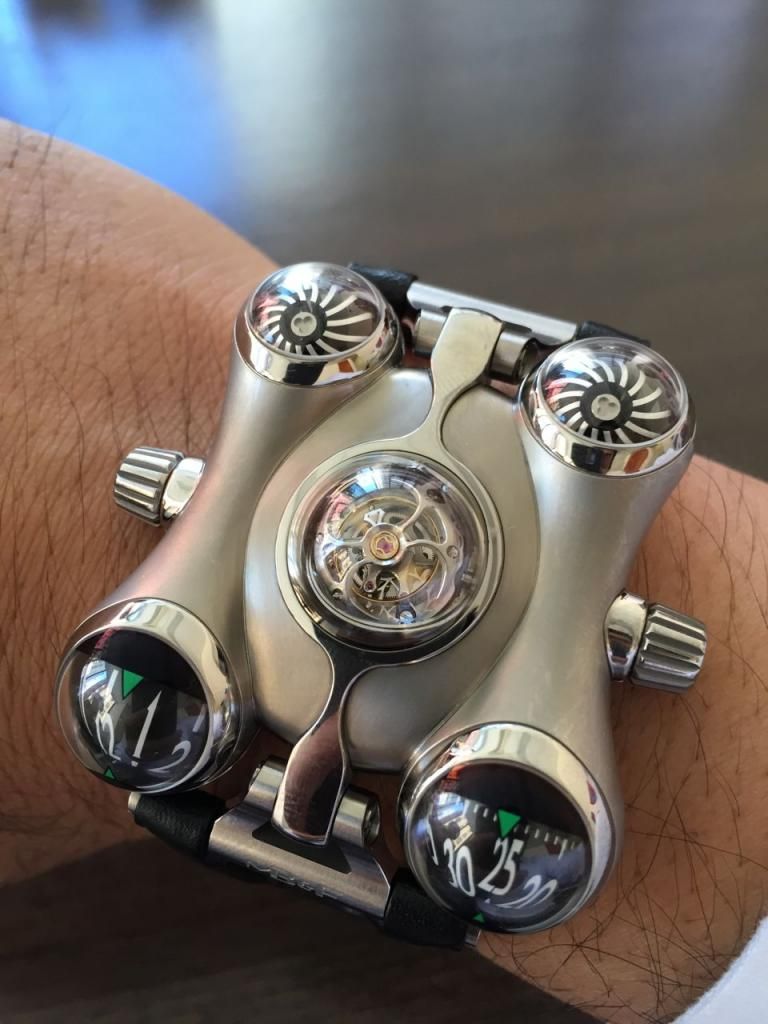
After I picked up my jaw and clicked it back in place, (come to think of it, I probably didn't put my jaw back properly after the first drop, hence the ease with which it dropped a second time...) I gathered my wits about me and admired the creation as the MB&F Head of Communications, Charris Yadigaroglou, sang its virtues. To be honest I was only half paying attention. I was too mesmerised and captivated by the HM6. (Apologies to Charris) The moment I put it on my wrist I knew I wanted one. It was as if the HM6 was made for me. The tourbillon which resides top and centre was the eye, with the titanium shutters its hi-tech eyelids, met my stare and urged me on. "Buy me buy me" it conveyed subconsciously and telepathically to me.
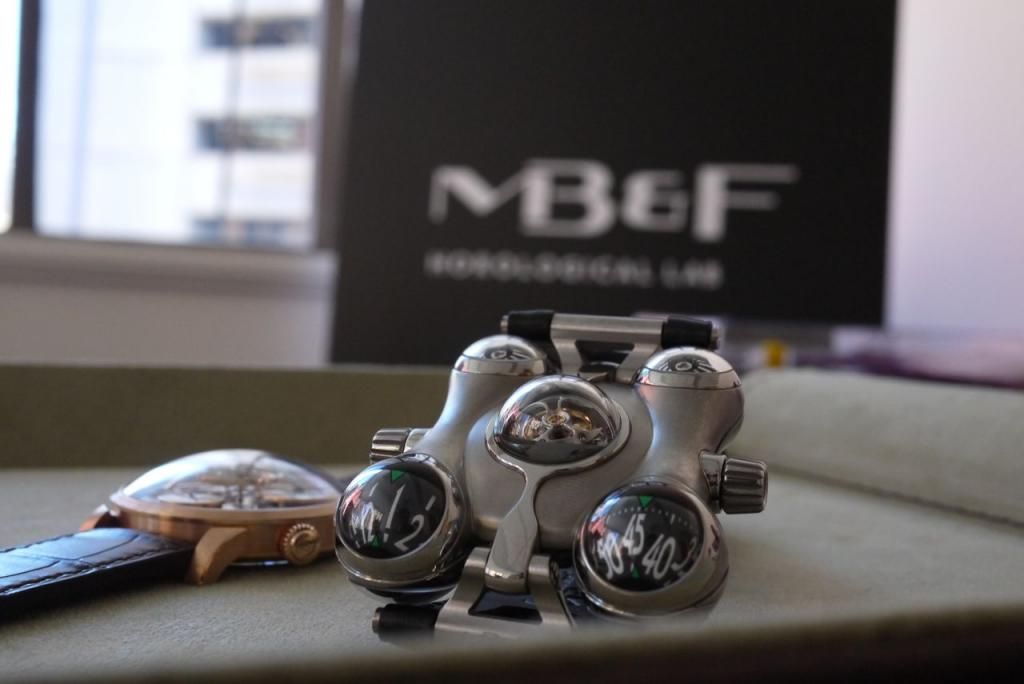


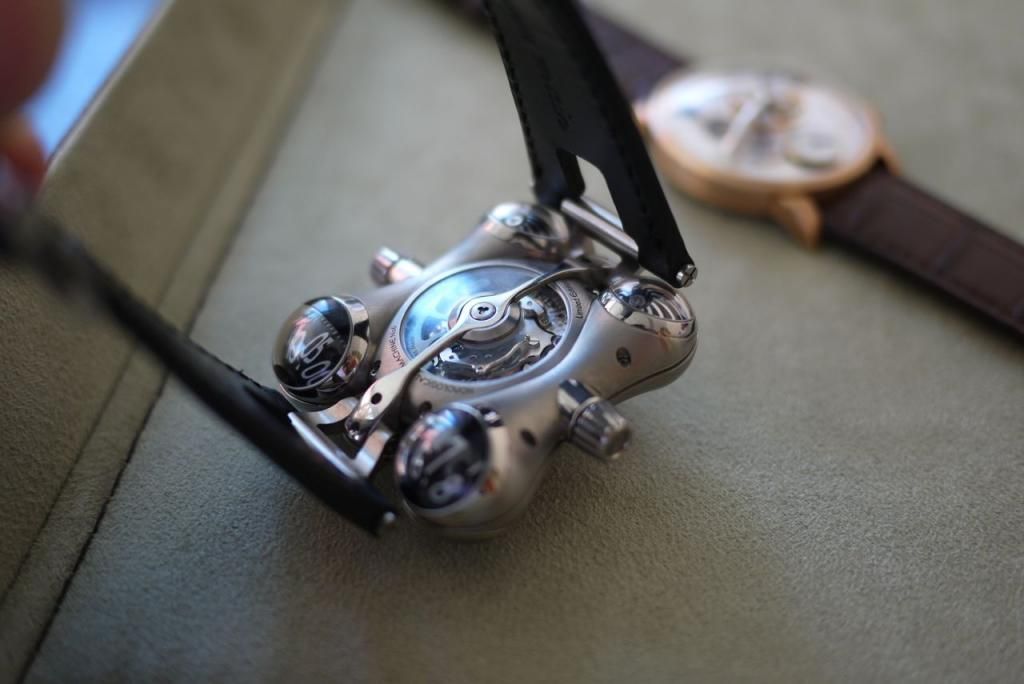
I shook it off and returned to reality. Just the fact that it EXISTS is astounding. I won't go into the details but a few things certainly stood out for me. The turbines being connected to the rotor, at 90 degree angles. The shutters. By playing with it you know it wasn't easy making it work as smoothly as it does. The shape of the case. THAT could not have been easy to do. The shape of the sapphire crystals (count them- 10 of them!) Nothing in this watch is off the shelf. And it's so wearable.


Of course, the HM6 is not designed to appeal to everyone, nor do they want to. If everyone loved it, then to MB&F, it's a failure. And for a 50-piece run, they don't need too many people liking it. This keeps the circle small, and enables the brand to have a more personal contact with each owner. And like Panerai, it seems MB&F owners cannot seem to stop at just one. But unlike Panerai, each machine looks so completely different, whilst retaining somehow, a sense of familiarity. And calling them "machines"? I think that's underselling them a little. Especially the HM6, whose organic form is almost alive. (You cannot tell me the HM3 Frog isn't alive!) Plus I swear it was communicating with me. Something about selling the house. And a kidney.


What's also impressive are the lists of "friends" that corroborated on each project. You feel as though you're part of the family. You can put a name and a face to each part of the project. You know who did what. Just like those Mercedes AMG cars where the person responsible "signs" the engine they built. It's not done by some machine deep inside a factory somewhere inaccessible, like a Bond villain secret base. Each piece has the warmth and sincerity that is missing from today's mass-produced and mass-marketed production line commodity.
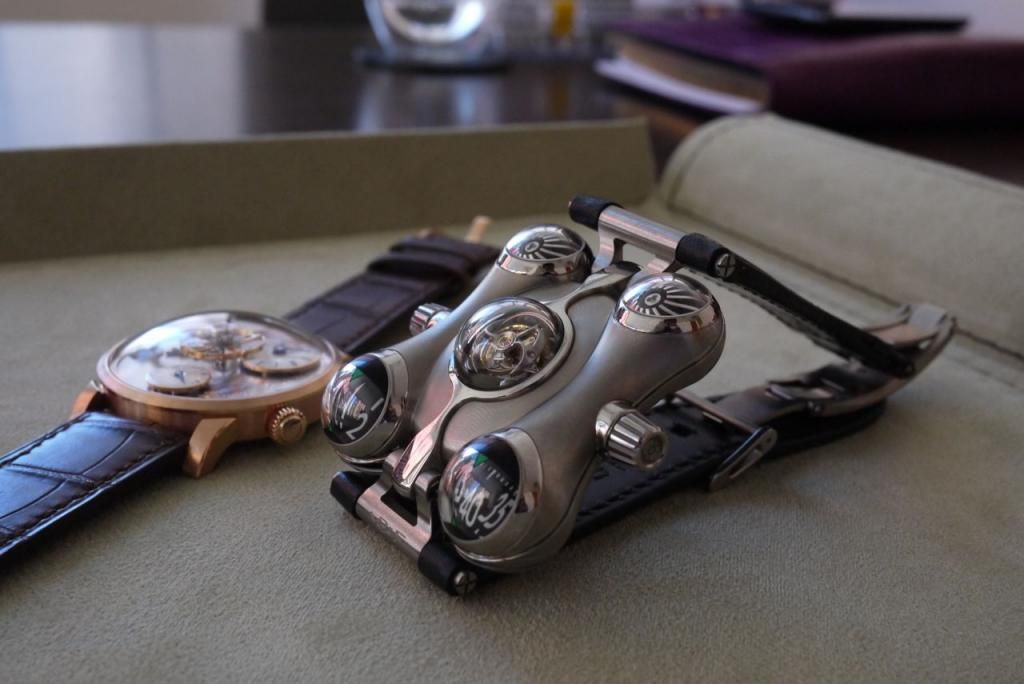
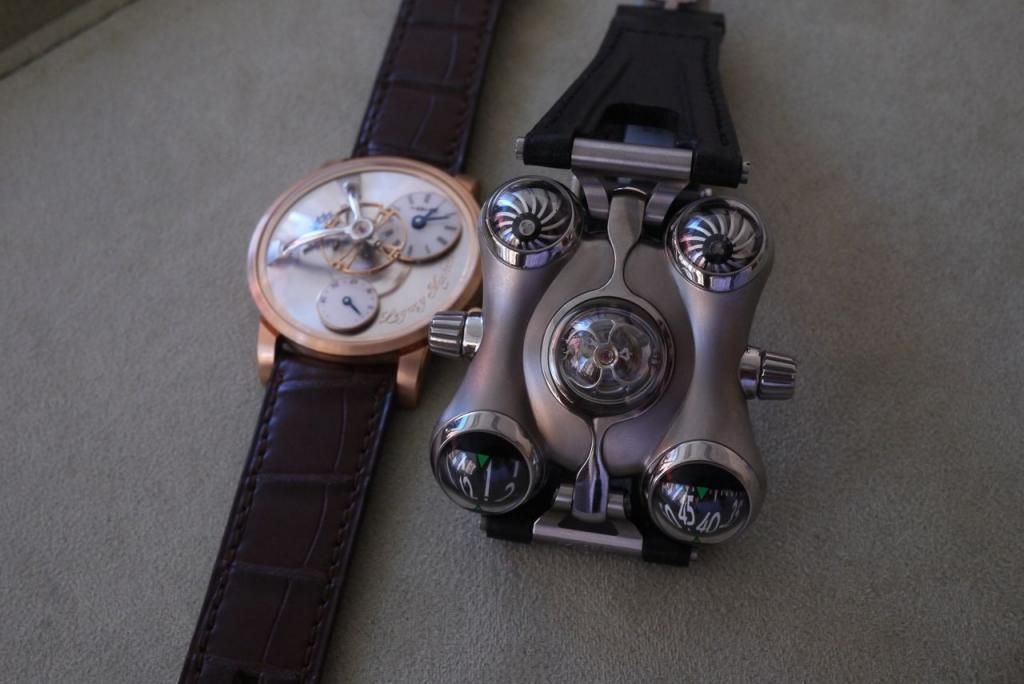


As we all know, this sort of craftsmanship, rarity, research and development and skill set all comes at a price. Price might be stupidly astronomical for something that could barely tell the time, and has no diamonds/precious metals but if you're looking at it as something to tell you the time, then I suggest you're looking at it all wrong. It's a collectable piece of art masquerading as a timepiece. And with this in mind, the odd quarter of a million dollars doesn't seem so bad.
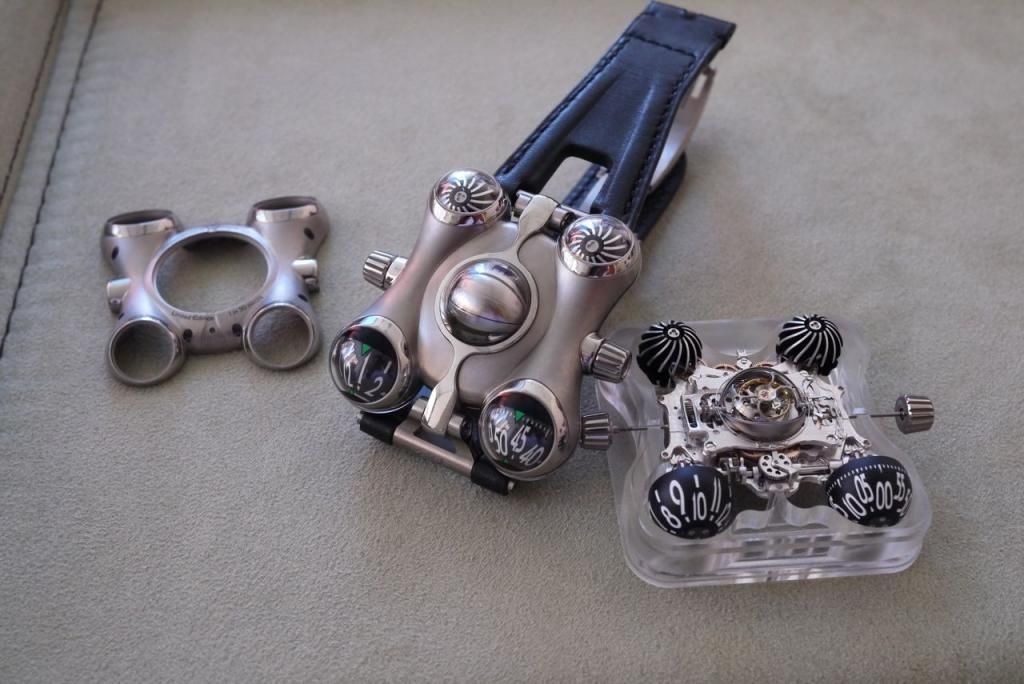


Like art and wine, this is an investment. Even if I sold my home (something the wife might frown upon) and gave the bank its share, I'll still be nowhere close to having the funds to afford my favourite MB&Fs (HM4,5,6 and all the Legacy Machines), so here's what I propose. I'm looking for 50 people to buy shares in the MB&F Ownership Investment Trust Fund. $5000 buy in and this gets you a share of days to wear the HM6, (A second investment fund will be set up for other models) and the possibility to borrow against the equity for other lesser investments such as a property.* Leave your name and bank details below. I'll be in touch.


*details to be worked out later.

This is the eye, urging me to buy buy buy

Saturday, October 19, 2013

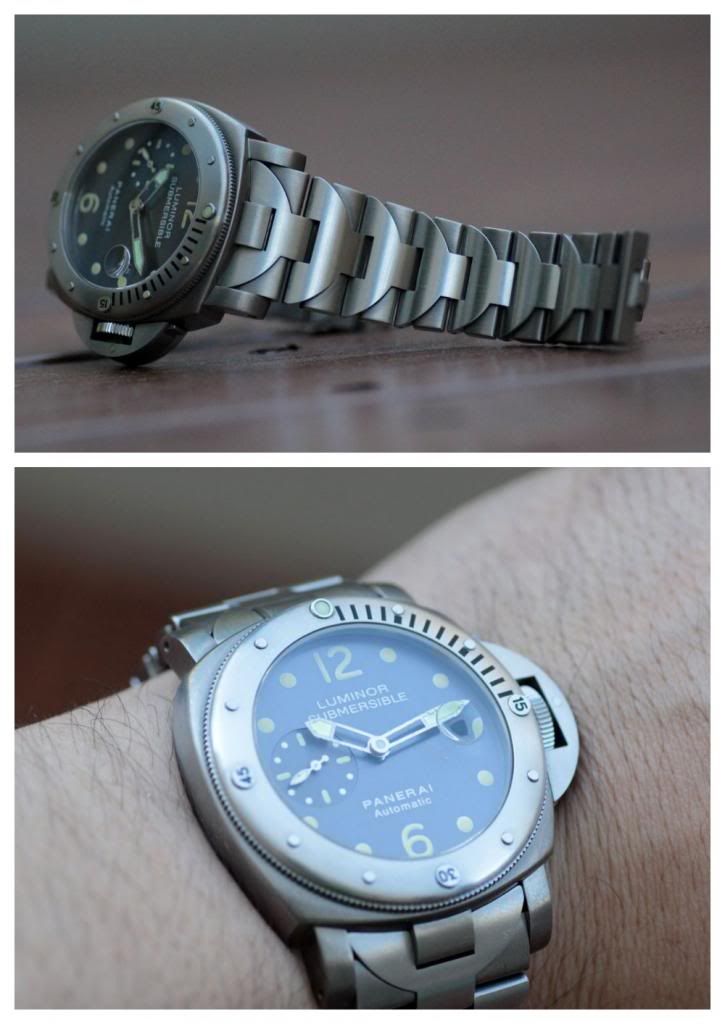
On The Wrist: Panerai PAM 106 Luminor Submersible

It's not everyday we come across this piece - the PAM106, which just might be one of the more elusive regular models in the Panerai range (as in, it wasn't designated a special edition). Why is it elusive? Officially, only 1000 pieces were ever made over two years, in 2002 and 2003 (D and E series). It appears to be the first Submersible to receive the bracelet, and it is also the series to receive the updated bezel with ratchet at one minute intervals, and minute indices between 12 and 3. The PAM106 also features a bi-metal case and bracelet. The case itself is in titanium with a stainless steel bezel, and the bracelet is a mix of brushed steel and titanium, making this watch quite subdued and low key. Another interesting facet about the 106 is the dial. The shade of anthracite actually changes from a light grey to almost back depending on lighting and angle.


Thanks to its stainless steel/titanium construction, the watch itself is not too heavy and not too light. It sits on the wrist just right. (Didn't mean to rhyme there). At 44mm in diameter it's not a small watch, but it's no longer the BIG watch it used to be. The bracelet tapers from the lugs to the clasp, reducing a bit of visual weight as well. What I don't understand is why Panerai produced the bracelet with only half the clasp!! I believe many of the original clasps broke quite easily and were replaced with what should have been, a proper full folding clasp. I'm guessing the owner of this particular example wears the watch more on strap than on bracelet, which might be the reason why the original half clasp appears to be quite sturdy still. Personally I'm a big fan of the older style bracelet, which was modelled upon the crown bridge. The bracelet design was simplified on newer models and I think this is a great shame, as it now just looks generic and dare I say it, cheap...


Another known issue for the Submersible models of this age is the pitting of the hands, as can be plainly seen in this example. This is a bit of a mystery as it's actually not a case of moisture getting into the watch. The hands would be the only place with signs of pitting whereas the rest of the watch is fine. Online chatter suggests that these hands were replaced under warranty, but of course, as purists go, it's better to keep everything as original as possible, right?

Now, the dial. There were two versions available. Tritium dials and super-luminova dials. Again, the tritium is more highly sought after and now shows a warm patina. It is said that D series were produced with tritium and this changed to the super-luminova in the E series. But of course, if the tritium dial was replaced during service, the replacement would be the lume version.


The PAM106 is powered by the OPIII movement, which is just Panerai speak for a valjoux 7750 minus all the chrono functions. As such it's a reliable movement and everyone can service it. And because it is a 7750, you get the signature rotor wobble if you shake the watch the right (or wrong) way.

Granted, the Submersible is not as "iconic" as either the Luminor or the Radiomir. It is a bit of a hybrid design-wise (mix of Egiziano and Luminor WITH an automatic movement). However Panerai continued with this style and it's come into its own as a strong separate model line within Panerai, and although its style might be polarising to some, you could say it's found its niche and you can always take comfort in knowing there aren't as many Submersibles out there as Luminors or Radiomirs or Fiddys... If you manage to find a PAM106 in a good condition, geddit as they'll probably become harder and harder to find. Unless, of course, you settle for the more ubiquitous Pam 24 or Pam 25...


Thanks to the owner of this lovely timepiece for offering me the opportunity to review the watch.

Wednesday, August 28, 2013

On The Wrist: Jaeger-LeCoultre Master Ultra Thin Jubilee

There were some less-than flattering words thrown at Jaeger-LeCoultre when they first launched the Master "Ultra-Thin" range. Those words ranged from the tame "that ain't so thin" to the downright nasty "they're lying about them ultra thins." (ed's notes: the vocab has been toned down to suit a wider range of audience) It's as if Jaeger has taken all these criticisms to heart and they're now doing ultra thins that are in fact, actually ultra thin.


To wit: The Master Ultra Thin Jubilee. The name is startling short compared to its Jubilee brethren. But as we have mentioned before here it is a lot more difficult to do a thin watch than a big watch with a ton of complications. This watch is the best example of "watchmaking dexterity" to borrow a term used frequently in PR blurbs. The Master Ultra Thin Jubilee runs a well-proven manual winding movement calibre 849, which is used in the Master Ultra Thin 34 and 38. This movement, at 1.85mm, is relatively thick (Vacheron's ultra thin movement is but 1.55mm) but the whole cased up watch hieght of 4.05mm is a mere 0.05mm thinner than the Vacheron, thus claiming the title of the world's thinnest mechanical watch right now.


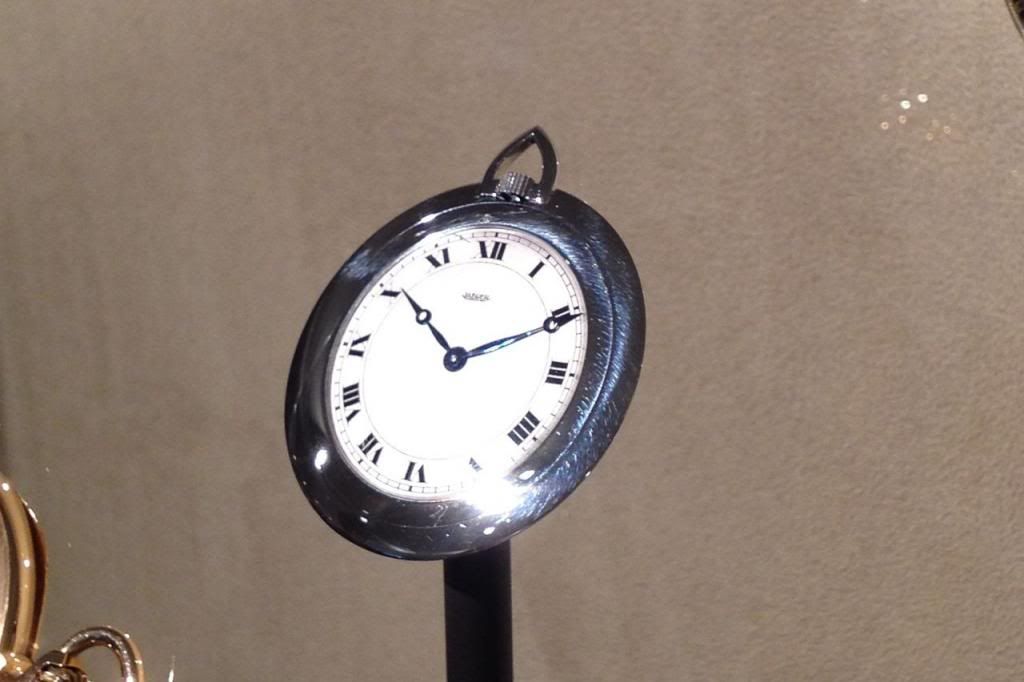
The Master Ultra Thin Jubilee pays tribute to a time in the history of the brand - when Mr Jaeger met Mr LeCoultre. It was back around 1903 when Edmond Jaeger challenged watchmakers in Geneva to produce an ultra thin movement of his design, and Jacque-David LeCoultre, grandson of Antoine LeCoultre, said "Challenge accepted!" and in1907 the world's thinnest pocket watch was created. The movement inside (calibre 145), measuring a mere 1.38mm, remains the thinnest movement in the world. This meeting led to the eventual creation of Jaeger-LeCoultre.

The original ultra thin pocket watch from 1907 - Courtesy of Jaeger-LeCoultre
Here's a bit of maths trivia. You take away the movement height of 1.85mm away from the total watch height of 4.05mm and what does that leave you? The answer is not a whole lot! But the better answer is 2.2mm, in which you still need to cram in a crystal, two hands, a dial and a case back. If you think about it there is very little room to work with, and this watch is assembled by the top watchmakers in the high complications workshop at the Manufacture. The case is what Jaeger calls a "knife-edge" case meaning there isn't actually a 'case' so to speak. It's that thin.


Even though it is made from the same extra-white platinum as the other watches in the Jubilee collection , it is extremely light and you almost don't feel it when it is on the wrist. The blue alligator strap goes really well with the watch, but unfortunately the one we looked at was a prototype, and production watches will be (and has been) delivered with a shiny black croco strap, making it very, very dressy. (I'd try to find a nice dark blue strap to swap the watch back onto)


This piece is a limited edition of 880 pieces worldwide, and a snip at only $18,900. We think at this price they'll be gone as fast as the watch is thin.

Friday, August 23, 2013

LeJour Valjoux 7734 Chrono - 2 Years On...


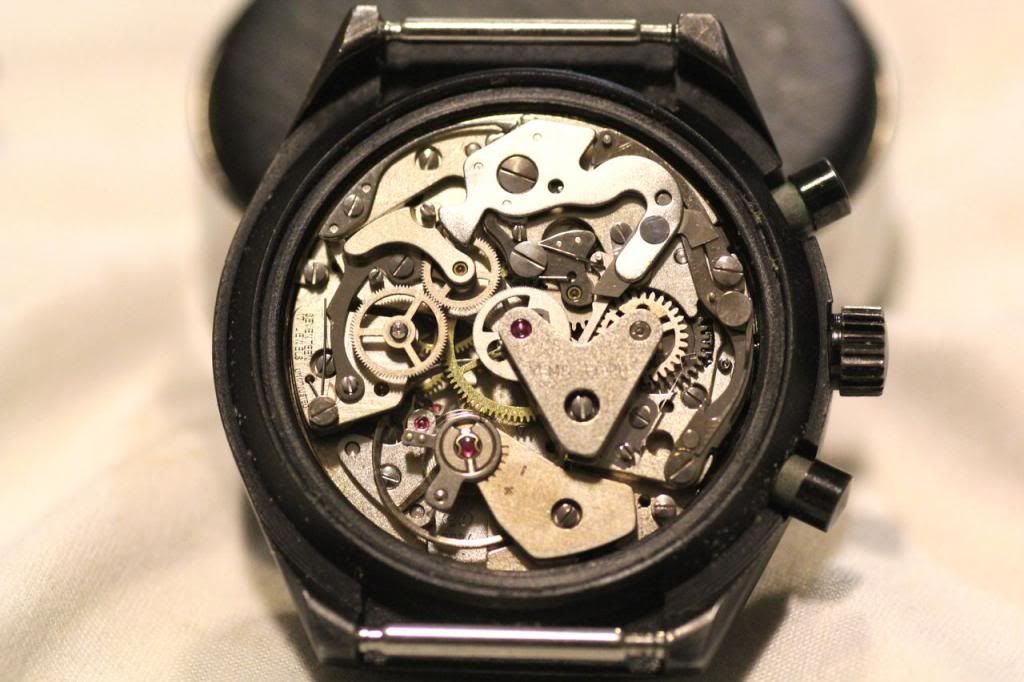
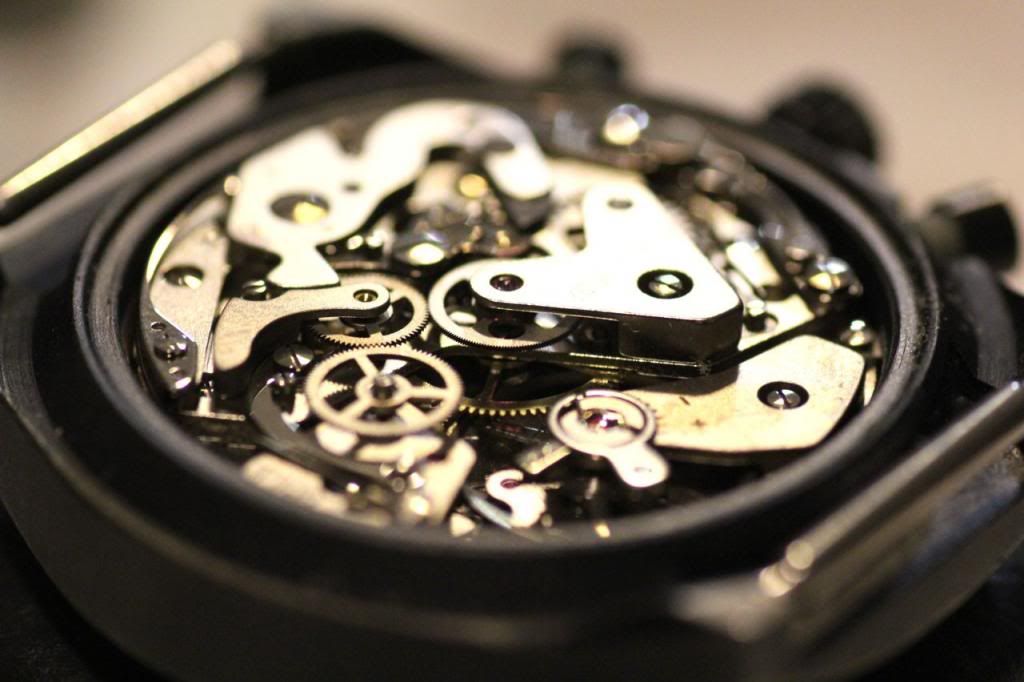
So I thought I'd open up the LeJour to see the Valjoux 7734 movement within. It's not the prettiest movement - far from it. but there's something quite honest about it. it's not pretending to be something it's not. Just an honest, workhorse of a movement that endeavours to provide relatively reliable timekeeping for many many years. It is surprisingly refreshing to see something like this after we've been spoilt by the glamourous sapphire crystal case back, bevelled edges, geneva stripes and blued screws. It's the basic white tee and jeans of movements.


The watch has been on rotation for the past 2 years. You can see the first post here. Opening the watch up wasn't my intention. I'd just wanted to change the strap but thought I might as well have a look at the movement while I was at it. I haven't worn this watch all that much, but I do still like it as much as the day I first acquired it. It has a certain charm and warmth that always brings a smile to my face when I see it. I still haven't bothered with checking its accuracy. To be honest there are only 2 hands so it's not like I'll notice any deviation (unless it's something like a minute a day).


Thanks to the shortish lugs the watch wears quite well on my wrist. It is tall, but not unmanageable. Having swapped it onto regular straps it is actually very comfortable.


I'm happy to report that in the two years under my care the watch has remained more or less in the same condition. The case back seal looks to have seen better days when I opened the watch up. I might get around to having the glass and back seal replaced one of these days, but that would be more to keep the dust out than making the watch water resistant. Other than that it was just a good excuse for me to practice my macro photography skills...


Tuesday, June 5, 2012

Hands-on with the Sothis Horus chronograph


Wolfgang Steinkrüger, the creative mind behind the watch brand Sothis, died recently, his legacy a series of highly recognisable and playful watches with an Egyptian influence. Although the brand started under another name, its founders Wolfgang and Karina Steinkrüger changed its name to Sothis, the Egyptian name for the star Sirius, in 1999. 

In this post we look at one of his most well-known models, the Horus.

Horus was the ancient Egyptians’ patron god, usually depicted as a falcon-headed man wearing a red and white crown. The Horus chronograph was produced in three versions – with an ivory/ silver dial, a matte black/ anthracite, and silver guilloche, each in a limited (numbered) edition of 200.

This is one of the ivory/ silvered dialled iterations (featured on the cover of Wristwatch Annual 2007). The black/ anthracite and silver guilloche versions are slightly more dressy. 

With the time indicated via a single 24-hour hand tipped at the ends with a sun and a star, the Horus has a quirky way of indicating both time and day/ night. The hand indicates the time and the star or sun indicates night or day. Time is shown in 5 minute increments and it takes 24 hours to do one complete revolution.

In addition, the star on the dial rotates with the running seconds.


The crown has a distinctive engraved hieroglyph for ‘Sothis’. 

Unlike the hours and minutes display, the chronograph is more traditional.


As you can tell from the specs below, this is a watch with a decent amount of height to it. With the bracelet, it weighs 175g. It’s not uncomfortable, but with the thickness, you can definitely feel every bit of its 44mm size.


TECHNICAL SPECIFICATIONS

Reference: 026001-W 
Movement: Automatic Valjous ETA 7750, customised by SOTHIS, engraved gold plated rotor 
Functions: hours, minutes, date, chronograph
Case: Stainless steel L 316 
Crystal : sapphire on both sides 
Water resistance : 5 atm 
Size: 44 mm.
Height : 13.9 mm 
Dial: matte black/ anthracite, ivory/ silver or silver guilloche 
Strap: leather strap with deployment buckle, stainless steel bracelet or set 
Limited edition: 200 pieces 


With its distinctive design, this watch may not be to everyone’s taste, but if you’re looking for a fun quirky chronograph from a brand that likes to do something different design-wise, it is still possible to find some of these, even in Australia, where they have an AD. 
 
The future of Sothis is still uncertain; Karina issued a press release about it that you can view here


[AP]

Thursday, May 24, 2012

The Rolex Ref. 5513 Mk IV


Having already blogged about the Ref. 5510 and the Double Red Sea-Dweller (Ref. 1665), today’s classic Rolex is the Ref. 5513 Mark IV. To read about the beginnings of the Rolex Submariners, go to the Ref. 5510 link above, but as was mentioned there by TonyC the 5510, which had a short production run (est. third-quarter of 1958 until late 1960), was replaced by a larger cased 5512/ 5513 (COSC/ non-COSC). 


The 5512 and 5513 were both fitted with the oversized crown which became a standard feature of the Submariner line, and came initially with a pointed crown guard, but later changed to the more rounded crown guard. Sometime in the early 1960s, Rolex discontinued the use of radium paint for the indices, switching to the safer Tritium. 


The 5513 was produced from 1962 through until approximately June 1990. It used Calibres 1520 and 1530, and the latter appeared in both the 5513 and 5512 for a time. Early dials from the 5512 and 5513 had what is called a ‘gilt’ dial, referring to the fact that the colour of the text was gold. Around 1965 or 1966 Rolex discontinued the use of gilt dials on the Submariner watches and switched to white printing. 


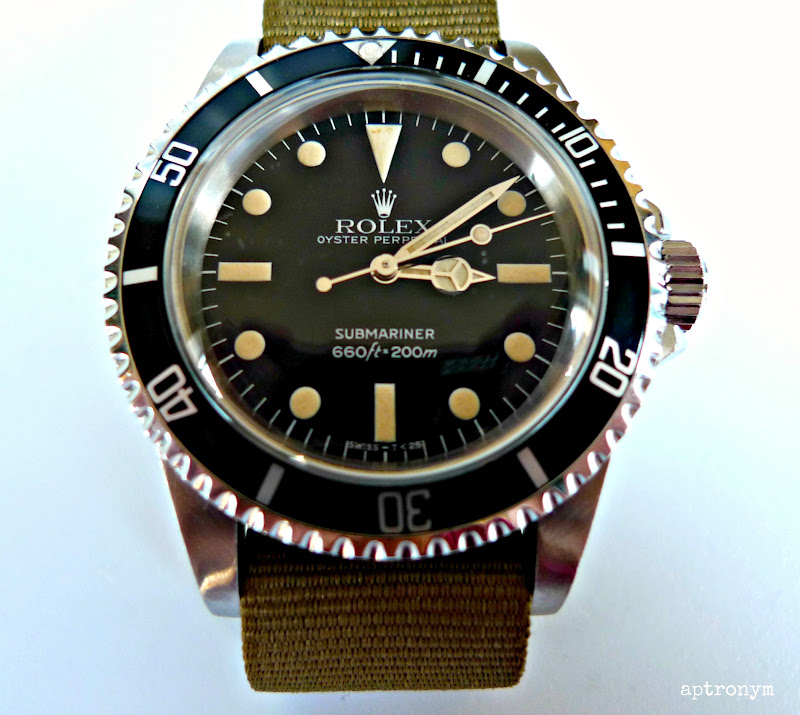
This is 5513 MK IV ‘maxi dial’ with a 7.9mil serial, from about 1983. The bezel is sharp, the dial and indices in remarkable condition.

What is a ‘maxi dial’? Well the term was first used by Rolex at Baselworld 2003 to describe the larger luminous dots on the Reference 16610LV. It was then appropriated retrospectively by vintage Rolex collectors for vintage Royal Navy Submariners, and then taken back even further, chronologically, to refer to older Submariner models. A close examination shows that the post-1975 maxi dials share two characteristics: larger lume dots and generally bolder text, especially for the depth rating and 'Submariner'. 


The Type IV shown in these photos is the second-to-last known style of matte dial for the 551x reference, showing up on Subs with high 6 million case serials until around about the late 7 millions. 

Even if you're not an old-school Rolex fan, you have to admit that this is in pretty damn good condition, and a classic versatile watch.

So … have we turned you into a possible vintage Rolex sports watch enthusiast yet? 


[AP - with thanks to TonyC and initialjh]

Thursday, May 17, 2012

A look at a rare Fifty Fathoms


Are there sounds in the sea
Fifty Fathoms deep?

Sea Music : W. J. Turner  (1884 – 1946)


In 1952, the French government created an elite team within the Navy called the ‘Nageurs de combat’ (combat swimmers). Headed by Captain Bob Maloubier, the new team’s missions included underwater intelligence, sabotage operations and clandestine port attacks.

Underwater diving was still in its infancy at this point, so Maloubier and his team had to design their diving equipment from scratch. This took two years, and involved new diving suits, fins, goggles, and a watch. The team was equipped with diving watches, but Maloubier was not satisfied, so in conjunction with Lieutenant Claude Riffaud, he set about designing a better one. Their design was first submitted to Lip, whose ambivalence was summarised by their comment that his design was "a portable clock without any future".

The irony of this decision by Lip was not too far away.

Undeterred, Maloubier and Riffaud convinced Jehan-Jacques Fiechter at Blancpain, himself a keen diver, to produce the watch, which they named the ‘Fifty Fathoms’. A fathom is a unit of length used as a depth measurement in English-speaking countries, corresponding to a depth of 1.829 metres. Fifty Fathoms equates to 91.45 metres, the depth one can reach with traditional diving equipment. Jehan-Jacques was the nephew of Betty Fiechter who, with André Leal, had purchased Blancpain in June 1933. Betty had assisted in running Blancpain since 1915, and under the Fiechters, the Manufacture flourished.

The final Fifty Fathoms that went into production was not the exact design that Maloubier and Riffaud had presented, as Fiechter used his own diving experience to make some adaptations. These included a screw-down caseback with a double ‘O-ring’ system, and a humidity indicator at 6 o’clock (blue if the air in the case was dry, pink if water had penetrated the watch case).

Blancpain were unable to sell their watches directly to the French navy, and had to make their way to the Nageurs de combat via Spirotechnique, who were the official suppliers of scuba diving equipment to the French armed forces. Established in 1946, La Spirotechnique, which later became ‘Aqua Lung’, had its origins in 1942-43, when Jacques Yves Cousteau and engineer Emille Gagnan, who was working for L'air Liquide, a French company specialising in compressed gas, created the first scuba regulator. 

Now we come to the (amusingly) ironic part. At the time, Lip was a dominant player in the French watch market. Blancpain was an unknown. This meant that Blancpain and Lip had to sign a marketing and distribution deal to get an foothold in the French market. In 1954 the Fifty Fathoms watches were launched, with both Lip and Blancpain markings on the dial. One wonders whether there were any animated discussions at this time at Lip about opportunities lost. 


Within a decade of its launch, Blancpain's Fifty Fathoms had been adopted by a few specialist oceanographic exploration and research organisations. Most famously, Jacques Cousteau selected the Fifty Fathoms as the dive watch of choice for his 1956 Cannes Film Festival Palme d'Or winning ‘Le monde du silence’ (The Silent World). 
  
From the early 1950s through the 1970s, the Fifty Fathoms became popular amongst the military, and used by the armed forces of Israel, Germany, Sweden, Norway, Denmark, Poland, Finland and the U.S. When the Americans were looking for a dive watch, there was a ‘Buy American’ policy, whereby American manufacturers were given a 25% price advantage over non-American competitors. Fortunately for Blancpain, Allen Tornek, who had met Jehan-Jacques Fiechter through their common interest in diving, took an interest in helping out. To get around the various restrictions, the Tornek-Rayville company took the Fifty Fathoms and rebranded it for the U.S. military under two names “Blancpain Tornek” and “Rayville Tornek” (‘Rayville’, a phonetic anagram of Villeret, was the name used by Fiechter for some of Blancpain’s production). About 1000 Tornek-Rayville Fifty Fathoms were produced, most of which were destroyed by the Navy at the end of the commission, so they are particularly sought after nowadays. 


To understand the history of Fifty Fathoms is arguably a lifetime’s worth of work given the list of companies involved, the number of iterations (estimated at around 100) of design/ movements/ size, and the fact that there have been both military and civilian versions.

In late 2010 and through to 2011, Blancpain launched a travelling worldwide exhibition of the history of the Fifty Fathoms. Starting at their boutique at Place Vendôme, Paris, it was a Fifty Fathoms/ dive watch enthusiasts’ dream, an incredible exhibition over sixty watches retracing its history and a truly once-in-a-lifetime chance to see such a group together.

Mostly consisting of historical models owned by collectors but also covering the latest models, this beauty, belonging to a distinguished collector friend of JPVFX’s, formed part of this important exhibition.


A rare early Fifty Fathoms Rotomatic Incabloc from 1954-1955 (possibly pre-dating the Rolex Submariner), this watch is 41mm with a thickness of 12mm. In a stainless steel case with a screw down case back, it is anti-magnetic and has a bi-directional bezel. The dial is a glossy gilt, and the indices and baton hands are radium-coated. The movement is Cal A. Schild 1361N, rhodium-plated with 17 jewels, line lever escapement, monometallic balance, shock-absorber and self-compensating flat balance-spring.


Invented in 1934 and manufactured by Incabloc S.A., the Incabloc shock protection system is the trade name for a spring-loaded mounting system for the jewel bearings that support the balance wheel in a mechanical watch, to protect the wheel's delicate pivots from damage in the event of physical shock.

The early Fifty Fathoms watches are very difficult to find nowadays, and poor condition is often an issue. There is really something particularly amazing about vintage tool watches like this one that somehow, after over half a century, manage to still have a brightness and clarity to them.

I admit that I’ve wanted a vintage Fifty Fathoms for little while. I really wouldn’t mind this one … 


 Yes you read correctly - a note signed for the 50 Fathoms owner by Captain Bob Maloubier himself


Call me old fashioned, but I’ve never managed to get my head around rose gold Fifty Fathoms, tourbillon Fifty Fathoms etc etc etc. I understand the desire to develop and innovate models that have become synonymous with your brand, but when a watch was created as a proudly utilitarian dive watch, I can’t help but think that something is lost when it is turned into an unnecessarily elaborate timepiece.   


[AP]

Tuesday, May 15, 2012

Hands-on with an unusual enamel & gold vein dialled Longines


As you know, we love our vintage watches, and today we have another rare horological beast for you. This one is particularly unusual. No, it’s not a Longines with a cracked dial which has had the cracks filled with gold. Meet the enamel and gold vein dialled Longines Flagship.


Launched in 1957, the Longines Flagship collection focused on classic slim cases, designed to be waterproof, and seen as a rival to Omega’s Seamaster at the time. This example is circa 1966. Measuring 35 x 39 mm (not including the crown), it has the original enamel dial with gold veins running through it, giving it a ‘cracked’ look. This is an intriguing and striking dress watch whose nuances are best viewed through a loupe; it is only then that you get the full effect of the gilt and enamel, and it's just stunning.


Interestingly, despite this being a 1960s model, the hands are Art Deco in style, and almost architectural. It’s an unusual combination, the veining with the hands, and it works.

The watch is signed on the dial, case (signed ‘Longines-Wittnauer') and crown, its movement a Longines calibre 285 manual wind with 17 jewels. The bezel is 14 K gold, as are the lug caps, but the back is stainless steel.


Owned by a collector of vintage Longines who has not seen another one like this before, if you have come across another one in your horological travels, please tell us, as he’d love to learn more about this watch.


Oh and just in case you’re wondering about the importance of the Flagship collection to Longines, their Heritage Collection, which honours the brand’s most iconic watches by recreating them anew, contains some Flagship models that hark back to the early days of the model line.


[AP]

Wednesday, April 25, 2012

Jaeger-LeCoultre's Duomètre à Quantième Lunaire LE


Sometimes, you don’t realise that there’s a beautiful watch that you’ve read about floating tantalisingly nearby. Then someone offers you the chance to take a look at it.

Firstly, what are the ‘Duomètre’ watches?

Introduced in 2007, the basic idea is to separate the normal time keeping function of the watch (hours, minutes, and seconds) from the other function, hence ‘duo’. Traditionally, in a watch with a complication the latter makes the watch’s rate deviate upon its activation e.g. a chronograph as it is switched on, a repeater as it rings, or even a calendar function ticking over. The functions share a common power source - the activation of the complication will lead a reduction in the time function of the watch, due to the use of power, and affect accuracy.


To bypass this, JLC’s Duomètre models feature two independent watch mechanisms within one calibre: one spring barrel for the time function, and another for the operation of the complication. In the case of this Duomètre à Quantième Lunaire, these two are the time, and a moon phase function. Each ‘wing’ of the movement has its own barrel with a power reserve of 50 hours.

Monday, April 23, 2012

A look at a Galante Spring Drive


Seiko has many watch lines at all price points, many of which don’t make it to Australia, and some which do, but only in a very limited form. Launched in 2009, the Galante line/ sub-brand is, like their Spring Drive series, one of the brand’s upmarket lines and, in fact, uses Spring Drive movements as well as mechanical ones. Only sold at a limited number of retailers and Seiko boutiques, there is, in fact, a retailer in Sydney (Sydney Vintage Watches, in the Strand Arcade).

You can read more about the Spring Drive movement here but this movement, introduced in 2005 was viewed by Seiko as their technically most significant development since the quartz Astron.


The Galante watches are immediately recognisable from their very distinctive case design. There are four large mounting screws which connect the round case to a tonneau open case back; out of the ordinary, unexpected, and whether it works or not (especially the use of two shapes) is a very subjective assessment. Does it work for me? I don’t mind the quirkiness, and can admire the thought and skill that went into this, but I don’t know whether the novelty value would wear off quickly.

This is the Galante Spring Drive SBLA037J. It has a large case, quite thick and heavy, and it is not a watch that can be worn by everyone. For many, it is liable to become a ding magnet as they become accustomed to the unusual case design.

Thursday, March 8, 2012

The rare Longines-Wittnauer Second Setting watch


One of the reasons I take a camera along to our weekly GTGs is because I never know whether an unexpected visitor, or a new acquisition, might pop up. This watch was one of the former.

Firstly, a bit of history.

The relationship between Wittnauer and Longines goes back a long way. Up to the 1890s, all of the Longines watches had been brought into the U.S. and Canada through J. Eugene Robert & Co., NY., which was taken over by Roberts’ brother-in-law Albert Wittnauer in 1890. Thus, all Longines watches imported to North America during this tenure have ‘Wittnauer’ on the dial. In 1936, the Wittnauer family sold A.Wittnauer Co., and a re-organised arrangement with Longines lead to the creation of the Longines-Wittnauer Watch Co.

What eventually became a longstanding relationship with aviation began in 1907, when Wittnauer supplied a pair of watches to the Navy, which was testing its aviation capabilities. During WWI, Wittnauer supplied military wristwatches and navigational devices to American Expeditionary Forces and an aircraft clock to the forerunner of the U.S. Army Air Corps.

In 1927, Wittnauer and Longines collaborated with Captain Philip van Horn Weems, a pioneering aviator who taught navigation to Charles Lindberg. This lead to Weems registering a patent for a ‘Second Setting Watch’ in 1929. Seen by many to be the first pilot’s watch, the Second Setting watch was intended to complement on-board compasses, flight charts and chronometers.

During flights, navigational adjustments were necessary for time errors, as small deviations in the accuracy of time measurement could lead to errors in flight calculations (fuel consumption, position and time to destination). Pilots would listen to the minute by minute radio beeps (e.g. GMT) to accurately adjust the centre seconds dial. This would indicate the time error on their watch so they could do calculations more accurately.

To make these watch adjustments easier, Weems put in a movable inner dial, which adjusted the dial to the hand. The aviator would move the dial in accordance with the radio time signal, noting any deviations from Greenwich Mean Time.


Throughout its life, there have been numerous iterations of the Weems Second Setting watch, including later versions with a rotating seconds-register. The first series, the A3, was produced between 1929 – 1936, the second (A12) between 1936 – 1946, a series for the Japanese Imperial Navy between 1936 – 1946 (IJNAS), the A11 between 1938 – 1948, a 26mm version, the A12, for the period of 1936 – 1948, plus a couple of other variations.

This example is an early model. In sterling silver 47mm case (55mm lug to lug) with an onion crown, it has a double-hinged case back which, unfortunately, I couldn’t open.