Showing posts with label Patek Philippe. Show all posts

Sunday, July 5, 2020

Profile: Anita Porchet


Anita Porchet - Portrait from thenakedwatchmaker.com

What do you think of when the word ‘enamel’ is mentioned? 


I think of shiny smooth white dials, a kiln firing at 800 odd degrees Celsius and... that's about it really. Not much else comes to mind. Nevermind the fact that the art of enamelling is an art form that one may not master even after 20 or even 30 years of experience. There is nothing quite like a clean, crisp, white enamel dial, and Seiko’s use of it is a testament to the elegance in simplicity. But the art of enamelling, that’s a whole ‘nother thing. What? How hard can it be to do a white enamel dial? You've come to the right place. 


Many years ago when I was lucky enough to have visited Manufacture Jaeger-LeCoultre, during a tour of their in-house enamel workshop, founded by Miklos Merczel, we were told that enamelling was a craft in danger of being lost to time – it wasn’t being taught in schools, and apprentices weren’t willing to invest decades into honing the craft. 


Things have changed dramatically since then. Due to the increased demand of enamelled timepieces over the past decade it is again being professionally taught, and new life given to a once dying craft. However, this may be a blessing and a curse. It is no longer as rare as it used to be, and although the price of admission isn’t exactly low, those with the means are able to acquire a piece of miniature art relatively easily. It almost became industrialised insomuch as a craft can be; a product, rather than art. There are views that the Swiss watch industry should keep some things ‘sacred’ and not mass produce everything because of demand. 


Hermes Cape Cod


So what exactly does it take to become a master enameller? Like watchmaking it is a highly skilled craft and takes years, if not decades, to be anywhere near good enough for your craft to be recognised and perhaps commissioned by brands (watch or otherwise) or an in-house artisan. 


Currently, one of the most respected and revered is the independent master enameller, Anita Porchet, although if you ask her, she would not call herself that. In fact, after two decades of producing amazing pieces for the likes of Patek Philippe (who were one of the first to recognise her talent), Vacheron Constantin, Piaget, Hermes, and other prestigious Maisons, she still feels that she has not mastered the art. And therein lies the problem of the industry. 


Piaget The Rose - Featuring Cloisonné technique


As with many crafts, increasing popularity entices more people to study it, with some not hesitating to label themselves “enameller” with mere months of experience. For sure there are some talented artists who may acquire the skills of miniaturising art, but enamel isn’t like painting. It requires time to be familiar with the raw materials, to know when the grain is fine enough, and to time each firing in the kiln to perfection, as a few seconds too long in the kiln can ruin months’ worth of work. Impurities in the glass can cause bubbles or discolouration. There are no shortcuts. 


Working on Piaget - The Rose


Anita Porchet was born in La Chaux-de-Fonds and learnt the basics of enamel work through her godfather, before studying fine arts. It would turn out to be portentous when she won a Patek Philippe prize shortly after graduating. Her significance is as such that in 2015 the Fondation de la Haute Horlogerie presented her with the “Hommage au Talent” prize. It is important to note that as well as her own artistic work and her apprentices, she has also taught, including at the School of Applied Arts (EAA) in La Chaux-de-Fonds.


Various enamel colours


She started out solo in the 1980s, establishing her home studio in the countryside somewhere between Geneva and Lausanne in 1993. She now has three apprentices. During her long career she has experienced the dramatic rise in demand of the craft last two decades; from almost no takers to brands spending millions creating enamel timepieces. Back in the mid-1990s, Patek Philippe requested from Anita Porchet her first enamel dials. Then other Maisons followed. She became more skilled and more proficient, and over the years created an unique signature, as well as mastering a wide range of disciplines:


Champlevé - which consists of cutting away troughs or cells in a metal plate and filling the depressions with enamel. The raised metal lines between the cutout areas form the design outline.


Paillonné (Spangling) - which involves applying microscopic specks of gold leaf to the enamel


Cloisonné - a technique that allows the motif to be outlined with a gold wire finer than a hair’s breadth


Grisaille - a technique by which an image is executed entirely in shades of grey and usually severely modelled to create the illusion of sculpture


Limoges - white painting - using enamel very finely ground with heavy vegetable oils, which gives a very thick white paste. 


Dawn on the lake by Anita Porchet for Patek Philippe's175th anniversary


A Patek Philippe dome clock with cloisonne and paillone enamel


Some of her more challenging work included creating the ceiling of the Opéra Garnier on the Métiers d’Art Chagall & l’Opéra de Paris “Tribute to Famous Composers” for Vacheron Constantin, the reproduction of Judith by Gustav Klimt on a Patek Philippe pocketwatch involved a combination of techniques.  


Opéra Garnier on the Métiers d’Art Chagall & l’Opéra de Paris “Tribute to Famous Composers” for Vacheron Constantin


Porchet has achieved her consistent level of quality only after years of experimentation, and it can take up to a year to finish a complex dial. Each firing in the kiln can last between 30 to 90 seconds. Even if the timing is perfect, it is no guarantee the step WILL be successful. “Cracks on enamel do not all happen for the same reasons,” Porchet explains to Robb Report. “The origin of the cracks can come from the quality of the colour, from the thickness, or from the metal. I try to find a solution for each case, but it’s not always possible.” It is this skill, accumulation of experience over time, that makes Anita Porchet a master enameller, a title which I’m sure she will refuse.


*I mentioned the significance of Patek Philippe to the career of Anita Porchet. One of the first things that those new to Patek (and who are not native French speakers) learn is that the ‘émail’ on some dials does not refer to electronic mail but that it is the French word for enamel. Thus, an enameller is an ‘émailler’. 


Friday, June 19, 2020

Quick Look: Patek Philippe Ref 6007A-001 Calatrava "Manufacture Limited Edition"

2020 so far has been a funny year. Not so much ha-ha funny mind you. I won't bore you with the details though, assuming if you're reading this, you already know full well what's happened...

And here we have Patek, launching a watch from the previous year (yes that's right. They even tell us so on the case back) meaning it has already gone up in value, given it's a steel, limited edition, casual dress/sports watch with a blue dial. 

Ref 6007A-001

The year has been so strange that even us, The Sydney Tarts, having lain dormant for the best part of errr... 5 years?? Felt it necessary to revitalise and re-energise, and resurrect ourselves and start posting again, as we are in a completely "unprecedented" times.

Enough of a tangent though. Let's get back to the watch. Patek is well known for saying that their clients do not actually own one and are merely temporary guardians until their offsprings can lay claim to the sound investment that is luxury watches and ideally sell it to fund further education or perhaps, more investments. And no doubt this watch will be an investment, as steel Calatravas aren't all that common, and this model is only limited to 1000 pieces.

New Manufacture 2019

A quick run down. The watch is 40mm. powered by calibre 324 (the PP equivalent to the JLC 899 or the ETA 2892-A2). It is automatic, so the shortish power reserve won't matter. But even then I do have doubts just how many of the 1000 pieces will actually be worn and how many will be safe queens, and become a part of an investment portfolio. It'll retail for the AUD equivalent of around about $42,000. that's considered a bargain by Patek standards. Trust me.

There are 3 hands, and a date at 3:00, complete with black numerals on white background. Hour markers and hands are lumed. Matte blue dial with the door to the Ninja Turtle's NYC abode as the central decoration. Thick bezel aids in the overall "balance" of the design, finished off with a blue strap and a pin buckle.

So, 1000 pieces worldwide. That can't be too difficult to come by, provided you have a spare $40k to spend post COVID-19, what with the pent-up urge to spend and such and such? Well, don't forget, this is Patek steel watch territory. Meaning it's not as easy as it sounds. Just because you have the dough doesn't mean you get to go...

Oh and yes. The watch celebrates a new Manufacture that they built in Plan-les-Ouates, Geneva, costing 600 million CHF. 10 floors all up; 4 underground. Brings all the crafts under the one roof. (a la Jaeger-LeCoultre and Zenith...) A restaurant for 880 guests, parking for 700 cars, 4 VIP lounges.


The New Patek Manufacture


Wednesday, February 19, 2014

The Quest For Thinness Part 2: The Minute Repeater Strikes Back

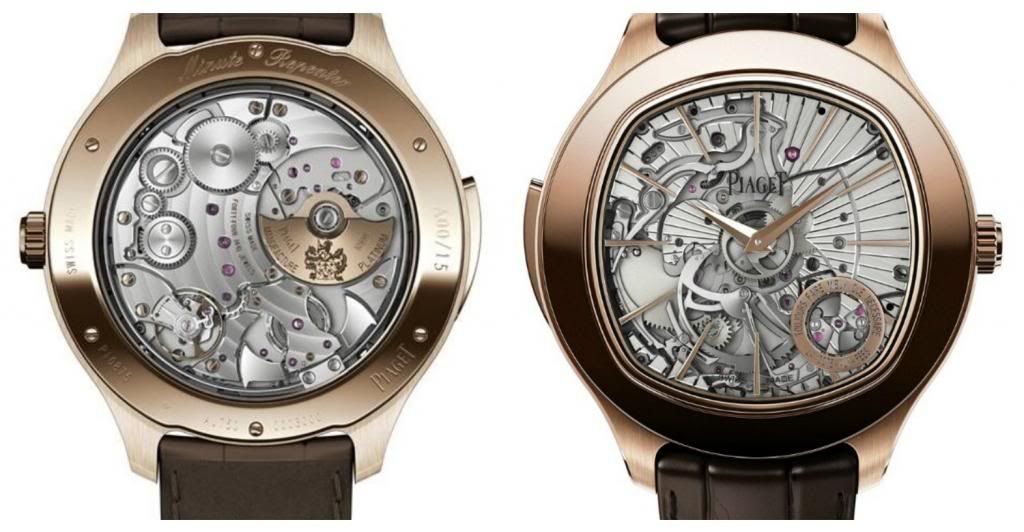
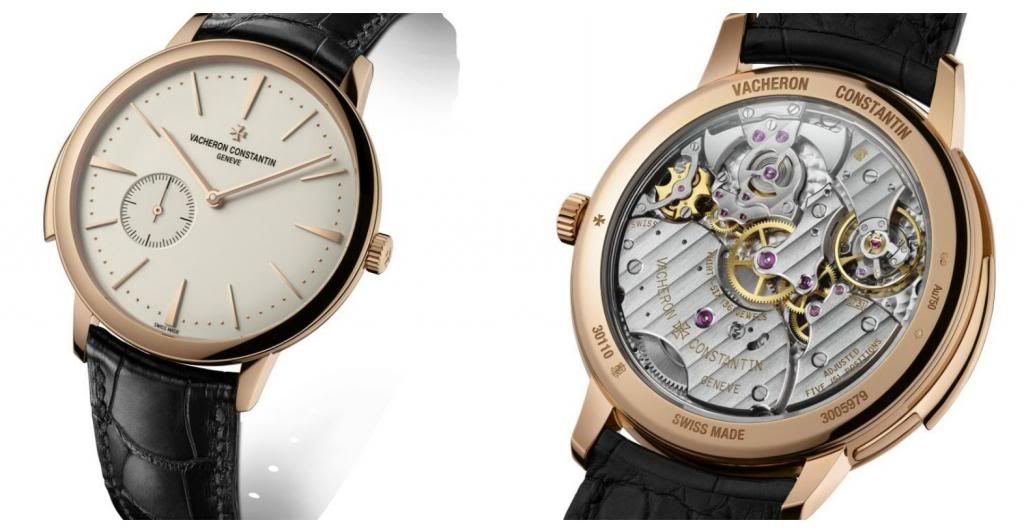
It is very entertaining observing the intra-company sibling rivalry that doesn't seem to stop. Round 2 involves the same 3 siblings of the Richemont group: Jaeger-LeCoultre, Piaget and Vacheron Constantin. Piaget as you might know wanted to hold the record for everything thinness category there is in the world of haute horlogerie. And they did have all the records (thinnest automatic, thinnest mechanical, thinnest minute repeater, etc) until Vacheron decided to spoil things by introducing the thinnest minute repeater watch late in 2013, pushing the total height down to a mere 8.09mm (compared to Piaget's 9.4mm in the Piaget Emperador Coussin XL, which was released in early 2013).


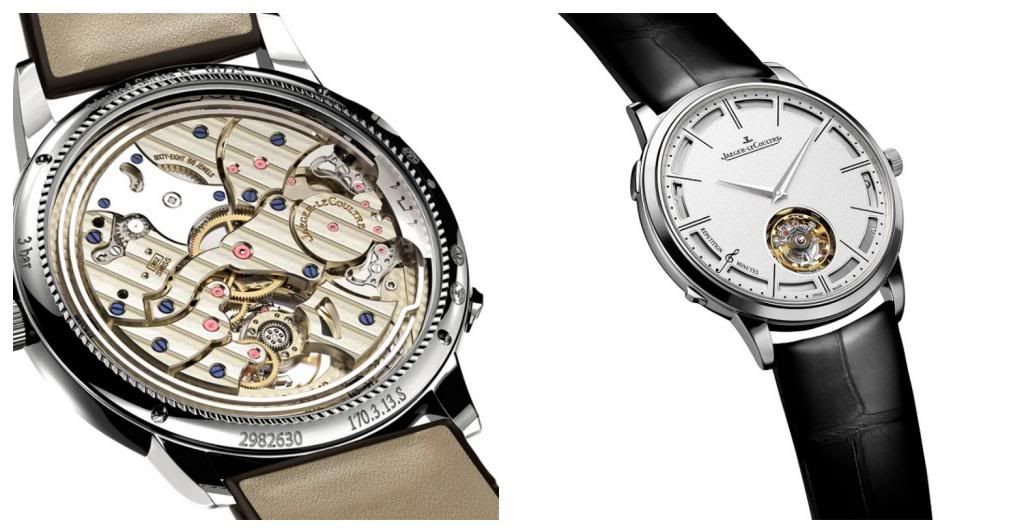
JLC, still reeling from having their thinnest mechanical watch record wrenched away by Piaget after such a short period decided that there is nothing like the sweet revenge of beating them at their own game (and dealing a double blow to Vacheron at the same time) and launched not only the world's thinnest minute repeater watch, but one with a flying tourbillon/flying balance AND a peripheral winding system to boot! Just as the thickness of the thinnest manual wind watch dropped quite significantly (in terms of percentages) the thickness of the ultra thin minute repeater watch dropped from 9.4mm to 7.9mm in just under 12 months. Sure is amazing what intra-group competition can do!


(Yes I realise that it takes far longer than mere months to plan/design/engineer/manufacture such amazing feats of craftsmanship and oneupsmanship but it makes for a much more entertaining read to pretend as if all this has just happened in real time)

I guess Vacheron can console themselves at still owning the record of the thinnest minute repeater movement (at 3.9mm thin) compared to JLC/Piaget's (at around 4.8mm each) but then again, the Vacheron movement is manual wound whereas both JLC and Piaget are both automatic movements.


The Vacheron and the Piaget are both quite traditional in their movement design, whereas JLC pushed the envelop just that little bit more in order to cram in extra complications (just like Piaget did away with a separate movement and case construction in their quest for ultimate thinness in a mechanical watch and combined the two to make the watch one integrated unit). Rather than having a slider to activate the minute repeater, JLC instead opted for a pusher, which stays flush with the case after activating the minute repeater, and a separate mini slider to release the pusher if you didn't catch the time the first time 'round.

JLC has also removed as much as possible around the tourbillon to make it first of all, reduce the amount of space it takes up and second, to offer a completely unobstructed view of the tourbillon. Again, people have expressed concern at the fragility of a flying tourbillon topped with a flying balance, but I guess JLC's done their homework and made sure something like this will still be sturdy enough for everyday wear.

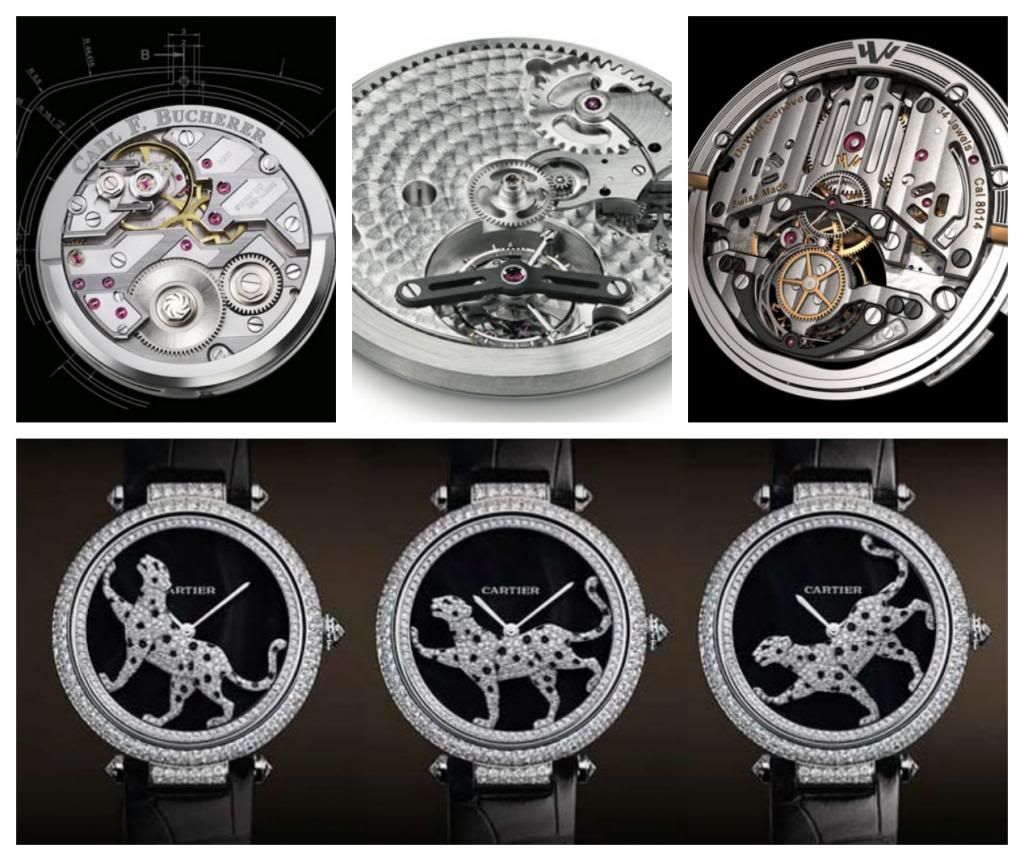
And finally, a peripheral winding system dispenses with a centrally mounted rotor (takes up too much space), instead a weight spins around the edge to wind the movement up. This idea is not new.  The first patents to this system where filed in 1955 by Paul Gostel and a decade later by Patek Philippe. The first brand to offer this system in a serial production was Carl F Bucherer back in 2008. Subsequently numerous brands also presented their version sof the peripheral winding system, with DeWitt in 2009 with their Calibre DW8014, followed by Audemars Piguet with their Calibre 2897 in 2011, then in 2012, by Cartier (of all brands) with their calibre 9603 MC, even though they've not announced it as such, instead focusing on the design attributes (a bejewelled panther spins above the dial, but is in fact the 'rotor' for the movement). And finally, in 2013 with Breguet's Calibre 581DR, which currently also holds the record of the thinnest automatic tourbillon movement (that's another one Piaget needs to get back...).

From Top Left: Carl F Bucherer, Audemars Piguet, DeWitt, Cartier. Breguet movement not shown because I couldn't find a brand PR shot.

Personally I like this strive for thinness. As Daniel Riedo, CEO of Jaeger-LeCoultre mentioned, that it is much easier to make a watch with a thick case, than it is to make it thin. It shows the capabilities of a manufacture, when they are able to make a watch as thin as possible, without all that dead space inside the watch. I salivate at the prospect of what could possibly come next! I wonder how much space the minute repeater takes up? If JLC got rid of it, could they challenge Breguet for the thinnest automatic tourbillon movement? Or does Vacheron and Piaget have something in the works already? Only time will tell and perhaps stay tuned for: The Quest For Thinness Part 3: The Whirlwind Timekeeper.

Monday, September 9, 2013

Top 10 Women's Swiss Mechanical/Automatic Watches

It appears that there is a demand of some sort out there for lists of top watches or recommended watches. It also appears that such a list doesn't really exist for ladies' watches. At least not in any usable form. So here at The Sydney Tarts we thought we'd compile a list of top 10 watches for women. These are watches we feel are either classics in their own right, or extremely popular/in-demand. They're not necessarily watches we'd recommend, but of course, watches are entirely subjective and all the watches in this list are pretty good watches in their own right. Really comes down to what sort of watches you like, and how thick your wallet is.

For this post we will be concentrating on the 10 best mechanical/automatic Swiss watches for women. This will cover all price points and we'll do another post later on focusing on quartz models. For brands that offer various ladies' watches in mechanical or automatic, we've picked the most popular or the most iconic model, but will also mention in the text in regards to the other models.

So, here we are, in no particular order... Well, that's not really true. They're in order of "what comes to mind", ie, the first watch is the first one that comes to mind, etc etc. By the 8th we were grasping at straws simply because a lot of watches for women seems to be quartz only...

1. Rolex Lady Datejust Automatic
Well this one is a no-brainer. It's not the prettiest watch in the list but it is classic, and reliable, and a proven workhorse of a watch. Like its male counterpart, these will withstand pretty much anything you throw at it. Rolex watches are over-engineered and are of course, designed first and foremost to be tool watches. So if you are tough on your watches, you really can't go wrong with the Rolex. They also come in a huge variety of colour/material/dial combos, making it easy (or tough) for you to choose one the exact version that's best suited to you.


2. Omega Ladymatic
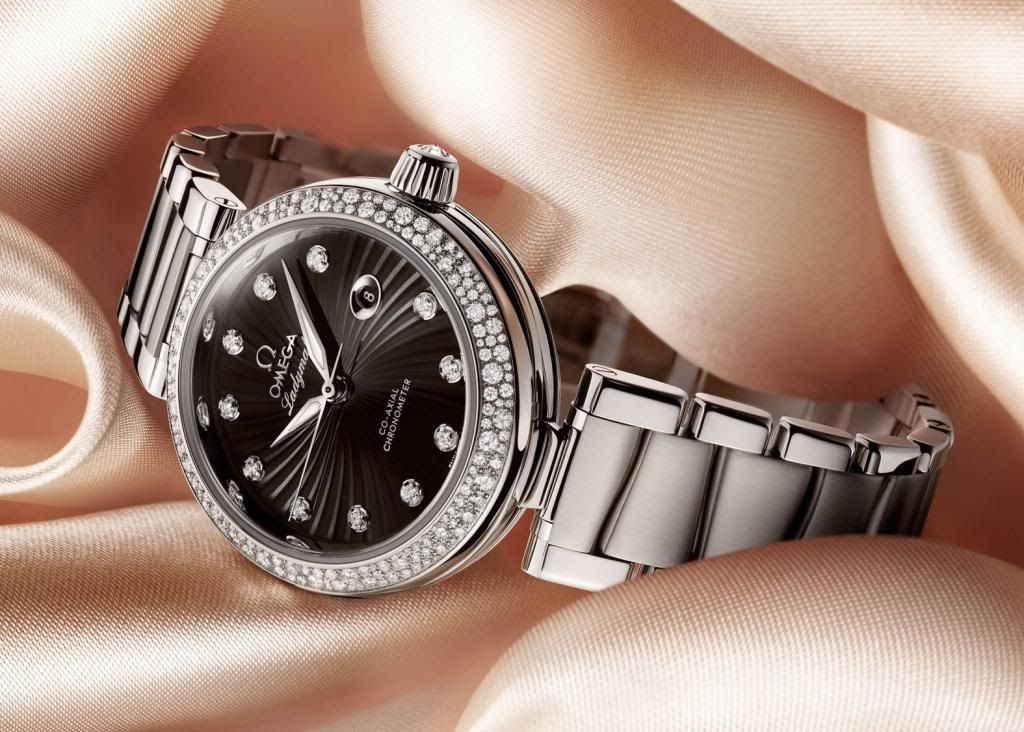
This is a fairly new addition to the Omega range, although the name Ladymatic has been used in the past. The current Ladymatic, as modeled by Nicole Kidman, is designed purely for women, rather than a scaled-down men's model. The watch is extremely elegant, comes in a biggish size, perfectly on-trend and powered by an in-house movement. Like the Rolex, there are quite a number of dial/material combinations to choose from. The Ladymatic might be new, but it's proved to be very popular and fast becoming a classic for Omega. They've certainly developed a winner here. (Honourable mention: the Ladies Constellation, but these do sell more in the quartz model)


3. Jaeger-LeCoultre Reverso Lady Manual
We debated long and hard on this one, and finally settled on the Reverso Lady. The cause of the debate is the new Rendez-Vous range, which is just on 2 years old and doing extremely well for Jaeger-LeCoultre. However, our reasoning was that if you were to only get one Jaeger-LeCoultre, it would have to be the Reverso, as it is iconic for JLC, and no one else makes anything like it. (ie, reversible case) So here we are. Our pick of the litter would be the Duetto model, simply because you get two watches for the price of one. There's the daytime (front) side and the evening (reverse) side, powered by the same mechanical movement. (Honourable mention: Reverso with a single side and plain case back for personalisation, or, if you must have a round watch, the Rendez-Vous)


4. Chanel J12 Automatic
I'm sure this watch needs no introduction. Chanel has done an amazing job with this model, and in a relatively short time, created an instantly recognisable icon that has possible brought about the renaissance of the use of ceramic as a case material and the style copied ad nauseum (Much like the Datejust). These are so popular in fact that they're commanding extremely high resale prices, and in some cases, higher than the original list price.


5. Cartier Tank Francaise auto
Cartier has a number of classic watch models, from the Tank, to Santos, to the more current Ballon Bleu... and even within the Tank and Santos range, there are numerous sub-ranges to choose from... but the watch we keep coming back to is the Tank Francaise. To be honest these probably sell more in the quartz version, but the automatic is right up there.


6. Tag Heuer Lady Link Auto (34.5mm)
The Lady Link comes in different sizes and the automatic movement powers the 34.5mm size version. Like the Ladymatic and the Rendez-Vous, this is a series designed especially for ladies. Ok you might argue that there IS a Link series for gents, but at the very least the Lady Link isn't a pre-shrunk Gents version. Beautifully modelled by Cameron Diaz, the Lady Link is classy with a hint of sportiness. Just like Cameron herself. Tag could not have chosen a better ambassador for this range.


7. Breguet Reine de Naples
Personally, not a big fan of this piece. However, it is quite popular and apparently doing quite well for Breguet. There is just something not quite right to my eyes about an egg-shaped watch. But you can't ignore the pedigree. Breguet is a genunine watchmaker and respected by all. I... just can't get past the styling. But you have to give credit where it's due. It certainly is distinctive.


8. Girard Perregaux Cat’s eye
The Cat's Eye collection was launched in 2004, and is available from a simple three-handed watch to something with complications.The oval shape allows for this without being too large to fit on feminine wrists. It is also quite heartwarming to see complication watches for women, and you'd expect nothing less from another brand with rich watchmaking history.


9. Patek Philippe Nautilus Ladies Automatic
The first Patek ladies watch that came to mind was actually the Twenty4, then we realised that you'd have to spend the equivalent of a nice apartment to get it with a mechanical movement (along with carats of diamonds). So the Nautilus is out next choice and it would seem that this range is probably the default women's watch for women who appreciates the watchmaking craftsmanship. Granted it is a pre-shrunk gents watch and gussied up a bit with diamonds, mother-of -pearl and pastel colours, but they have managed to make the range quite feminine and attractive.


10. Piaget Altiplano (34mm)
The whole Altiplano range trades on one exquisite feature - being ridiculously thin. They're classy and feminine, powered by an ultra-thin mechanical movement... there is nothing not to like with this range. Don't forget that although Piaget seems to be just as well known for their jewellery, they do have a proper watchmaking history and do lay claim to the world's thinnest automatic movement, so these watches aren't just pretty faces!


Thursday, March 15, 2012

What's a watch worth?


Here's a short piece I found online which I found interesting and hope that you do too. Bloomberg Television's Elliott Gotkine reports from Baselworld 2012 on the economics of watch making.


[AP]

Wednesday, January 25, 2012

A GTG at Scopri Italian Restaurant

Scopri
191 Nicholson Street
Carlton
VIC 3053
Ph : (03) 9347 8252


A week after having spent a few days in Melbourne, I found myself there again for the Melbourne Watchband’s end of year dinner last month, having been talked into the overnight visit by a watch friend in Perth who would also be there for the occasion.


They'd booked out the private room at the top of Scopri, an Italian restaurant in Carlton which, happily, is BYO, allowing the wine buffs to bring a bottle or two. Despite being a group of 15 in the private room (or floor, rather), there was no requirement to abide by a set group menu, so apart from some shared starters, we chose from the a la carte menu. 


First up were some shared primi piatti:

Insalata caprese

Simple sweet flavours of good tomatoes, plenty of basil, good buffalo mozzarella.

Affettato di Bresaola di Wagyu
Local air dried Wagyu beef Bresaola with rocket, parmesan & cherry tomato salad

Unfortunately, because I was so distracted by trying talking and watches, I only managed to get one slice of the bresaola. Suffice to say that I wish that there'd been more of this smooth, rich charcuterie.

Thursday, November 24, 2011

Selections from Antiquorum's NY December auction


With the end of 2011 nigh, Antiquorum's December "Important Modern & Vintage Timepieces" auction in New York will feature a mixed bag of 450 modern and vintage timepieces, and even some parts (see lots 323 to 327).

You can view the full catalogue at this link but here are a couple of interesting (and sometimes quirky) timepieces that grabbed my attention. I am partial to lots 158 and 188. Descriptions and photographs are from the catalogue:


Lot 139 – Jaeger LeCoultre for Hermès, retailed by the latter. Movement No. 2176671, case No. 1315945. Made in the 1970's. Fine and rare, 18K yellow gold wristwatch with large lugs. Two-body, horizontal rectangular, polished and brushed, inclined bezel, extended lugs, winding-crown at 6. Satine silver with applied steel baton indexes. Steel baton hands. M. Cal. 818/2, tonneau, rhodium-plated, fausses cotes decoration, 17 jewels, straight lever escapement, monometallic balance, shock-absorber to balance and escape wheels, self-compensating fl at balance spring. Dial and movement signed. Dim. 42 x 30 mm. Thickness 7 mm.

Estimate: 1,000 USD - 2,000 USD
Estimate: 900 CHF - 1,700 CHF
Estimate: 700 EUR - 1,500 EUR


Lot 157 – Scarab beetle. Unsigned, Swiss, circa 1870. Fine gold and enamel, diamond-set pendant form watch designed as a scarab-beetle. Accompanied by a fitted box and key. Three part, underside chased and engraved with legs and underbody, wing covers entirely decorated in translucent red enamel over engine-turning with black spots, main body with black enamel stripes, the thorax with a diamond-set collar, spring loaded wing covers hinged and opening from a button in the base to reveal the dial. White enamel with Roman numerals. Blued steel "spade" hands. Oval 7"' 1/2 gilt brass, bar calibre with going barrel, 8 jewels, cylinder escapement and plain three-arm balance, fl at balance spring with regulator. Total length 46 mm.

Estimate: 15,000 USD - 20,000 USD
Estimate: 13,000 CHF - 17,000 CHF
Estimate: 11,000 EUR - 14,000 EUR


Lot 158 – Vacheron & Constantin Ref. 7323 white gold. Genève, No. 616631, case No. 49845. Circa 1970. Very fine and unusual, thin, keyless 18K white gold oval shaped pocket watch. Two body, polished bezel with satin reverse, cabouchon set winding crown. Silvered with painted Roman numerals. Blued steel index hands. Calibre. 1003 within oval steel holder, rhodium plated with fausses cotes decoration, 17 jewels, Geneva seal, straight-line lever escapement, blued steel balance spring adjusted to heat, cold, isochronism and 5 positions, index regulator. Dim. 35 mm x 47 mm.

Estimate: 2,800 USD - 4,300 USD
Estimate: 2,500 CHF - 3,800 CHF
Estimate: 2,000 EUR - 3,000 EUR


Lot 188 - Patek Philippe Telequartz. No. 842067. Circa 1975. Fine and rare, 220v., radio-controlled Module LS 0 electronic Master Clock. C. Rectangular, stepped, steel, black control panel with LCD display and buttons for setting. D. Electronic LCD digital display. M. Electronic, based on quartz oscillator, integral receiver Module AD 10SN, Serie 2384 receiver box. Dim. 24 x 33 x 7 cm.

Estimate: 1,500 USD - 3,000 USD
Estimate: 1,300 CHF - 2,600 CHF
Estimate: 1,000 EUR - 2,000 EUR


Lot 441 - Yellow gold top winder Vacheron & Constantin, Genève, No. 370816, case No. 262383. Made in the early 1930's. Very fine and rare, 18K yellow gold wristwatch. C. Three-body, solid, polished, concave lugs, winding crown at 12, domed crystal. D. Black with applied yellow gold Arabic numerals and baton indexes, outer minute divisions, subsidiary seconds dial. Yellow gold epée hands. M. Cal. 10 1/2''', gilt brass, 15 jewels, straight-line lever escapement, cut bimetallic compensation balance, blued steel fl at balance spring. Dial, case and movement signed. Diam. 30 mm. Thickness 8 mm.

Estimate: 4,300 USD - 7,000 USD
Estimate: 3,800 CHF - 6,000 CHF
Estimate: 3,000 EUR - 5,000 EUR


One of the stars of this auction, and the cover watch, is the Parmigiani Bugatti  Type 370. This piece unique, with a 10-day power reserve, is in a stunning curved rectangular shape, its movement shaped like an automotive engine set inside an oval-shaped cylinder. The watch is wound and set via the underside, and comes with a “starter key”, in the manner of a car. The key is inserted into the winding hole to wind the watch, the “key’s” reverse is used to set the time. It also has 28 baguette diamonds.


Lot 180 – Parmigiani Fleurier “Bugatti” 18-carat white gold and diamonds. "Bugatti - Type 370," Piece Unique, case No. 23706. Made in 2007, sold January 27th, 2008. Accompanied by the original fitted box, travel box, certificate of origin, instructions and automatic winding pen. Extremely fine, rare and unusual, rectangular curved, movement constructed in the shape of an automotive engine encased in an oval-shaped cylinder, 18K white gold and diamonds driver's wristwatch with 10-day autonomy (displayed on a graduated drum) and an 18K white gold Parmigiani double deployant clasp. Accompanied by the original fitted box, travel box, certificate of origin, instructions and automatic winding pen.

Eight-body, solid, polished, transparent top, sides and back to view the movement, bezel set with 28 tapered baguette diamonds (approx. carat weight 3.1), case back with 4 screws, sapphire crystals. White gold with oeil-de-perdrix decoration, applied white gold EB (Ettore Bugatti) logo, luminous white gold baton indexes on a matte black outer reserve. Luminous white gold alpha hands. M. Cal. PF 370 oval mounted on silent blocks, rhodium-plated, 37 jewels, straight-line lever escapement, monometallic balance, shock absorber, self-compensating fl at balance spring, double-barrel. Dial, case and movement signed. Dim. 32 x 50 mm. Thickness 19 mm.

Estimate: 100,000 USD - 150,000 USD
Estimate: 90,000 CHF - 130,000 CHF
Estimate: 70,000 EUR - 105,000 EUR


Happy bidding!


[AP]

Monday, November 21, 2011

Grand Prix d'Horlogerie de Genève 2011 : results


The 2011 Aiguille d'Or Grand Prix has just been awarded to De Bethune for its DB28 at the 11th Geneva Watchmaking Grand Prix (GPHG) on Saturday 19 November.

The Grand Prix was founded in 2001 by the Geneva Watchmaking Grand Prix Foundation and the Banque Privée Edmond de Rothschild to celebrate and recognise horological excellence.

You can read about the nominated watches, which included Australia's own Eva Leube, here.

This year’s winners are :

“Aiguille d’Or” Grand Prix: De Bethune DB28
“Petite Aiguille” Prize (for models under CHF 5’000): Montblanc, Star Worldtime GMT Automatic
Best Ladies’ Watch Prize: Boucheron, Crazy Jungle Hathi
Best Men’s Watch Prize: Hermès, Arceau Le Temps Suspendu
Best Design Watch Prize: Urwerk, UR-110
Best Jewellery and Artistic Crafts Watch Prize: Van Cleef & Arpels, Lady Arpels Polar Landscape
Best Complicated Watch Prize: Zenith, Academy Christophe Colomb Equation of Time
Best Sports Watch Prize: TAG Heuer, Mikrotimer Flying 1000 Chronograph
Best Watchmaker Prize: Vianney Halter
Special Jury Prize: Patek Philippe Museum


The public prize, awarded by visitors to the exhibition and voters on the World Tempus and GPHG, went to Audemars Piguet’s Millenary 4101.


All the prize winners and nominated watches will be exhibited at the Salon International de l’Horlogerie de Prestige Belles Montres at the Carrousel du Louvre from November 24th to 27th.

Available in four iterations (reference DB28TIS8 with the titanium case, black dial, and titanium floating lugs is 87'000 CHF), more information about this year’s winner can be found here.


[AP]

Wednesday, November 16, 2011

Patek Philippe Nautilus Ref. 5712/1A


This year has seen the loss of a number of watch luminaries. One of these was Gérald Genta.

One of the (many) watches for which he was (and still is) most well-known is Patek Philippe’s Nautilus, introduced in 1976. It was the brand's first move away from dress watches into sports watches, and has proven to be an immensely popular mainstay of their collections since then.

The stainless steel Nautilus Ref. 5712/1A is one of the more complicated watches in the Nautilus line-up. Apart from displaying hours and minutes on its grey-blue dial, the Ref. 5172/1A has a seconds subdial at 4 o’clock, a power-reserve indicator between 10 and 11 o'clock, and an analog date dial at 7 o’clock which has an integrated moon-phase display. There is a pusher for the moon-phase on the side of the case. Nautilus models generally have a water resistance rating of 120 meters, but this model is only 60 metres, because of the moon-phase pusher.


Ref. 5712/1A is powered by the 3.98mm thick (or rather, thin) automatic Patek Philippe calibre 240 PS IRM C LU movement which is visible through an open caseback, including the 22k gold mini-rotor. This movement is what makes helps make the watch feel so remarkably slim. Although 43mm x 38mm, it was far less hefty than I had expected it to be, and surprisingly light on the wrist, as well.

First up, I have to declare that the Nautilus isn’t really my type of watch, aesthetically. The shape, combined with the bracelet, don’t suit me, nor am I drawn to them. Not that I can afford one anyway, but in spite of my ambivalence towards the Nautilus design, in looking at this model, I had to admire this watch’s workmanship, and the view through the open case-back. The watch and bracelet moulded to the wrist, sitting very comfortably and discreetly. Not a watch for everyone, perhaps, but the quality shines through.

Tuesday, August 9, 2011

Judge rules against collector in $50K watch lawsuit


It’s a watch collector’s worst nightmare.

A German collector is stuck with a $50,000 dud after a Canadian Supreme Court judge ruled against him in a case he brought against the West Vancouver family who sold it to him on ebay.

Advertised in April 2008 as a “Patek Philippe rare-model rose pink gold vintage 1950s” wristwatch of a prototype design that had never retailed,owned by the family for 40 years, and listed for sale at $65,000, the entry included photos of the watch and a Certificate of Origin. Oliver Hartmann, a watch collector of three decades standing who owns 20 Pateks, put in a bid at $45,000 for what he believed to be a rare Ref.3413.

The defendants Christopher Fulton and his mother Wendy McKerness told Hartmann that they had received offers of $50,000 but preferred to sell to a collector like Hartmann than to a dealer due to the watch's "sentimental value."

He increased his offer to $50,000, which was accepted on April 8.

Hartmann told the court that he couldn’t get a certificate of authenticity from Patek Philippe because the movement belonged to an entirely different watch, and that Patek had never built the watch case. He claimed damages for breach of contract on the basis that he was "induced" to pay $50,000 for a watch that was not a genuine Patek Philippe.

When Hartmann had approached the sellers for a refund, they refused, arguing they acted in good faith and sold exactly what they offered. B.C. Supreme Court Justice Robert Johnston agreed. "This watch sufficiently corresponded to the description the defendants gave it that I do not find that it could not be used for any purpose related to its description, nor that it lacked merchantable quality." "I do not find on the evidence that it was a condition of this sale that an abstract or other confirmation of authenticity could be obtained from Patek Philippe," said Johnston in his decision.

The Judge stated that Hartmann could not rely on the expertise of the sellers, who were simply selling a family heirloom and were not experts. He also ruled that were several other things that should have tipped off Hartmann : that the watch had never been sold retail, that it was advertised as a prototype, and that the seller’s ebay description said it was made for, and not by, Patek Philippe.

Expert Stefan Muser examined the watch and found a number of discrepancies, including that the case was the wrong size, not manually assembled, and lacked the correct markings. Further, the dial had also been altered to fit the movement. Muser described the watch to the court as "without any doubt a forgery" with a resale value "only that of the used raw materials."

The ebay description was as follows :

"PATEK PHILIPPE RARE MODEL ROSE PINK GOLD VINTAGE 1950'S

Patek Philippe man’s rare model wristwatch in 18 carat rose/pink gold. Came from family members 40 year collection of finest mid-Century art, furniture, and automobiles. According note, a prototype test made for Patek Philippe in the late 1950’s and was never retailed. The watch is in beautiful condition and comes with box and paper. I had very close-up pictures taken to show every detail. The watch looks perfect to the regular eye, in other words, it looks better in person than it does in these close-up photos. If you want something truly special I believe this is it. A watch maker took apart the watch for pictures and assured me - me the watch is in fine running condition and that the dial is original and not being restored. Case, dial, movement signed. He also informed me that the winding wheel is worn and should be replaced. Please note this. If anyone has a winding wheel for this model I would like to hear from you. I will consider serious offers. Questions please email before bidding. I will accept payment by bank wire with an email confirmation within 24 hours of close of auction. If you cannot complete in this way please do not bid. The watch will not be shipped until we receive clear funds in our family account. No exceptions. The watch will be lovingly sent via Fed X or UPS overnight fully insured and the tracking number will be provided immediately after shipment. Our hope is to make a new owner very happy. If confirmation of wired funds is not received in 24 hours of close I retain the right to void the transaction. Thank you"

The full judgement of Hartmann v McKerness [2011 BCSC 927], can be read here, and it arguably raises more questions than it answers.

The following paragraphs in the judgement are particularly interesting :

[34] 3. There is absolutely no difference between the markings of a prototype test watch made for Patek Philippe and a production model. The prototype watches were just produced in very limited numbers. They were signed, numbered and registered at the Patek Philippe archive, exactly like the regular production models.

[36] Whether the watch is an authentic Patek Philippe is an interesting question, the answer to which, depending on the depth of analysis, might approach the philosophical. It appears from the evidence that Patek Philippe manufactured all of the components except the case, although the Patek Philippe components were not necessarily intended to be assembled together. What is relevant for these parties, however, is whether what was delivered corresponded to the representations made.

[37] Dr. Hartmann says he was told there was a certificate of origin with the watch, based on the words “… the watch comes with … paper” and the photograph of a document entitled “CERTIFICATE D’ORIGINE ET DE GARANTIE” that formed part of the eBay offering. Dr. Hartmann received the paper he saw in the photograph, and having agreed to withdraw that portion of Mr. Muser’s opinion questioning the authenticity of that document, he has no complaint that he did not get what was represented as to the paper.

The paragraphs raise numerous questions, not least of all :

1. Surely whether a watch is a Patek Philippe or not is not a "philosophical question"?
2. If there was a Certificate of Origin, does it specify a Ref. 3413. If so, it is rather curious that they have an “authentic Certificate of Origin” for this Reference, which they have matched up with a frankenwatch. Or did the Certificate of Origin need further investigation? Details about the Certificate are somewhat frustratingly sparse in the judgement, and paragraph 37 is just a bit puzzling regarding the authenticity of the document.

Then we have these two paragraphs concerning the expert, Mr Muser :

[61] In considering Mr. Muser’s opinion as a whole, both written and oral, it appears that his dismissal of this watch is heavily influenced by what he has been told, and what he understands from experience, about the position taken by the Patek Philippe archives concerning this particular watch. He said that if one cannot obtain from Patek Philippe a certificate or abstract concerning a particular watch, he and others consider the watch a fraud and a forgery.

[65] Even if there were direct evidence from Patek Philippe that it disowned this watch, that would not be determinative, as the description clearly stated that it was not just a prototype, but a test watch, that had never been sold at retail. Further, the description stated that the watch had been made for Patek Philippe, not by Patek Philippe.

This is curious.

There don’t seem to be any photos online of this offending piece, but here are the details of a Ref. 3413 that was auctioned by Christies in November 2010. It realised CHF68,750. Only eight examples of a Reference 3413 are publicly known to exist, including this other one that was auctioned by Christies in 2008.

The vendor "Stillwater891" no longer appears to be active on ebay Canada.

Caveat emptor. Especially in Canada.


[AP]

Tuesday, June 15, 2010

Patek Philippe : Basel 2010


A few weeks ago, your humble HK Tarter manage to score an invitation to the most anticipated collection exhibit this year – the 2010 Patek Philippe Basel releases.


The event was hosted by the Hour Glass Hong Kong and held at a pretty nice hotel. The first reader to guess the venue gets a minute repeater*.


Thursday, June 3, 2010

Patek Philippe Ref. 5054


This is the first in what will be an ongoing series about randomly selected watches that one of us currently owns, or has owned.

I thought that I'd start the series with one of the most beautiful and classic 'Tart Watches', the Patek Philippe Complication Ref. 5054.

Introduced to Patek's range in 1999, and now discontinued, this particular watch is the RG model.  It was also available in WG and Platinum.


Interestingly, the case is only 31mm, but it seems to sit much larger than this on the wrist.  The case is 3.98mm thick, and has a dual position winding crown - pushed in for manual winding, and pulled out for setting the time.  Both the date and moon are set by push pieces, and if you try to make changes whilst the automatic date change is engaged, an automatic safety device prevents internal damage.

The milled, turban crown is a noticeable departure from the more usual crown decorated with the Calatrava cross.

Tuesday, January 5, 2010

Guylian Chocolate Cafe

Sydney Guylian Belgian Chocolate Café
91 George St
The Rocks
Sydney NSW 2000
Ph : +61 (02) 8274 7500


A sudden flurry of SMSs lead to three of us meeting up for an impromptu coffee. Two (G-Man and AP) had already had lunch together and parted ways to run errands, but P's unexpected availability lead to the triumverate meeting up at the Guylian Cafe. The location was chosen for no reason other reason that it was the nearest place to our meeting point.

Strangely enough, despite the fact that there were several people waiting, the Cafe chose not to open the upper area (which is in fact a more pleasant place than the lower one) until we turned up.


 Olympus E-P1


Two lattes were ordered.