Showing posts with label Flieger. Show all posts

Tuesday, September 16, 2014

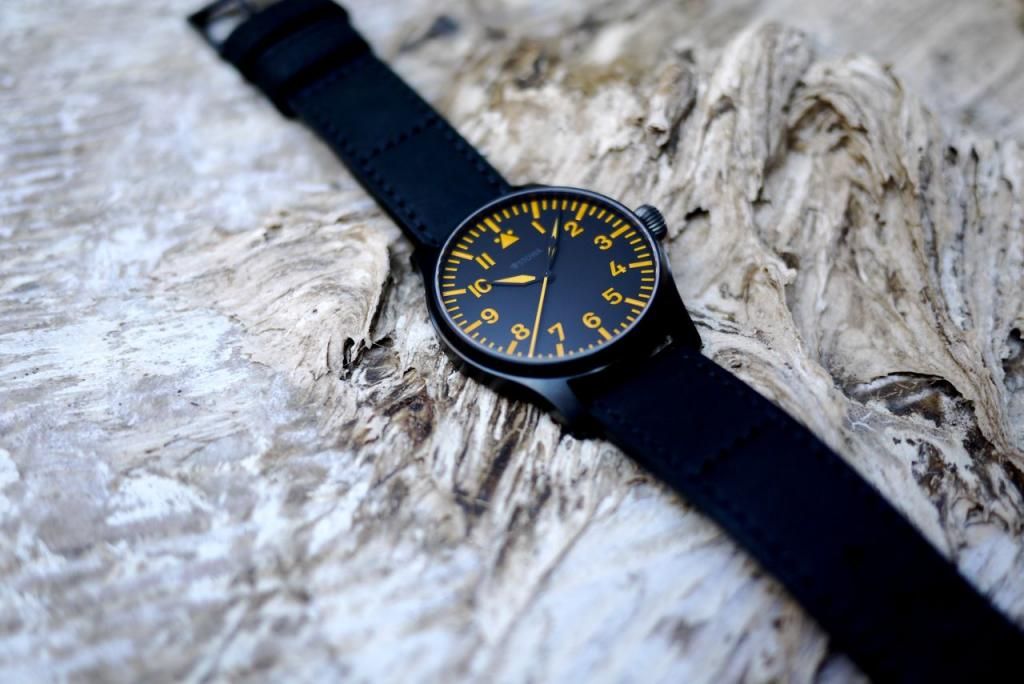
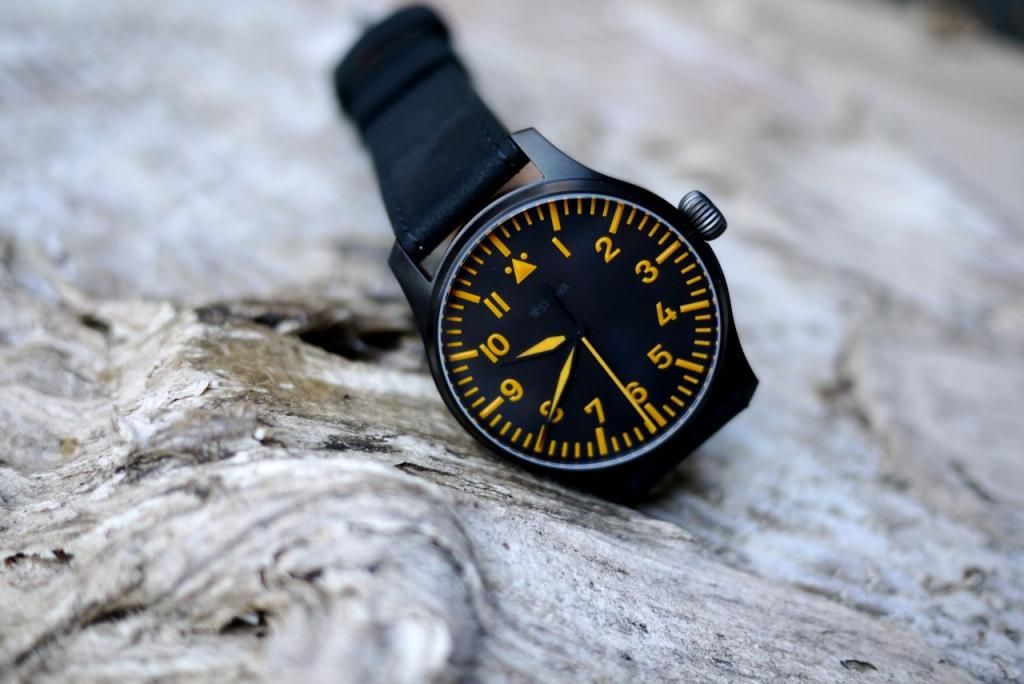
On The Wrist: Stowa Flieger Black Forest Edition 1 Australian Review

We love black watches
Oh, yes we do
We love black watches
And we will be true.

When the watch isn't black
We're blue.
Oh, Black watches we love you. **

End flash back to my high school musical days. (Yes I was in high school musicals. What? I enjoy the performance arts...chicks dig guys who can bust a move and hold a tune... Really...)


But there is SOMETHING about an all-black stealthy sinister looking matte black anything isn't there? Matte black cars turns heads. Matte black sneakers are always on trend. Coco Chanel also said something about the colour black. Black will always be the new black no matter what the advertising execs tries to tell you. 


Especially a black watch named after one of the most delicious black-themed desserts- the Black Forest cake. Stowa will tell you a different "official" story about some forest close to their home but we know the truth .

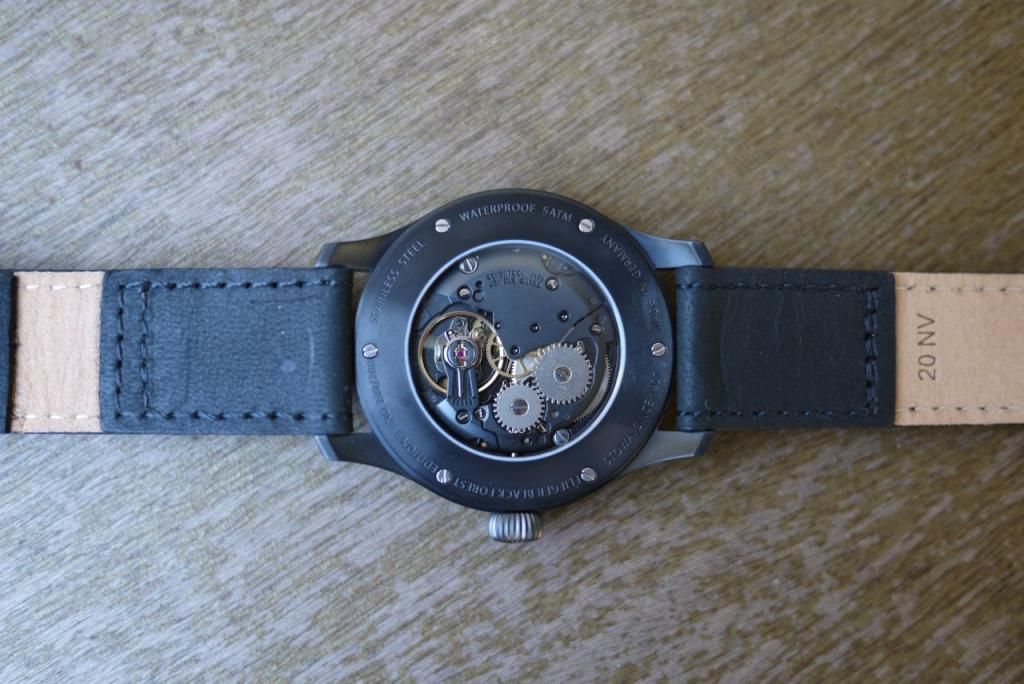
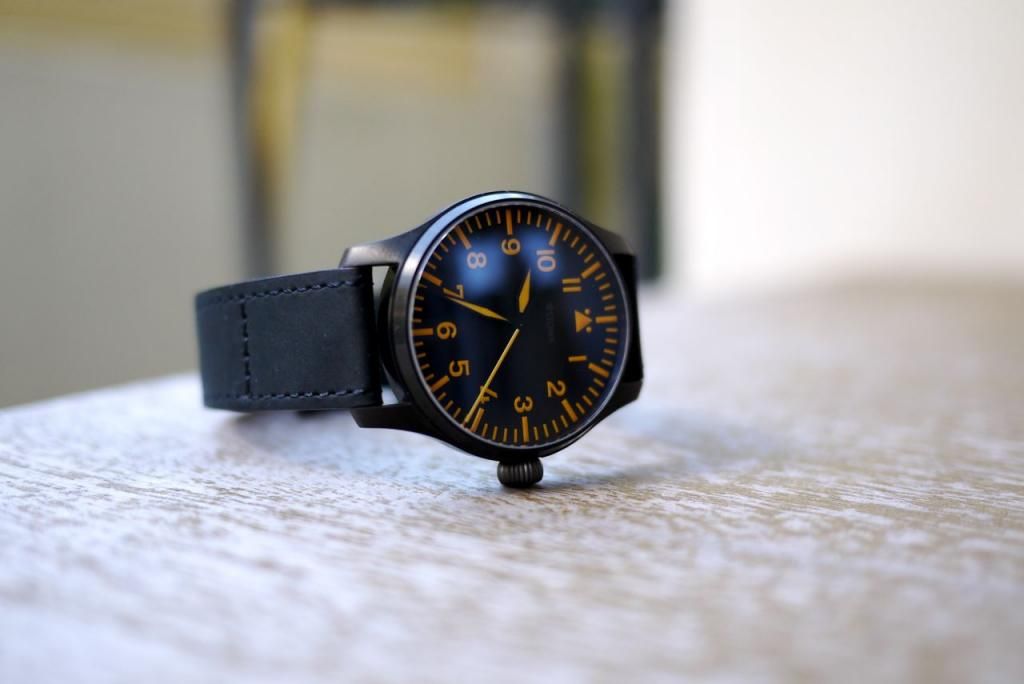
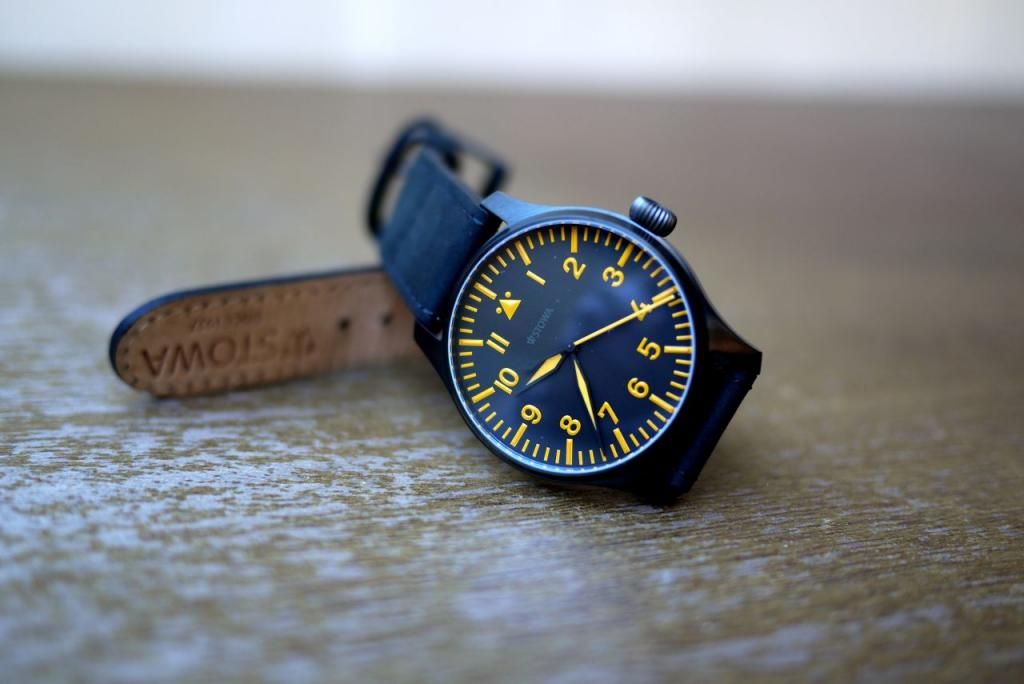
It's the first time a DLC coated watch is offered by Stowa (we talked about this process here) and it's a limited edition of only 200 pieces worldwide. It is based on an existing model but modernized and made "better" by being all black (with the movement given the same treatment) and a splash of bright orange to give it that extra pizzazz (and to make time telling easier). Tongue-in-cheek aside we really do like the black/orange colorway (to steal a sneaker term). 


Stowa watches are produced under the guidance of watchmaker Jorg Schauer, and the case work is flawless. Really. At this price point (around 800 Euro. less VAT if you're outside Europe) there is no better case. Shame I can't say the same about the movement. The original plan was to make the eta 2801-2, essentially a 2824 minus the rotor, to be fully black with bright orange branding on it, but technical difficulties put that idea to bed. Personally I felt that if an all-black movement wasn't going to happen, I'd much rather they covered it up and offered a special case back. 


Having said that, the movement minus rotor meant less height and I was pleasantly surprised at just how thin the whole watch is. Dress watch thin. Not stupidly thin like a Piaget Altiplano but thin enough for everyday wear. It won't intrude and won't present itself to being caught on door frames and cuffs. 


The dial is very clean, the logo is only really visible at certain angles under certain lighting. Everything you need to tell the time and nothing you don't. Like, oh I dunno... Say... a paragraph on the dial saying how officially accurate this watch is... The strap is thick, soft and comfortable. Nuff said. Overall the watch feels great, sits well on the wrist and it is very light.

I do feel that a classic pilot watch is a must in every collection. And because so many brands make this style of watches, you really are spoilt for choice at every price point. You could go authentic and buy one from the original manufactures of the pilot watch or if you're less picky, even fossil makes one. 


So what about this Stowa Black Forest? It's not my first pick for a pilot watch. I'd go for something more historically correct in terms of aesthetics (for example, below right). But as a second? Most definitely. Problem is that this Black Forest edition 1 IS a limited edition of only 200 pieces and they're all sold out. (I was lucky enough to see and review this piece, thanks to the generosity of its owner). This piece COULD be the only one in Australia. But luckily, Stowa makes a wide range of flieger watches and they're quite reasonably priced. You can see the range HERE.

Here's the Black Forest next to its OG cousin. Photo courtesy of the owner
**By the way I plagiarised and butchered the lyrics to "Bye Bye Birdie" at the beginning of the post.

Friday, December 6, 2013

Top 10 Best Swiss/German Mechanical/Automatic watches under $1000 UPDATE: 2013

It's been just over a year since our first top 10 Swiss/German mechanical/automatic watches under $1000 was published and the response was overwhelming! We had no idea so many people were interested in high quality mechanical watches under $1000 and that this figure seemed to have really struck a chord. So one year one, we have decided to come up with an updated list of our top 10 Swiss/German mechanical/automatic watches under $1000.

A number of things have changed. firstly, the AUD isn't where it used to be. This meant a couple of watches that were under are now over, so they were excluded. There were also a few watches that people felt weren't really properly Swiss or German, so this year, we have stricter rules and definitions. To be included in this year's list, the watch MUST have either "Swiss Made" or "Made In Germany" on the dial.

German watches again takes up 50% of the slots, but not only that, the watches are so well priced that you could almost buy 2 for $1000. Funnily enough all of the German watches runs Swiss movements! And on with the list:


Steinhart Le Mans GT Automatic - 412 Euro (excl. VAT)


For this year I have chosen Le Mans GT automatic, as it is another of their in-house designs. It's pretty darn obvious from the name and the style what they were going for in this watch. For the price you get an elaboree grade ETA2824-2 movement, and amazing dial detailing AND case detailing. (Spoke of the alloy wheel on the dial, case is the tyre, with tyre grooves on the side of the case and strap, and the case back is the disc brake!) Granted this watch isn't for everyone, but for a motor racing fan, I think it's a must have. You can buy direct from their website.

http://www.steinhartwatches.de/en/Le-Mans-GT-automatic,559.html


Stowa Ikarus - from 488 Euro (excl. VAT)


The Ikarus is a stunning looking watch drawing on pilot watch design cues, but with a matte finished grey dial (apparently from galvanisation) and a subtle date window at 6:00. The layout is classic and with a diametre at 40mm, also extremely wearable. The Stowa case quality is top notch (a step above Steinhart) and it is powered by ETA2824-2. You have the option of upgrading a number of items on the watch for extra dough, direct from their website.

http://www.stowa.de/


Archimede Pilot 42 Automatic - 399 euro (excl. VAT)


On the list for the second year running- their prices have gone up a little bit, but still extremely good value.

One thing Archimede is famous for is the watch case. Their cases are made by Ickler, (who also produces watches under several other brands) and you know when I said the case is good for Steinhart at the price? Well, Archimede watch cases take it to an entirely different plane. I'd rate them alongside many of the bigger 'prestige' brands. Which makes their pilot watch, a pinch at 399 euros, steal of the century.That is, of course, if you like pilot watches. They do have other models in the range, but I think their Pilot line is the most successful. And everyone needs a Pilot watch in their collection, right? It's a classic that'll never go out of style. If you can afford it, for an extra 20 euro, you get a sterile dial ie, no branding, and that gives it a very clean look. And like a decent German car, you can also spend lots optioning up the watch with such luxury items as curved sapphire, custom engraving, bracelet etc. This is also available direct from their website.

http://www.archimede-uhren.de/archimede-uhren-kollektion-pilot-deckwatch-klassik-taucher-outdoor-automatik-handaufzug-chronograph-2824-6498-7750/pilot-automatik-2824-handaufzug-6498-chronograph-7750-b-uhr-fliegeruhr/pilot-42-automatik-fliegeruhr-b-uhr-eta-2824.html


Defakto Akkord - from 420 euro


On the list for the 2nd year in a row, we still love the styling and the pricing.
Their watches are also made by Ickler, so you know the case quality is top notch. But the Defakto brand itself enploys very minimalistic, bauhaus inspired designs. Perfect for those who are sick of paragraphs printed on dials. The Akkord is more traditional with 2 hands, (but you can also get 1-handed watches for that extra minimalistic look) and powered by ETA 2824. Available direct from their website. Like their sister brand, Archimede, you can also choose your customisation for the watch for extra dough.

http://www.defakto-uhren.de/en/configurator/


Max Bill by Junghans Manual - USD853


The last German watch on the list, it's their first appearance on the Tart's top 10. The watch style is bauhaus minimalistic, and it is a small diametre watch (at 34mm). However, as the watch is all dial and no bezel, it does wear bigger and it's great for someone looking for a dressy, understated watch. The height of the watch is only 8.8mm, which is really quite thin and will easily fit under the cuffs. The watch is powered by ETA2801-2 (essentially a 2824 without the rotor) and available direct from the website.

http://www.maxbillwatches.com/junghans-bill-mechanical-027370000-p-10.html


Christopher Ward C5 Malvern Auto/C8 Pilot Mk II Vintage - 396 Pounds


Yes another variation on the pilot watch. What can I say? It's a classic design! Chris Ward is an English brand with watches made in Switzerland. Their watches aren't bad at all, and should be considered if you can get over the awkward branding. CHRWARD just looks awkward.... The watch is powered by Sellita SW200-1 (essentially a 2824 clone) meaning you're not likely to have any issues. A lot of the bigger brands are switching over teo Sellita as ETA slowly decreases supplies to brands outside the swatchgroup and Sellita takes over the slack. You can get them direct from their website

http://www.christopherward.co.uk/men/aviation/c8-svkt-mk2.html


Mondaine Automatic - 439 Pounds (Maybe VAT back...)


Mondaine are known for being the Swiss railway clock. The distinctive dial is highly legible and can be accurately read at a distance, thanks to its high contrast colours and simplicity. In 1986 this design was interpreted into the wristwatch form and they haven't looked back since. Most Mondaine watches are quartz, but they do have a small collection of automatic watches, aptly named "automatic". They come in 40mm case diametre and are powered by the Sellita S220-1 with day-date functions. See the watch here and maybe purchased here:

http://www.jurawatches.co.uk/collections/mondaine-watches/products/mondaine-automatic-day-date-a132-30348-11sbb-watch-md-103


The final 3 watches on the list are all part of the giant conglomerate the swatchgroup. Being big has its advantages- price advantages. They are able to offer extremely good value and the following are just the tip of the iceberg.


Hamilton Intra-Matic Auto 38mm USD870


To be honest, this watch just might have the best bang-for-your-bux at the under $1000 category. It is the only watch powered by the ETA 2892-A2 movement, and this is a much more "premium" movement compared to the ETWA 2824-2. Nothing wrong with the 2824. Mind you, it's probably one of the most reliable, but you generally don't see the 2892 fitted to watches under $1000. Keep in mind that the same basic movement is used in Omega as Calibre 1120, and was also used as a base for the very first versions of Omega's co-axial movement, the Calibre 2500. This Hamilton, although only 38mm in diametre, it wears much bigger thanks to its all-dial-and-no-bezel design. It really really is a shame that Hamilton isn't sold in Australia. I'm sure they'll do extremely well here.


Tissot Heritage Visodate from 2012 USD650


The Visodate is inspired by 50s Tissot watches of the same name and it really is a great modern interpretation of a classic. For those who must have both the day and the date on display, this is a great watch. Go with the white dial though. I can't stand the day/date disc being in different colours to the dial. Just can't. I also really like the ye-olde-style Tissot logo on the dial. Powered by the ETA 2836-2 (Basically day-date version of the ETA2824) you can't go wrong and it's a gorgeous classic looking watch. I'd take this one if you can't get your hands on the Hamilton.


Swatch Automatic - $220 (at your local friendly Swatch retailer/boutique)


There are plenty of Swatch Irony automatics you can choose from, and seriously? If you want something Swiss, automatic, and in steel, and don't have a big watch budget, this truly is the way to go. And yes, you can service these and yes, a great watchmaker will be able to regulate the watch to within COSC accuracy (ie -4 to +6 seconds a day), and yes, really for around $220 Aussie. I'll be honest, there won't be much (if at all) of those old-dude-in-a-white-lab-coat involved in the making of this watch, but really... I don't think that's a factor at this price point...

Hopefully this list have introduced you to some watches that might now be up for consideration, and it's actually really not that pricey to get into a proper Swiss/German mechanical watch. My picks of the bunch would be the Hamilton for dress watch and the Archimede for the sports watch. C'mon. You can't have just the one watch. Seriously. It just won't work. Same as you can't have just the one knife.
Monday, May 7, 2012

A look at a 1939 Longines Lindbergh


In March, I wrote about a rare Longines Wittnauer Second Setting watch. Thanks to a distinguished collector friend of JPVFX, we now have a follow-up post of an even more well known and rare Longines aeronatical beast - the Longines Hour Angle watch, known as the 'Longines Lindbergh'. 

Designed by Longines and Lindbergh based on the Weems design, this was a continuation of Longines’ relationship with pilots; the brand was the official supplier of time instruments to the International Aeronautical Federation (IAF) from 1919. 

The Lindbergh Hour Angle Watch was designed by Col. Charles A. Lindbergh as a navigational aid for pilots and was, in fact, used by renowned aviators such as Amelia Earhart and Amy Johnson. Used in conjunction with a sextant, nautical almanac and a radio to receive a time signal, it made allowed for the calculation of the ‘Greenwich hour angle’ i.e. longitude.

So, what is an ‘hour angle’? 

From the aviation point of view, it is the angular distance west of the Greenwich meridian. The earth’s full rotation is 360° – an hour, therefore, is an ‘hour angle’ of 15°. This means that a 60° hour angle, for example, equates to 4 hours with respect to the Greenwich meridian. 

Here are some pages from the Longines website about the modern ‘heritage’ version of the Hour Angle that they released a few years ago, with an explanation of its use. Click on each screenshot to get a larger image.


This stunning example dates from 1939. A 47mm sized steel case with an onion crown, the main dial is white enamel with black Roman numerals. The revolving bezel is silver inlaid with enamel nu, the 15 degree intervals as mentioned above are on a rotating bezel. The crown at 2 o’clock turns the inner dial, which is calibrated for 60 seconds and 15 degrees.


The Lindbergh and the Weems actually came out with two movements. 

Firstly, the Cal.18.69N, which allows the time to be pin set by pressing the pin down and then rotate the crown to set the time, whilst when you pull the crown out, it rotates the central disc to offset the time. 

Secondly, it also came with the Cal. 37.9, which has a small wheel under the crown. The wheel rotates the central disc and the time set in the traditional way by pulling out the crown.

Inside this Lindbergh is the Cal. 18.69N movement. This calibre was produced by Longines from 1895 onwards. It has a nickel-finished lever movement, 15 jewels, bimetallic compensation balance, and hinged stainless steel cuvette. Cal 18.69N allows the time to be pin set (you press the pin down and then rotate the crown to set the time) while when you pull the crown out, it rotates the central disc to offset the time.

This Lindbergh is in remarkable condition. The enamel dial and Breguet-styled blued hands are bright, the numerals clear, the bezel showing the fabulous patina of its age but with the numbers still clearly visible. As is the case with the Second Setting watch, it sits comfortably on the wrist in spite of its size.


As mentioned above, the Longines Heritage line, along with producing a homage to the Weems Second Setting, also resurrected the Lindbergh Hour Angle Watch with similar faithfulness to the original, but with the added bonus of a caseback that opens to reveal the L699 automatic movement. 

The brand’s Heritage watches are very well received and to my mind, their best models. In some ways it’s interesting that designs which hark back to their past are so well regarded, but then again, it just proves the old adage about good design (I’ll spare you the ‘time’ pun). 


[AP]

Friday, March 23, 2012

Casio and Royal Air Force collaborate for new G-Shock


In one of the more practical watch brand collaborations that we’ve heard for a while, Casio has been working with Britain's Royal Air Force on a new range designed for use in combat.

Formed in 1918, the RAF is one of the oldest air forces in the world. G-Shock approached them for input on the specifications for a watch that would actually be useful for a professional pilot. The RAF asked its pilots (helicopter, jet, air transport) about what they wanted in a watch, and after the (much shortened) final list had been compiled, the RAF met with Casio’s R&D team and came up with the final specs. Some items that the pilots wanted, such as a torch, were excluded from the eventual design.

There was one overriding request from the RAF – that the watch be discreet, with no metallic surfaces (including buckles) because of reflection, and in a shade of grey that would be between the two types of suits worn by their pilots.

The foundation of this G-Shock is the Casio 'Triple G Resist' technology : shock-resistant, vibration-resistant, and resistant to centrifugal gravity. Added to this is something called 'Smart Access', described as an analogue movement where each of the three hands are controlled by individual motors, allowing the face of the watch to display different types of information. Functionally, 'Smart Access' will be able to do nifty things like allow the watch to measure the temperature in the flight cabin, using the hour, minute and second hands as indicators.

It will be a dual time zone watch, with one of these zones Greenwich Mean Time (‘Zulu’ time to aviator types). The Zulu time will be via a single-touch display. There will also be a stop watch for recording flight times and, as someone has already pointed out on a forum, a bomb-timer…

The case of the watch will include a shock-resistant electronic crown and quick-lock rotary switch so they can’t be activated by random contact with hard surfaces. The hands on the watch are also longer than G-Shock’s normal ones, at their request.

Accuracy-wise, it’s all about atomic timekeeping from the signals of the six atomic clocks worldwide. If nothing else, this will chew up a lot of power; the RAF watch will be solar powered and have a rechargeable battery. 


Obviously, being a watch designed for such use, it’s considerably more low key than many of Casio’s G-Shock offerings, but for those who know where to look, there will be one obvious identifying mark - a carbon fibre resin keeper on the strap will be decorated with the RAF 'wings' logo.

Rather dramatically called the “Gravity Defier” (Ref: GW-A1000RAF-1AER), it is being released in a limited edition of 2000 and will be on sale from June 2012 for GBP500. A rather expensive G-Shock, but I reckon it’ll sell out.


[AP]

Thursday, March 8, 2012

The rare Longines-Wittnauer Second Setting watch


One of the reasons I take a camera along to our weekly GTGs is because I never know whether an unexpected visitor, or a new acquisition, might pop up. This watch was one of the former.

Firstly, a bit of history.

The relationship between Wittnauer and Longines goes back a long way. Up to the 1890s, all of the Longines watches had been brought into the U.S. and Canada through J. Eugene Robert & Co., NY., which was taken over by Roberts’ brother-in-law Albert Wittnauer in 1890. Thus, all Longines watches imported to North America during this tenure have ‘Wittnauer’ on the dial. In 1936, the Wittnauer family sold A.Wittnauer Co., and a re-organised arrangement with Longines lead to the creation of the Longines-Wittnauer Watch Co.

What eventually became a longstanding relationship with aviation began in 1907, when Wittnauer supplied a pair of watches to the Navy, which was testing its aviation capabilities. During WWI, Wittnauer supplied military wristwatches and navigational devices to American Expeditionary Forces and an aircraft clock to the forerunner of the U.S. Army Air Corps.

In 1927, Wittnauer and Longines collaborated with Captain Philip van Horn Weems, a pioneering aviator who taught navigation to Charles Lindberg. This lead to Weems registering a patent for a ‘Second Setting Watch’ in 1929. Seen by many to be the first pilot’s watch, the Second Setting watch was intended to complement on-board compasses, flight charts and chronometers.

During flights, navigational adjustments were necessary for time errors, as small deviations in the accuracy of time measurement could lead to errors in flight calculations (fuel consumption, position and time to destination). Pilots would listen to the minute by minute radio beeps (e.g. GMT) to accurately adjust the centre seconds dial. This would indicate the time error on their watch so they could do calculations more accurately.

To make these watch adjustments easier, Weems put in a movable inner dial, which adjusted the dial to the hand. The aviator would move the dial in accordance with the radio time signal, noting any deviations from Greenwich Mean Time.


Throughout its life, there have been numerous iterations of the Weems Second Setting watch, including later versions with a rotating seconds-register. The first series, the A3, was produced between 1929 – 1936, the second (A12) between 1936 – 1946, a series for the Japanese Imperial Navy between 1936 – 1946 (IJNAS), the A11 between 1938 – 1948, a 26mm version, the A12, for the period of 1936 – 1948, plus a couple of other variations.

This example is an early model. In sterling silver 47mm case (55mm lug to lug) with an onion crown, it has a double-hinged case back which, unfortunately, I couldn’t open.

Saturday, August 20, 2011

Panamera Flieger 47


Pilots’ watches, whether they be B-Uhr heritage fliegers from the ‘knowns’ or one of the plethora of small brands which you only hear about through word of mouth or on watch fora, are one of the constants in the watch world. There are more fads than you can shake the proverbial stick at, but there will always be a healthy interest in these watches.

One of the ‘unknowns’ that I’ve come across recently is a brand called 'Panamera'. Not the Porsche Panamera, though they have produced a line of watches of this name, but a brand that is actually made by a German brand called Haemmer, which was established in 2008. Under their own brand (they call themselves “the brand for oversized watches") they seem to produce watches very similar to those made by TW Steel and UBoat.


Panamera, in addition to being a bit cheaper than Haemmer, are actually more attractive watches to my mind, though they too are similar, design wise, to other brands/ models.

Meet the Panamera Flieger 47.

Monday, March 28, 2011

Stowa Flieger Chronograph - Baselworld 2011

Now for something more affordable and less well known. In fact, I'm a little selfish about Stowa. To me, it's like one of the best kept secrets of the watch industry. They have history, great designs, great cases powered by reliable and proven ETA movements. They produced a gem of a chronograph last year, and this year is no different.


This year's Flieger Chronograph


The release this year has apparently polarized opinions, but I like it. A lot. I think it's a great take on the pilot chronograph, and they've done something not done before. The chronograph has been pared back to the basics, and anything you don't really need is deleted. So what you're left with is 2 hands for the time, and 2 hands for the chronograph. The minute counter at the 3:00 position only records elapsed time to 30 minutes, which to most people is more than enough. For me? Not quite as I use the chronograph to time parking, but that's not a deal breaker. I also quite like that fact that, since there's no space for the numerals at 2, 3 and 4, they deleted them completely, rather than having partially "eaten".


For me it is a very balanced looking watch, but unfortunately, the reduction of a few hands and date wheel did not reduce the overall height of the watch. It is still quite tall at around 14mm. This is one of the downsides of using a Valjoux 7753 movement as it's a very tall movement.


Having said that, Stowa represents one of the best value for money brands. Considering what you get, (Brilliant German case, high grade reliable ETA movement, modified to suit their needs) it's a bargain. Their chronograph is priced from 1650 Euro, and that includes the relatively high VAT.

I am a big fan of pilot watches and I'll most certainly be adding this one to the list. However, there is another Stowa further up, and that's the chronograph they released last year - Clean, simple and elegant. Reminds me of the IWC Portuguese, at a fraction of the price...


Following are the specs for the Flieger Chronograph (Data taken from the Stowa Website) : 

Dimensions 
Diameter:   41.00 mm
Height:  14.70 mm
Strap width:  22 mm
Lug-to-Lug size:  50.20 mm
Waterproof:  up to 5 ATM 

Material
Case:  Stainless steel, fine matt, grinded by hand
Dial: black matt, white printed, Superluminova C3
Crystals:  Front sapphire crystal domed and sapphire display case back
Hands:  Temperature-blued steel, Superluminova C3
Strap:  Leather strap or metal bracelet
Crown: Onion Crown

Movement
Caliber:  Valjoux 7753
Mechanism:  automatic
Half vibrations: 28.000 A/H
Function:  hour, minutes, 30 minute recorder (stop function)
Power Reserve:  approximately 40 hours
Number of jewels:  25 synthetic rubies
Finish:  Geneve Stripes finish, blued screws, golden STOWA engraving


[O]

Saturday, October 16, 2010

Hands-on with the Aristo Sextant


This is the second in an occasional series about watches that one of us currently owns, or has owned. A Patek Philippe Complication Ref. 5054 was the first in this series.

The Aristo Flieger Sextant has its roots in a German sextant watch used by Wernher von Braun and his team at the Peenemünde rocket proving ground ("Heeresversuchsanstalt Peenemuende") in the early 1940s.

Wernher Magnus Maximilian Freiherr von Braun (23 March 1912 – 16 June 1977), was a German-American rocket scientist and engineer who was one of the leading figures in the development of rocket  technology in both Germany and the U.S. during and after WWII. 

A one-time member of the Nazi Party and a commissioned SS officer, von Braun would later be regarded as arguably the foremost rocket engineer of the 20th century for his work at NASA.  He was the central figure in Germany's pre-war rocket development programme, responsible for the design and production of the V-2 combat rocket first at Peenemünde and then Mittelwerk, after the British bombed Peenemünde in August 1943.

After the war, Braun and some of his team were taken to the U.S. as part of the then-secret Operation Paperclip.  Von Braun worked on the US Army intermediate range ballistic missle program before his group was assimilated by NASA, under which he served as director of the newly-formed Marshall Space Flight Center, and as the chief architect of the Saturn V launch vehicle, the booster rocket that propelled the Apollo II lunar mission. In 1975 he received the National Medal of Science.

Made by Lange & Söhne, the 22 of the watches were delivered to the Heeresversuchsanstalt in 1943 at a price of 360RM, as the equivalent of at least 2,000€.  As a point of comparison, the first VW Beetles sold for 990RM.


When viewing at the dial through a mirror sextant, Braun and his team used the watch to calculate the ballistic data for the rockets they developed.