Showing posts with label divers watches. Show all posts

Thursday, May 17, 2012

A look at a rare Fifty Fathoms


Are there sounds in the sea
Fifty Fathoms deep?

Sea Music : W. J. Turner  (1884 – 1946)


In 1952, the French government created an elite team within the Navy called the ‘Nageurs de combat’ (combat swimmers). Headed by Captain Bob Maloubier, the new team’s missions included underwater intelligence, sabotage operations and clandestine port attacks.

Underwater diving was still in its infancy at this point, so Maloubier and his team had to design their diving equipment from scratch. This took two years, and involved new diving suits, fins, goggles, and a watch. The team was equipped with diving watches, but Maloubier was not satisfied, so in conjunction with Lieutenant Claude Riffaud, he set about designing a better one. Their design was first submitted to Lip, whose ambivalence was summarised by their comment that his design was "a portable clock without any future".

The irony of this decision by Lip was not too far away.

Undeterred, Maloubier and Riffaud convinced Jehan-Jacques Fiechter at Blancpain, himself a keen diver, to produce the watch, which they named the ‘Fifty Fathoms’. A fathom is a unit of length used as a depth measurement in English-speaking countries, corresponding to a depth of 1.829 metres. Fifty Fathoms equates to 91.45 metres, the depth one can reach with traditional diving equipment. Jehan-Jacques was the nephew of Betty Fiechter who, with André Leal, had purchased Blancpain in June 1933. Betty had assisted in running Blancpain since 1915, and under the Fiechters, the Manufacture flourished.

The final Fifty Fathoms that went into production was not the exact design that Maloubier and Riffaud had presented, as Fiechter used his own diving experience to make some adaptations. These included a screw-down caseback with a double ‘O-ring’ system, and a humidity indicator at 6 o’clock (blue if the air in the case was dry, pink if water had penetrated the watch case).

Blancpain were unable to sell their watches directly to the French navy, and had to make their way to the Nageurs de combat via Spirotechnique, who were the official suppliers of scuba diving equipment to the French armed forces. Established in 1946, La Spirotechnique, which later became ‘Aqua Lung’, had its origins in 1942-43, when Jacques Yves Cousteau and engineer Emille Gagnan, who was working for L'air Liquide, a French company specialising in compressed gas, created the first scuba regulator. 

Now we come to the (amusingly) ironic part. At the time, Lip was a dominant player in the French watch market. Blancpain was an unknown. This meant that Blancpain and Lip had to sign a marketing and distribution deal to get an foothold in the French market. In 1954 the Fifty Fathoms watches were launched, with both Lip and Blancpain markings on the dial. One wonders whether there were any animated discussions at this time at Lip about opportunities lost. 


Within a decade of its launch, Blancpain's Fifty Fathoms had been adopted by a few specialist oceanographic exploration and research organisations. Most famously, Jacques Cousteau selected the Fifty Fathoms as the dive watch of choice for his 1956 Cannes Film Festival Palme d'Or winning ‘Le monde du silence’ (The Silent World). 
  
From the early 1950s through the 1970s, the Fifty Fathoms became popular amongst the military, and used by the armed forces of Israel, Germany, Sweden, Norway, Denmark, Poland, Finland and the U.S. When the Americans were looking for a dive watch, there was a ‘Buy American’ policy, whereby American manufacturers were given a 25% price advantage over non-American competitors. Fortunately for Blancpain, Allen Tornek, who had met Jehan-Jacques Fiechter through their common interest in diving, took an interest in helping out. To get around the various restrictions, the Tornek-Rayville company took the Fifty Fathoms and rebranded it for the U.S. military under two names “Blancpain Tornek” and “Rayville Tornek” (‘Rayville’, a phonetic anagram of Villeret, was the name used by Fiechter for some of Blancpain’s production). About 1000 Tornek-Rayville Fifty Fathoms were produced, most of which were destroyed by the Navy at the end of the commission, so they are particularly sought after nowadays. 


To understand the history of Fifty Fathoms is arguably a lifetime’s worth of work given the list of companies involved, the number of iterations (estimated at around 100) of design/ movements/ size, and the fact that there have been both military and civilian versions.

In late 2010 and through to 2011, Blancpain launched a travelling worldwide exhibition of the history of the Fifty Fathoms. Starting at their boutique at Place Vendôme, Paris, it was a Fifty Fathoms/ dive watch enthusiasts’ dream, an incredible exhibition over sixty watches retracing its history and a truly once-in-a-lifetime chance to see such a group together.

Mostly consisting of historical models owned by collectors but also covering the latest models, this beauty, belonging to a distinguished collector friend of JPVFX’s, formed part of this important exhibition.


A rare early Fifty Fathoms Rotomatic Incabloc from 1954-1955 (possibly pre-dating the Rolex Submariner), this watch is 41mm with a thickness of 12mm. In a stainless steel case with a screw down case back, it is anti-magnetic and has a bi-directional bezel. The dial is a glossy gilt, and the indices and baton hands are radium-coated. The movement is Cal A. Schild 1361N, rhodium-plated with 17 jewels, line lever escapement, monometallic balance, shock-absorber and self-compensating flat balance-spring.


Invented in 1934 and manufactured by Incabloc S.A., the Incabloc shock protection system is the trade name for a spring-loaded mounting system for the jewel bearings that support the balance wheel in a mechanical watch, to protect the wheel's delicate pivots from damage in the event of physical shock.

The early Fifty Fathoms watches are very difficult to find nowadays, and poor condition is often an issue. There is really something particularly amazing about vintage tool watches like this one that somehow, after over half a century, manage to still have a brightness and clarity to them.

I admit that I’ve wanted a vintage Fifty Fathoms for little while. I really wouldn’t mind this one … 


 Yes you read correctly - a note signed for the 50 Fathoms owner by Captain Bob Maloubier himself


Call me old fashioned, but I’ve never managed to get my head around rose gold Fifty Fathoms, tourbillon Fifty Fathoms etc etc etc. I understand the desire to develop and innovate models that have become synonymous with your brand, but when a watch was created as a proudly utilitarian dive watch, I can’t help but think that something is lost when it is turned into an unnecessarily elaborate timepiece.   


[AP]

Friday, March 9, 2012

Baselworld 2012 : Tudor Heritage Black Bay


Although we have some (vintage) Rolex devotees amongst us, we also have some Tudor fans, and with this year’s Baselworld 2012 offerings from the former, a few of us have already been muttering aloud about whether Tudor is more interesting than its older sibling. The Heritage Chrono (especially attractive on the NATO) features in at least one person’s collection, and the new 're-edition', the Heritage Black Bay (Ref. 79220R) has captured our attention.

Tudor was introduced by Rolex founder Hans Wilsdorf in March 1946, when he declared that he wished to make watches that could be sold at a lower price than Rolexes. With their own Oyster, Prince and Submariner models, for many years the brand was very closely identified with Rolex, including carrying the Rolex crown on the watch face, use of Rolex signed bracelets and crowns and even the Oyster case. Especially during the first couple of decades of the brand’s existence, people would say that if you’re buying a Tudor, you’re buying a Rolex. For example one of the most popular Tudor models has been the Submariner. Early models used a modified Fleurier 350 caliber, branded the Tudor 390 caliber. These are often mistaken as Rolex movements as they shared a similar rotor winding device. During the mid to late 1960’s Rolex switched ETA to supply the base movements for Tudors. By the 1990s, a stronger delineation was established between the two brands, so that Tudor wasn’t merely seen as the cheaper cousin of Rolex, though for many aficionados, Tudor has long held its own and been considered as bang for buck.

The new Tudor Heritage Black Bay is inspired by the brand’s vintage divers, whose history harks back to 1954, but modernised and resized to 41mm. The ‘snowflake’ reference relates to the distinctive shape of the hands, which were a feature of some 1970s models (e.g. 'Snowflake Submariner'), so it’s basically a 1950s Tudor with 1970s influences, sized for 2012 preferences and with added colour.


With the vintage-inspired domed crystal, black domed ‘gilt’ (gold-lettered) dial and lumed hour markers, this new model has a matte burgundy unidirectional bezel, a colour featuring in 1970s models. This burgundy is also picked up in the Tudor rose engraved crown.

Friday, December 9, 2011

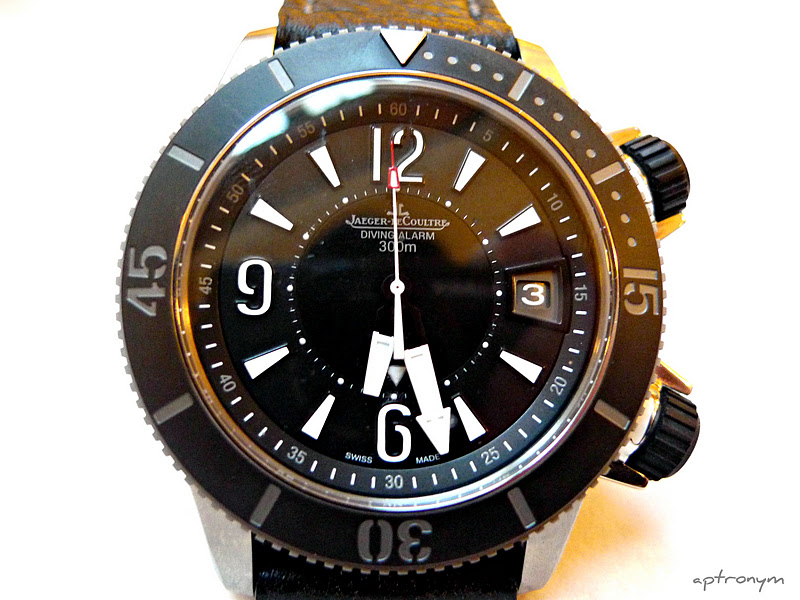
Jaeger-LeCoultre Master Compressor Diving Alarm Navy SEAL


In 1959, Jaeger-LeCoultre launched the Memovox Deep Sea, the first diving watch to be fitted with an alarm that would alert the diver when the oxygen level was low, so that the diver would know when it was necessary to go back to the surface. Approximately 1,000 of these were made between 1959 and 1962.

This historical relationship with the Navy SEALs was affirmed when, in 2008, a partnership was announced between the SEALs and Jaeger-LeCoultre, with the unveiling of the Master Compressor Diving Navy SEALs collection.

The Master Compressor Diving Alarm Navy SEALs was made in a total limited edition of 1,500. As well as the largest ‘quota’ of those in titanium such as this Ref. 183T470 that I was recently fortunate enough to see, there are other variants, namely two Beverly Hills boutique iterations, and 30 made for Spain. The Beverly Hills Incursion Editions consisted of 19 pieces in black titanium (with yellow) and 62 models in gray PVD titanium (with orange) - 1962, the year of the Navy SEALs’ creation.


Encased in grade 5 titanium, this timepiece has a fabulously textured micro-beaded ceramic bezel. The titanium/ ceramic combination really works for me. I find they flow well together, making the watch understated and almost stealthy. I don’t really understand the pink gold option for some of the Master Compressor Navy SEAL models. Why would you want a diving watch in pink gold? Obviously, JLC aren’t the only perpetrators of this bewildering metal/ watch-purpose combination, the pink gold Blancpain Fifty Fathoms models just do my head in.

Wednesday, August 24, 2011

Tech Talk No.2 : 316L vs 904L (Grades of Stainless Steel)


This second in the 'Tech Talk' series will also be about watch materials, in this case, stainless steel.

A good majority of watch companies use 316L grade stainless steel for their cases. But, one brand in particular, insists on using 904L. So what's the difference? 

First, the dry stuff…

316L - Grade 316 is the standard molybdenum-bearing grade. The molybdenum gives Grade 316 high corrosion resistant properties and particularly high resistance to pitting (a form of extremely localised corrosion that leads to the creation of small holes in the metal) and crevice corrosion in chloride environments. Grade 316L is the low carbon version of 316. There is not much price difference between 316 and 316L.

Grade

C
Mn
Si
P
S
Cr
Mo
Ni
N
316L
Min
-
-
-
-
-
16.0
2.00
10.0
-
Max
0.03
2.0
 0.75
0.045
0.03
18.0
3.00
14.0
0.10


904L - Grade 904L is a non-stabilised low carbon high alloy austenitic stainless steel. The addition of copper to this grade gives it greatly improved resistance to strong reducing acids, particularly sulphuric acid. It is also highly resistant to chloride attack - both pitting/ crevice corrosion and stress corrosion cracking. It is also non-magnetic in all conditions. Further, it contains substantial content of the high cost ingredients nickel and molybdenum. 

Grade
C
Mn
Si
P
S
Cr
Mo
Ni
Cu
904L
min.
max.
-
0.020
-
2.00
-
1.00
-
0.045
-
0.035
19.0
23.0
4.0
5.0
23.0
28.0
1.0
2.0


Now that the dry stuff's out of the way what is the main advantage of 904L over 316L? 

It's not a higher grade of steel, merely a "different" grade. All that extra chromium and nickel simply means that it has better resistance to corrosion and pitting than 316L and that it is a more heat treatable steel to harden, to be used in dies, punches, bending and blanking equipment. So in fact, 904L is a "tool steel" much like how Rolex were first made to be "tool watches". 904L steel is only more expensive because it is not as popular in general application as 316L. 


Nickel chunk (from Wikipedia)


Chromium crystal and 1cm3 cube (from Wikipedia)

So what about everyday wear as divers' watches? Well 316L is not actually designed for continuous submersion in sea water. But that's not to say it's not any good. It is still extremely resistant to corrosion, nearly impervious to atmospheric and other mild corrosive agents,  and it is more than adequate for things like boat railing and exposure to sea water spray.

So would this mean that if you really wanted to go diving, you'd strap a Rolex to your wrist? Unless you're planning to dive into sulfuric acid or sodium hydroxide, it won't make a lick of difference. Plus, the seals, the movement, and most importantly, your body, would've dissolved long before that.


Molybdenum in crystalline fragment and 1 cm3 cube (from Wikipedia)

Also, how many people that wear a diving watch actually go diving with it? I think the amount of sea water most of these diving watches see are in publicity shots and perhaps at events. Watchnerds don't jokingly refer to their watches as "desk divers" for nothing!

The Omega Seamaster Chronograph Divers watch uses 316L steel

You must also keep in mind that the increased amounts of nickel and chromium and whatnot that reduce the susceptibility to corrosion and pitting only occur at high temperatures (for example, boiling concentrated nitric acid), which is not very likely in an ocean anyway.

So, at the end of the day, as long as you rinse your watch off with fresh water after a dive, or, if your sweat happens to be particularly acidic, rinse the watch every so often, she'll be right mate.

However, the higher content of nickel in 904L may lead to an allergic reaction on some people. Something to think about… (edit- according to @L_Horloger most of the nickel in 904 is captive, and not free. There is more nickel able to react in the 316, so is worse for allergies)

The Rolex Submariner Divers watch uses 904L steel


To finish off, here’s a little comparison of different materials used on diver's watches and their resistance to pitting :

The unit of measurement is PRE (Pitting Resistance Equivalent) - obviously the higher the number the better.

32 PRE (or higher) is considered as salt water resistant.

316L has a value of 24 PRE
904L has a value of 35 PRE


[o]