Showing posts with label Limited Editions. Show all posts

Tuesday, September 16, 2014

On The Wrist: Stowa Flieger Black Forest Edition 1 Australian Review

We love black watches
Oh, yes we do
We love black watches
And we will be true.

When the watch isn't black
We're blue.
Oh, Black watches we love you. **

End flash back to my high school musical days. (Yes I was in high school musicals. What? I enjoy the performance arts...chicks dig guys who can bust a move and hold a tune... Really...)
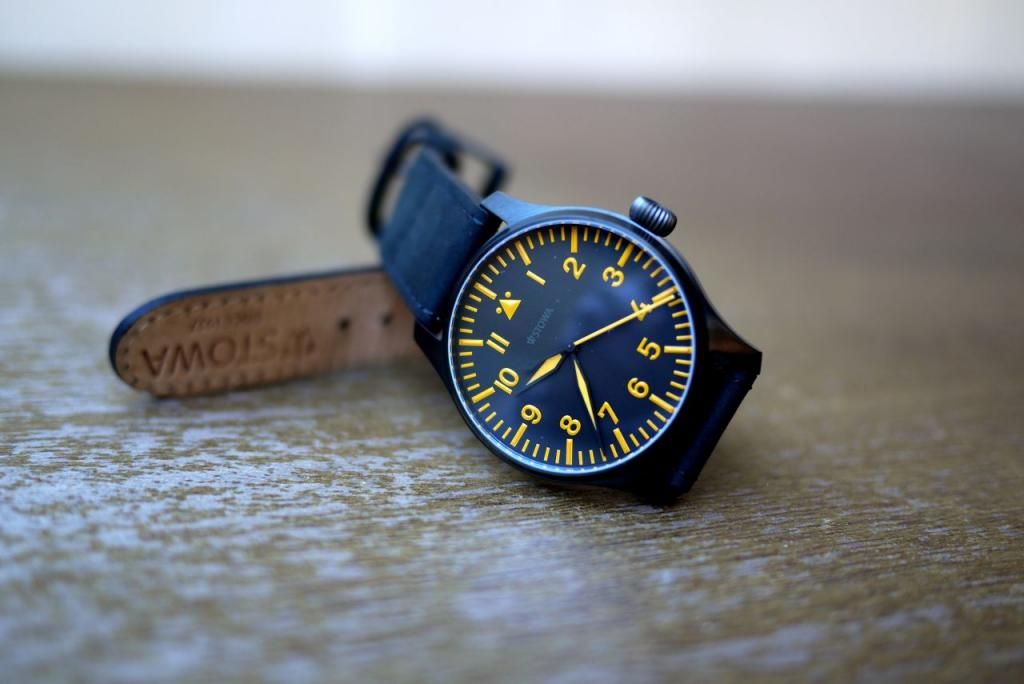


But there is SOMETHING about an all-black stealthy sinister looking matte black anything isn't there? Matte black cars turns heads. Matte black sneakers are always on trend. Coco Chanel also said something about the colour black. Black will always be the new black no matter what the advertising execs tries to tell you. 
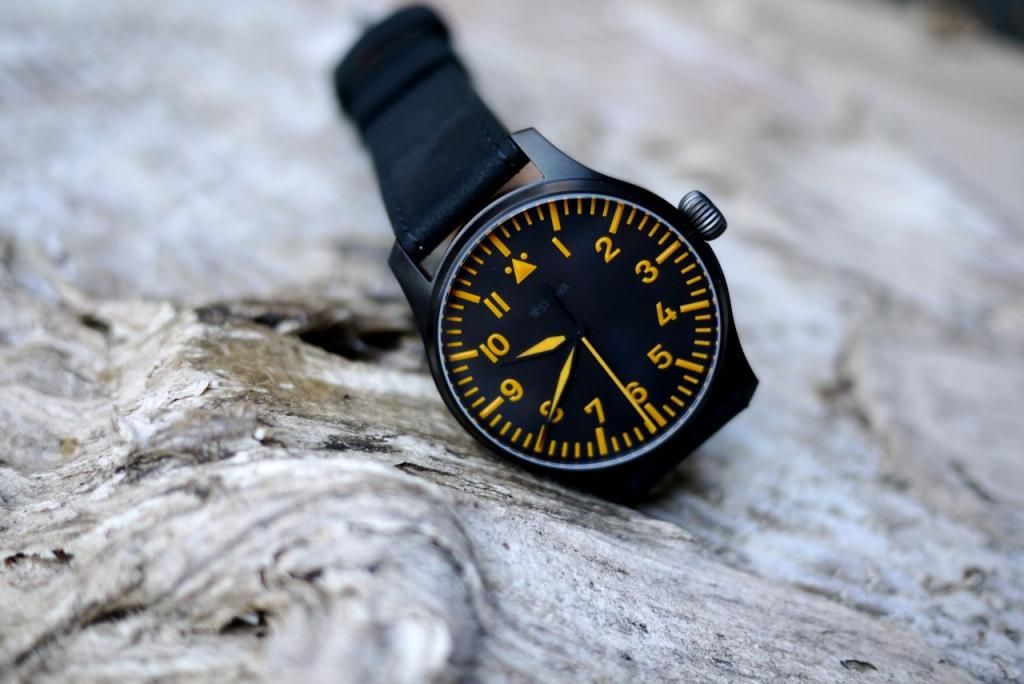


Especially a black watch named after one of the most delicious black-themed desserts- the Black Forest cake. Stowa will tell you a different "official" story about some forest close to their home but we know the truth .

It's the first time a DLC coated watch is offered by Stowa (we talked about this process here) and it's a limited edition of only 200 pieces worldwide. It is based on an existing model but modernized and made "better" by being all black (with the movement given the same treatment) and a splash of bright orange to give it that extra pizzazz (and to make time telling easier). Tongue-in-cheek aside we really do like the black/orange colorway (to steal a sneaker term). 
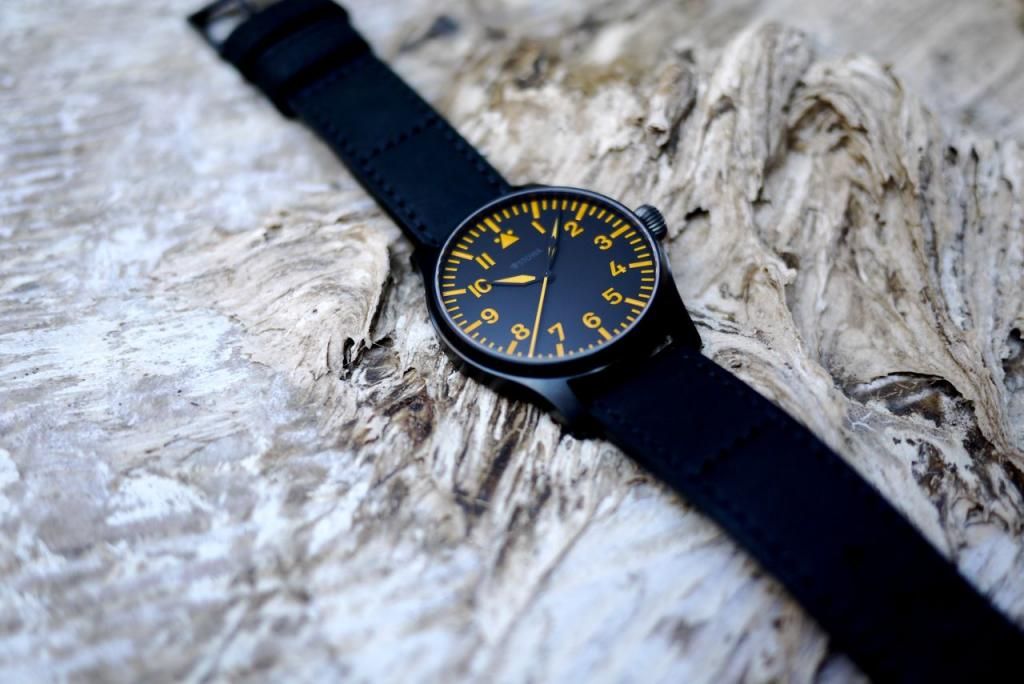


Stowa watches are produced under the guidance of watchmaker Jorg Schauer, and the case work is flawless. Really. At this price point (around 800 Euro. less VAT if you're outside Europe) there is no better case. Shame I can't say the same about the movement. The original plan was to make the eta 2801-2, essentially a 2824 minus the rotor, to be fully black with bright orange branding on it, but technical difficulties put that idea to bed. Personally I felt that if an all-black movement wasn't going to happen, I'd much rather they covered it up and offered a special case back. 
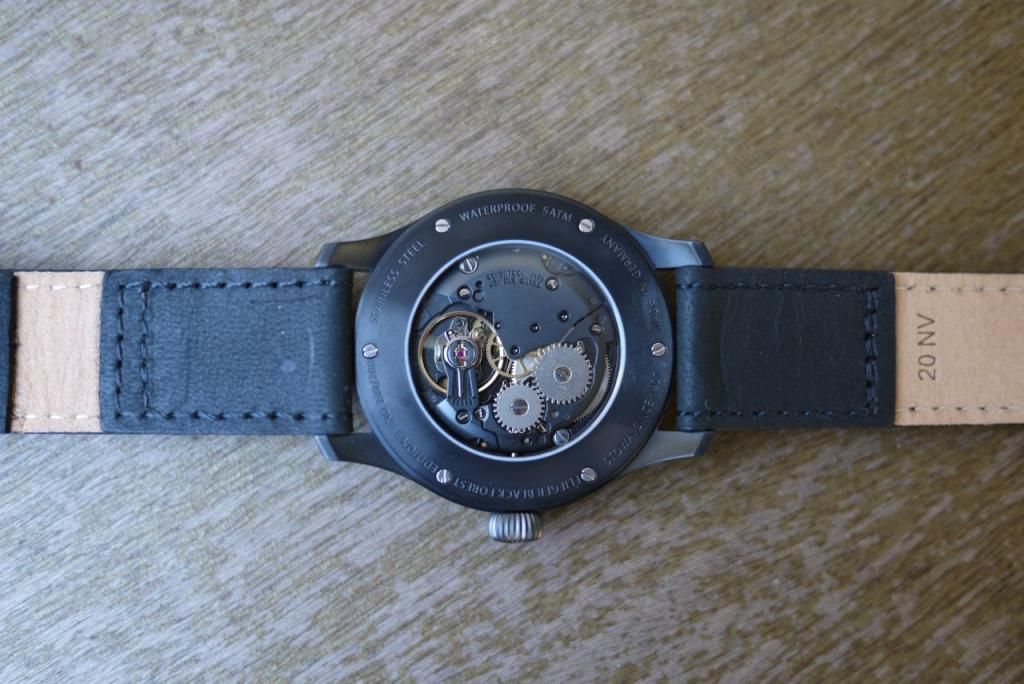


Having said that, the movement minus rotor meant less height and I was pleasantly surprised at just how thin the whole watch is. Dress watch thin. Not stupidly thin like a Piaget Altiplano but thin enough for everyday wear. It won't intrude and won't present itself to being caught on door frames and cuffs. 


The dial is very clean, the logo is only really visible at certain angles under certain lighting. Everything you need to tell the time and nothing you don't. Like, oh I dunno... Say... a paragraph on the dial saying how officially accurate this watch is... The strap is thick, soft and comfortable. Nuff said. Overall the watch feels great, sits well on the wrist and it is very light.

I do feel that a classic pilot watch is a must in every collection. And because so many brands make this style of watches, you really are spoilt for choice at every price point. You could go authentic and buy one from the original manufactures of the pilot watch or if you're less picky, even fossil makes one. 
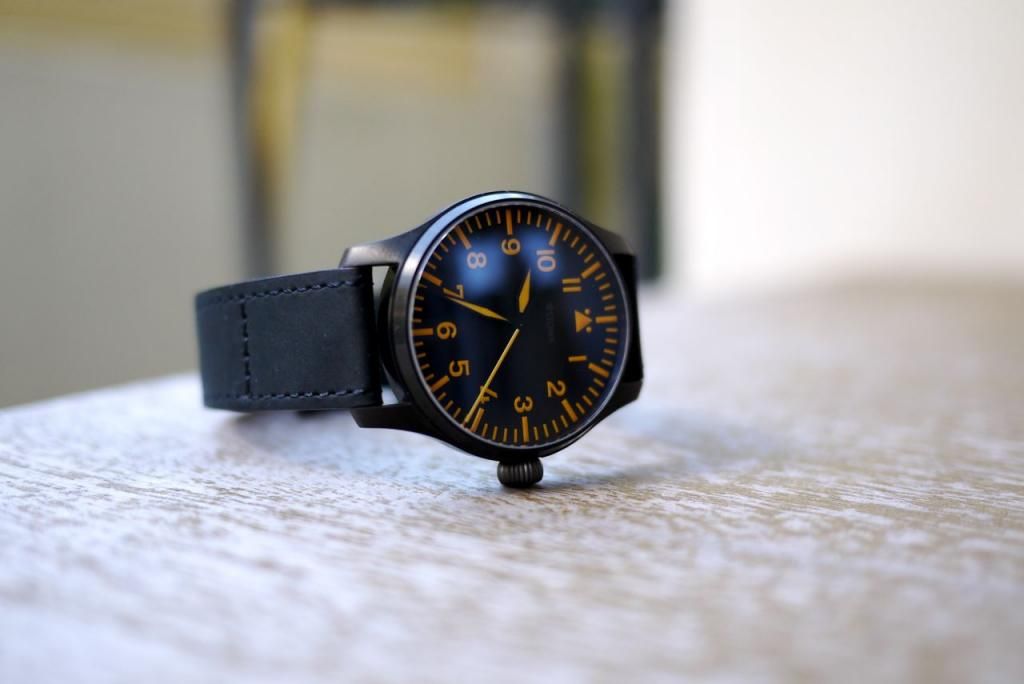


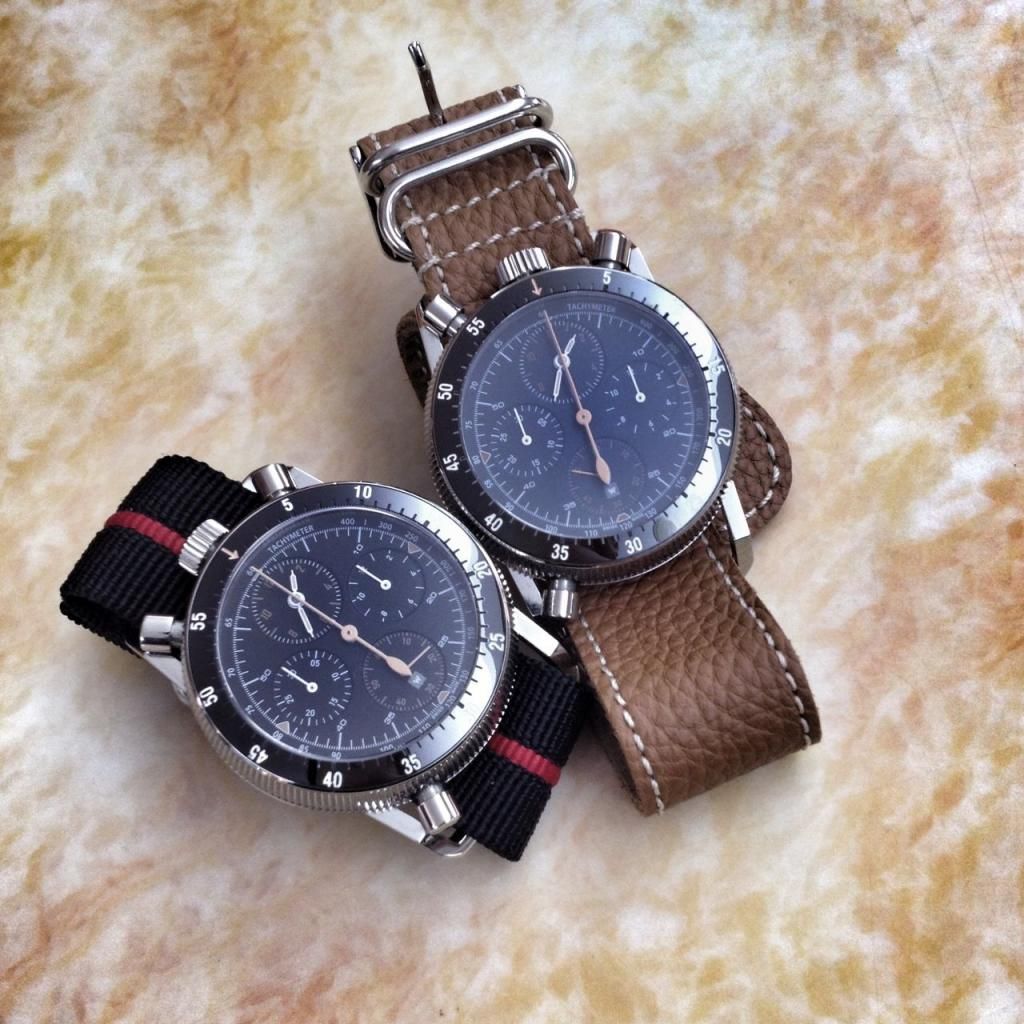
So what about this Stowa Black Forest? It's not my first pick for a pilot watch. I'd go for something more historically correct in terms of aesthetics (for example, below right). But as a second? Most definitely. Problem is that this Black Forest edition 1 IS a limited edition of only 200 pieces and they're all sold out. (I was lucky enough to see and review this piece, thanks to the generosity of its owner). This piece COULD be the only one in Australia. But luckily, Stowa makes a wide range of flieger watches and they're quite reasonably priced. You can see the range HERE.

Here's the Black Forest next to its OG cousin. Photo courtesy of the owner
**By the way I plagiarised and butchered the lyrics to "Bye Bye Birdie" at the beginning of the post.

Tuesday, September 2, 2014

Exclusive Australian First Look: TNT Challenger Rattrapante for watchuseek

Rattrapante. Split Second Chronograph. Double Chronograph. No matter which way you say it, practically speaking, it's a pretty useless complication to have on your mechanical watch. Tell me, when was the last time you need to time the difference in seconds (up to 60) of two separate things? I suppose you could use it to time 2 eggs. If you put them in the water at different times. But then again I'm not even sure how that would work.

The other way you'd use it, practically speaking, is you're timing laps. You use the split second function to stop it temporarily as you note down the time for the first lap, then let it catch up again and then repeat. So this will come in handy if you're watching formula one. Then again, maybe not.

But it is such a nice complication to have. To watch the two running chrono second hands going at different times, it's just so cool. Watching it catch up and the two hands runs again in sync. It's a lot of fun to watch. Much like staring at a tourbillon. Plus, rattrapante complication is quite rare. Rarer than tourbillons. And minute repeaters. And they're not easy to make either, so there's some bragging rights in that too. Somewhere.

Can you tell the difference between the black dial and the blue dial??

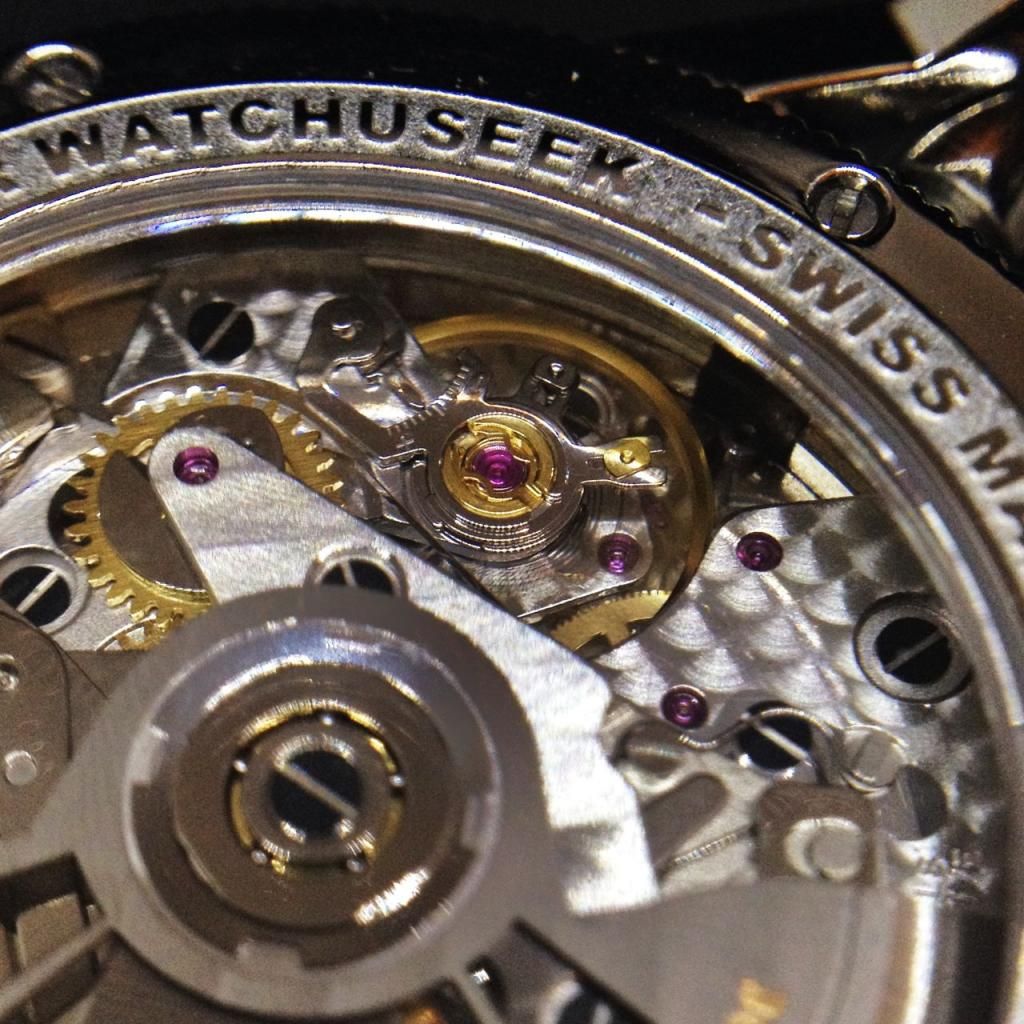
Which makes this watch all the more special. TNT, the company famous for being able to find obscure, long-forgotten movements, and put them into limited edition runs, produced this 75-piece series of rattranpante chronograph watches, exclusive for members of the forum watchuseek.com. The movement is based on the valjoux 7750, with the added rattrapante module and this movement is quite possibly the most popular to base the extra complications on, simply because it is so robust and reliable. Omega has done one with this movement, same with Rado (probably with the exact same movement). IWC also did one, again based on the Valjoux and I believe Chronowiss also had one. Just to name a few. And they're all priced quite high- from $5000k onwards.


I really don't know how TNT manages to track down these movements nor do I know how they can then get them all serviced, turned around with a case and dial and what not, and sold all for around 800 Euro. But I'm glad they did and I'm glad that watch enthusiasts in Australia managed to snag 2 out of the 75 examples (that we know of) and that I had a chance to get a really good look.

Reliable Valjoux 7750 movement with the rattrapante module

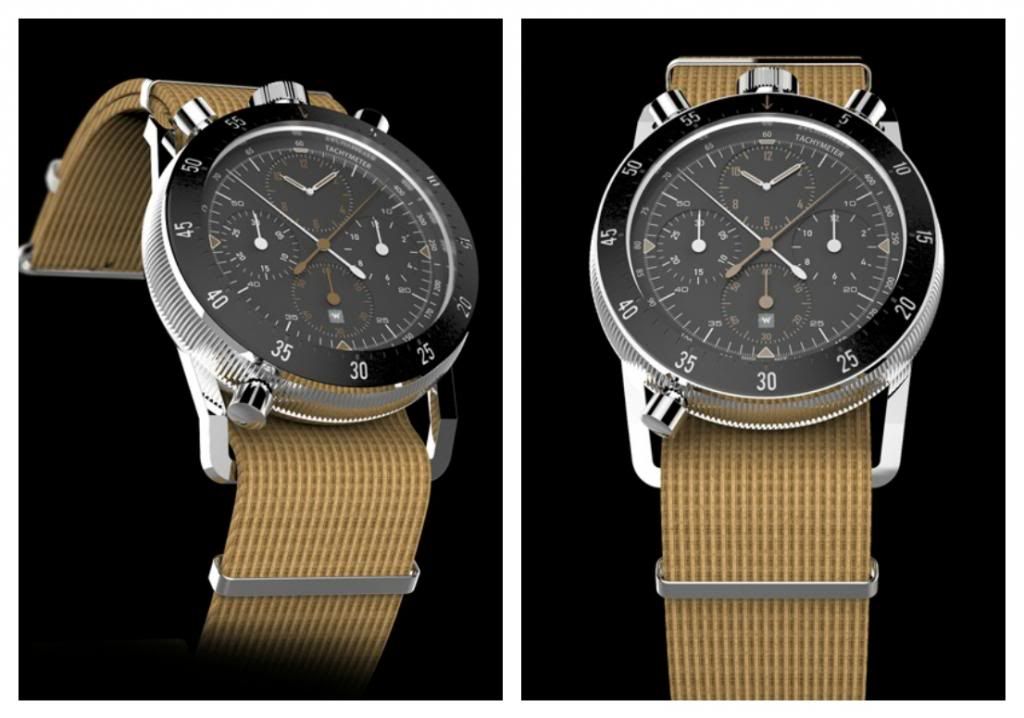
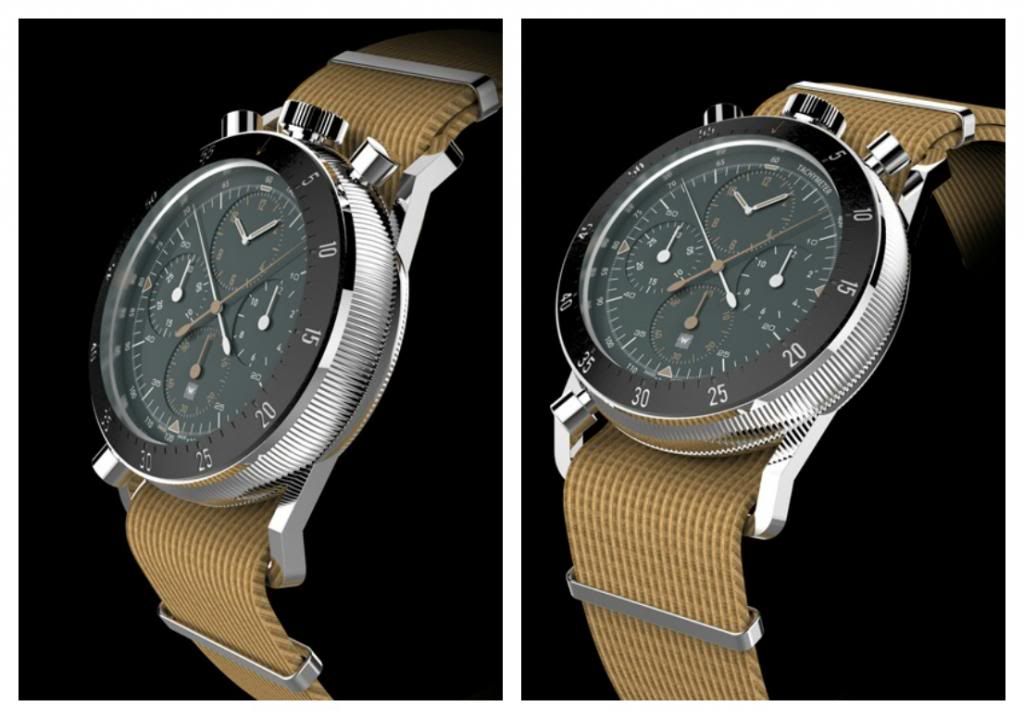
The coin-edge bull head case is shared with a few other models that TNT is producing, which is to be expected for economies of scale reasons, but the dial and function is exclusive to this watch. There is also zero TNT branding on the dial (with just a subtle watchuseek logo at 6:00 position). I'm not sure why they went for the bull head design. Yes, it's different, and you won't have pushers and crowns digging into the wrist, but with the configuration it has, the pushers are very close to the lugs, making the operation a little inconvenient. The pushers also travels a long way before engaging with the movement, which can annoy some people. It's also a little difficult to wind the crown or to set the time, again, due to its position. I suppose each person will find it different, and some might choose to live with the small inconveniences in order to have something quite unique.


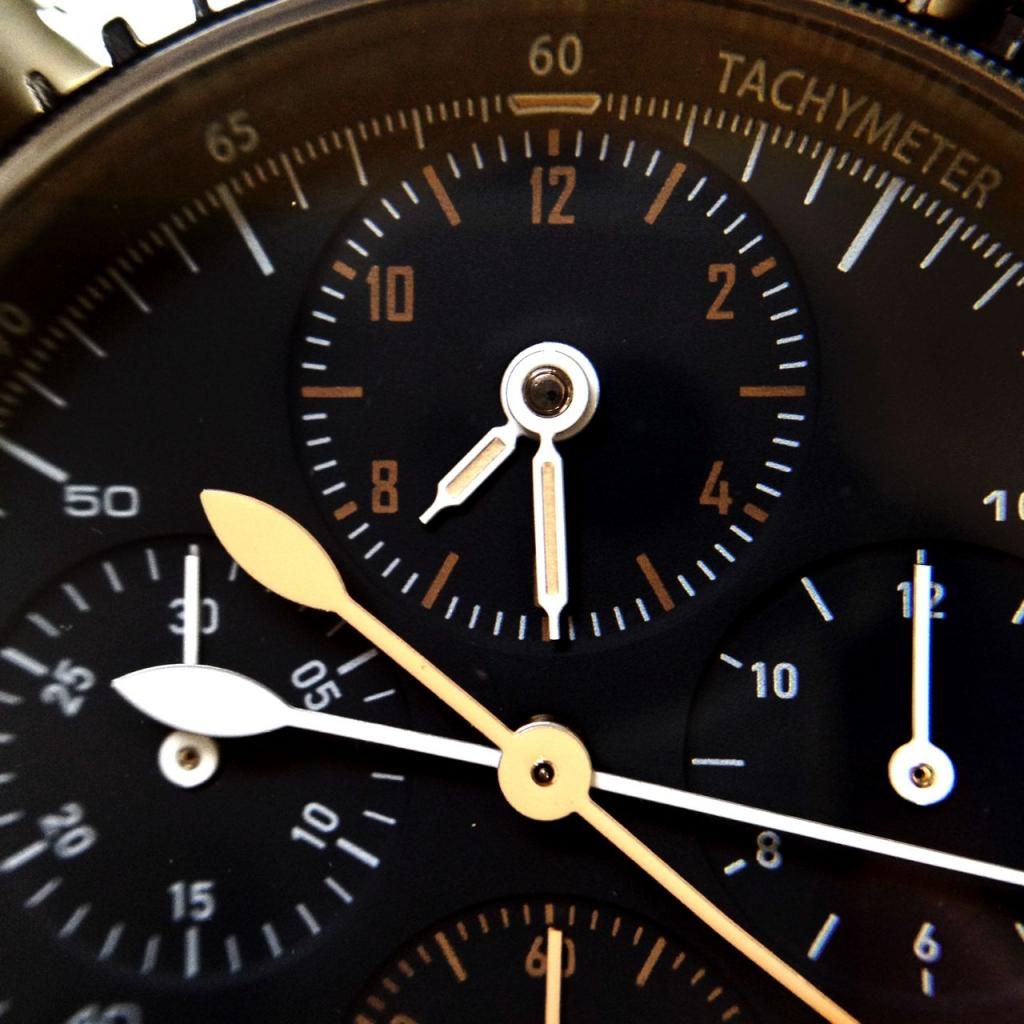
The dial is split into 4 smaller dials, one each for the chronograph functions and the time. Yes, the time is limited to the small dial at 12:00 and for those with less than perfect vision, telling the time might be a little strenuous. But it's not the only watch with a small dial for the time (I'm looking at YOU, Jacquet Droz) so this shouldn't detract from the watch as a while, and it does give a very balanced dial overall.

Small dial at 12:00 for the time

For the price, the quality and the finishing is excellent. Keep in mind that this is an 800 Euro watch so it needs to be compared like-for-like. It doesn't matter if the movement and complication is worth more than 800 Euro on its own. So, next to say, Tissot, Oris, or even Longines, the quality stacks up, but comes up short if you compare it to something a bit further up the food chain. Otherwise, you get sapphire crystal front and back, as well as a very nicely done ceramic bezel. The less said about the included NATO strap the better, but the optional leather strap is soft and supple.


I didn't get the chance to time it, but I'm sure accuracy won't be too bad. It is a 7750 after all, and any good watchmaker will be able to regulate it to chronometre specs. The watch although thick, wears very well on the wrist and it is very comfortable. I wouldn't pair it with a suit, but again that's up to you. Two dials are available but having seen the two side by side the difference isn't great. The black dial is not very black and the blueberry dial isn't very... blue. But who's to complain? It's a great looking watch, a fun complication and a very, very limited edition to boot. It's a great watch for not a lot of outlay and for the 75 people (or less - I believe some bought two) who has them, it's definitely a keeper.


Friday, September 13, 2013

Challenger Rattrapante for WatchUSeek Limited Edition by TNT

Who doesn't love limited editions? To be part of an exclusive little club, knowing that there are only x number of the item in the world. It is this desire that drives so many watch brands to continue releasing limited editions. However, the downside is that in order to keep production costs down on limited editions (even though customers are probably charged more due to the 'limited nature), more often than not limited editions are nothing more than a change of dial, colour, hands, etc. Perhaps even as little as extra text of the dial, or even just an additional engraving. I'm not going to start pointing fingers and name names but this practice is quite prevalent, especially in the *ahem* high end of the market.

Then there's limited edition that's, well not really limited. 10,000 pieces is by no means limited.

So, how's a pleb like me going to get my hands on limited edition watches that are actually limited? The answer is quite simple, really.

For starters, avoid big name brands. There are plenty of boutique brands who does very limited runs, and are more often than not very reasonably priced. Then there are forum watches where a particular watch forum will enlist the help of a boutique brand to produce a watch collectively designed by forum members, often based on an existing case/movement combo. And of course, there's also the method where a brand can utilise the watch forum was a distribution/marketing/sales channel, offering a certain model only to the members of the forum. More often than not, the production runs of these watches tend to be quite low. Low 3 digits low. Sometimes even only in double digits.


All this talk about limited edition is leading somewhere, and in case you haven't gauged from the erm, title, this is about the Challenger WatchUSeek Edition Rattrapante by TNT. I won't bore you with the details, but suffice to say that given the complications, the low production numbers (75 pieces) and the relatively low price, this might just be the watch bargain of the year. There is an interesting back story to this project, the beginnings of which stemmed from Torsten Nagengast, who has a knack of finding special movements lying around and then proceeding to case them up and sell them in limited runs (depending on how many movement he finds). He has produced numerous watch projects under various guises and this is one of his latest.

These movements were originally produced for a Russian watch brand (since folded) and he picked them up for a song. All the movements needed were a couple of parts which he was able to source from AROLA Alfred Rochat & Fils (the people that made the rattrapante module) and voila, you have a bunch of interesting working movements (we assume) that just need an interesting case design to really showcase the complication. And I think this particular case design, (bull head chrono with coin edge sides, fixed lugs to fit NATO style straps) is a winner. Sure, the design is not to everyone's liking. There's no date window, the main time display is shown on a subdial, fixed lugs so you can only fit NATO style straps, etc etc. But in reality, where else are you going to find such a distinctive and interesting watch for this kind of money for this limited number of pieces?


This watch is called the "Challenger" for a good reason. Torsten released a time only "Challenger" watch a few months prior, featuring the same case design with the crown at 12:00 and fixed lugs and limited to 99 pieces. So the Challenger rattrapante belongs to the same family line, and perhaps, if successful, we might see a further line extension sometime in the future?


I for one am quite eager to see this project to fruition and I have on very good authority that at least two pieces will be heading down under, both to Sydney (maybe more. We'll find out). And of course, when that does happen we'll bring you an in-depth review of the watch. Let's hope everything goes smoothly and they can start delivering at their anticipated date of around January to February 2014.

Sunday, May 20, 2012

Christiaan van der Klaauw Aquarius Planetarium


In an extravagant and bold segue from his Planetarium watch, touted as the world’s smallest functioning planetarium, Dutch watchmaker Christiaan Van Der Klaauw has combined with master-engraver Kees Engelbarts for a mashup of astrology with astronomy, resulting in the first of twelve pièce unique, the Aquarius Planetarium.

Based on the Planetarium, but really not resembling it at all, the Aquarius’ dial is dominated by an amazingly intricate depiction of this astrological sign in white gold. At 12 o’clock is the well-known planetarium, showing the cycles around the sun of the revolving Mercury, Venus, Earth, Mars, Jupiter and Saturn.

On the outer most ring of the planetarium are the astrological positions marked in black on a metallic finish base. At 5 o’clock is a matte finished sub dial identifying the month and the position of the sun. The time (hours, minutes, seconds) hands are carry on the matte theme, which means that they blend somewhat into the engraving work.


The 40mm platinum case has an open case back which reveals the 18k rotor hand-engraved by Jochen Benzinger. Each of the watches in the series will use the automatic CK1196 calibre movement with a built in planetarium module.

In total, there will be twelve of these timepieces, one for each zodiac sign. They come at a hefty €79,500 each (including taxes, if that makes a difference for you), and the remaining eleven will be made to order.  Will all twelve be ordered? It wouldn’t surprise me if they were.

Oh, and if you’re wondering about the price of the ‘regular’ Planetarium, the current list price for the KPT1126 model is € 31.500.


[AP]

Thursday, May 10, 2012

Just because ... a Grande Sonnerie


What is a Grande Sonnerie? 

It means ‘grand strike’ in French, and is a complication in a mechanical watch or clock which combines a passing quarter striking mechanism with a repeater. That is, on the quarter-hour it strikes the number of hours audibly on a gong, and then the number of quarter-hours since the hour on a second gong. The hour and quarter strikes can also be activated on demand at the push of a button. The hours and quarters chime 'en passant', or as they pass. In contrast, a petite sonnerie strikes the hours and quarters in passing without repeating the hours at each quarter.


This is a Grande et Petite Sonnerie from Audemars Piguet’s Jules Audemars line. An almost old-fashioned 39mm in size, it’s a lovely warm rose gold and one of a limited edition of 50 watches. This watch was part of the first series of Grande Sonneries made by Audemars Piguet in 1995. The rose gold case is 39mm, polished and brushed, with the slide at 2 for the Grand Sonnerie, Petit Sonnerie or silent functions, and a push-button at 10. The Cal. 2868 has 51 jewels, straight line level escapement, shock absorber, self-compensating flat balance-spring,and Côtes de Genève. The sonnerie strikes are via two polished steel hammers onto two gongs. 

Stunning. 


 [AP]

Wednesday, April 25, 2012

Jaeger-LeCoultre's Duomètre à Quantième Lunaire LE


Sometimes, you don’t realise that there’s a beautiful watch that you’ve read about floating tantalisingly nearby. Then someone offers you the chance to take a look at it.

Firstly, what are the ‘Duomètre’ watches?

Introduced in 2007, the basic idea is to separate the normal time keeping function of the watch (hours, minutes, and seconds) from the other function, hence ‘duo’. Traditionally, in a watch with a complication the latter makes the watch’s rate deviate upon its activation e.g. a chronograph as it is switched on, a repeater as it rings, or even a calendar function ticking over. The functions share a common power source - the activation of the complication will lead a reduction in the time function of the watch, due to the use of power, and affect accuracy.


To bypass this, JLC’s Duomètre models feature two independent watch mechanisms within one calibre: one spring barrel for the time function, and another for the operation of the complication. In the case of this Duomètre à Quantième Lunaire, these two are the time, and a moon phase function. Each ‘wing’ of the movement has its own barrel with a power reserve of 50 hours.

Tuesday, April 10, 2012

Bovet celebrates its 190th anniversary with ...


Non horological items produced by watch brands, although still the exception, is not new. Jewellery, cufflinks, pens, mobile phones...Although not the first (that goes to Omega, for the Aqua Terra eau de toilette), Bovet has released a perfume for women to celebrate the brand’s 190th anniversary. To their credit, they do try to draw on the brand’s origins in Fleurier, which is in an area also known as the valley of a thousand flowers, by making it a very floral fragrance.

The perfume will be sold in a limited edition of 190 (of course) handcrafted glass 60 mil or 2-ounce, bottles, as well as a smaller flask of 30 mil, designed in a shape reminiscent of Bovet’s early pocket watches. Each bottle has been individually blown by a Swiss master glass blower and the neck of each bottle has a 0.25 mm gold thread, of which an astonishing five metres are required to complete a single bottle.


The fragrance world has its own terms for the components of each of the elements of each notes, so I’ll let their official description speak for itself :

Top notes:
blackcurrant buds, spirit of magnolia, soul of cassie, veil of Parma violets

Middle (heart) notes:
Moroccan Rose petals, Turkish rose pearls, cream of Iris from Florence, aura of ylang ylang, smiles of Sambac jasmine, rosewood bark

Background notes:
Amber stones, Madagascan vanilla pods.


[AP]

Friday, March 30, 2012

A design 'Victory' for Bremont


Ever had the problem of having so many hands all bunched in the centre of the dial that you're just not sure how and where to place all the numbers?

This is how you do it:


Bremont Victory

and this is… well… I'll let you make up your mind.

Longines Master Collection Retrograde


Needless to say- kudos to Bremont - they've managed a clean dial with so many hands...

Call me old fashioned, but I prefer my dress watches to have a clean dial....

So what is the new Bremont Victory? Well it's the culmination of the brand's collaboration with the National Museum of the Royal Navy (Portsmouth) to create a limited edition watch with original parts of HMS Victory built into it.

HMS Victory is the only remaining 18th Century ship worldwide, and the oldest serving warship still to be in commission, with her own Captain, offices and crew. Laid down in 1759 and launched in 1765, she is most famously known as Lord Nelson's flagship at the Battle of Trafalgar in 1805. In 1922 she was moved to a dry dock at Portsmouth and preserved as a museum ship. She continues to be flagship of the Second Sea Lord and is the oldest naval ship still in commission.

This rather special watch is limited to just 250 pieces and you can pre-order one now from The Watch Gallery or Jura Watches, with delivery expected in November 2012.

If you're wondering about the 'why' of this partnership, I'll let Giles English's words explain - "Nelson went to my school and as a boy he always fascinated me, I remember clearly the first time I visited HMS Victory. Over the last few years both Nick and myself have been working with the Royal Navy Fleet air arm Heritage and that’s when we heard about the restoration of HMS Victory. With no hesitation we approached the Navy and discussed the possibility of creating a watch using original parts from the ship. Not only did we want to make the watch unique but we also want it to be a horological masterpiece."

Oh, and there will be a launch party on board HMS Victory in July 2012, to which customers with pre-orders will be invited to attend.


[o]

Wednesday, March 14, 2012

Baselworld 2012 : Longines 180th anniversary 'red 12' monopusher


As part of Longines’ commemorative models for its 180th anniversary, they have gone all ‘heritage’. One of these anniversary watches is the “Column-Wheel Single Push-Piece Chronograph”, perhaps more simply known as a monopusher chronograph. Based on the early wire-lugged watches, and appropriately in rose gold, this watch will be limited to 180 pieces.

Replicating a classic look of the old officers watches with a white dial, black Arabic numbers, a red ‘12’ and blued steel hands, but with a date aperture as well, this almost old-fashioned watch will not appeal to everyone, but particularly for those who have a soft spot for the old red 12s, it’s an unexpected and attractive model from Longines. I would have been happy to have had a date-free version, and perhaps, especially given that it is a special model for the brand, an enamel dial might have been worth considering. The 'blue' of the hands is a bit difficult to nail down exactly, the tones seem to be slightly different in each of these photos.


TECHNICAL SPECIFICATIONS

Reference number : L2.774.8.23.x
Functions : hours, minutes, seconds, date
Movement : Automatic Cal. L788.2 (ETA A08.261) with single push-piece and column-wheel chronograph mechanism. 13¼ lines
Jewels : 27
VPH : 28,800
Power reserve: 54 hours
Case : rose gold, 40 mm. Single push-piece integrated into the crown. Transparent sapphire case back
Dial White, black Arabic numerals and a red “12”
Water resistance : 3 bar (30m)
Strap: brown alligator


Amongst the ‘Tarts’ there are two members who own a number of vintage red 12s. It’s a thumbs up from them, though an enamel dial would have been even better and, as one person has suggested, perhaps if the finishing of the hands was a little less flat, it would have given the watch a bit more depth.


[AP]

Sunday, February 26, 2012

Telescopic hands - Parmigiani's Toric Ovale


You have probably noticed that I am rather taken by ‘alternative’ methods of time display; jump hours, mystery hands, rotating satellites, the use of liquid...well here’s another watch that has captured my attention for a time-telling difference. It's a two-hander, but a quirky one.

The Musée d'Horlogerie du Locle is located in a small historic country manor house called Château des Monts, about 1km north of the centre of Le Locle, in the canton of Neuchâtel. Open to the public, as well as a general collection of historical timepieces and movements, the museum’s collection also holds three specific collections :

1. Collection Maurice Yves Sandoz – which includes 18th and 19th century Swiss automatons.
2. Collection Henri Jeanmaire – with its focus on marquetry clock cases made by Charles André Boulle during the period of Louis XIV.
3. Collection Alfred Huguenin - focusing on the history of the Neuchâtel style pendule.

One of the pocket-watches that forms part of the Sandoz collection is a circa 1800 oval piece by British watchmakers Vardon & Stedmann. It features telescoping hands which expand and contract to follow the shape of the case, the hands driven by a cam hidden above the centre pinion.

The Sandoz family own Parmigiani Fleurier, and have decided to create a modern iteration of this piece, called the "Toric Ovale with Telescopic Hands". Limited to 30 pieces in white gold and 30 in rose gold, the flame-blued telescopic hands (identical to the original) get longer and shorter as they move around the oval dial, retracting as they approach 3 and 9 o’clock, expanding at 12 and 6 o’clock, and remaining equidistant from the bezel at all times. The use of only four Arabic numerals highlights the pared back look of the dial, with the numbers, markers and power reserve all matching the blued hands.


The dial itself, with a date and eight day power reserve, is an exercise in symmetrically balanced simplicity. The Grand Feu enamel and blued-hands combination is a classic elegant combination that I am drawn to.

Friday, February 3, 2012

Les Univers Infinis - Vacheron Constantin


Vacheron’s "Les Univers Infinis" is their latest Métiers d’Art collection, which highlights the artisanal crafts of enamelling, engraving, Escher influenced tessellation and guilloché. There’s something to be said about watches with a sense of whimsy rather than ultra complications, watches that remind us of art forms that, if we don’t support them, could die out.

The 2012 collection consists of three watches, each produced in a limited edition of twenty : Dove, Fish and Shell.

Each of the watches is 18K white gold, 40mm, contains Vacheron’s automatic Caliber 2460 SC which can be seen through an open case back, has 3 bar water resistance, and is individually numbered.


DOVE WATCH

 Ref. 86222/000G-9774

The dial of the Dove watch features 38 doves in flight, captured by engravers, Grand Feu champlevé enamelling and guilloché work. 'Champlever' refers to how an image is carved out before the enameller fills the cavities. Champlevé is distinguished from cloisonné enameling, in which the images/ spaces are created by soldering flat metal strips to the surface of the object.


For the Dove, the enameller completes the dial by applying a translucent enamel coating to the violet birds and opalescent enamel to the white ones. Once the enamelling is complete, the gemsetter inserts diamonds into one of the doves. Finally, the guillocheur, finishes it off.


FISH WATCH


Ref. 86222/000G-9689

A shoal of fish created by guilloché work and grand feu cloisonné enamelling commences with cutting the fish and engraving their eyes. The guillocheur then creates tenth-of-a-millimetre symmetrical motifs, curves are added, and the fish covered with scales. The enameller marks out the outline of the fish using a very fine gold wire to separate the various colours. The enamel is placed in each fish and it is then fired in an oven several times, after which the wires are polished down to the level of the enamelling before a final glaze of varnish is added.


SHELL WATCH


Ref. 86222/000G-9685

Shells and starfish are created by the same methods above, with grand feu champlevé enamelling to form an ochre-tinged seabed.


Even if the subject matter of these watches is not to your liking, or you find them a bit too visually elaborate for your tastes, you can still admire the craftsmanship that goes into these dials. Firstly, the engraver traces the shapes on the dial using a drypoint and then hollows out the fields or cavities in order to create a relief engraving using this champlevé technique.


After that is the enamelling work. Firstly, the cavities created by the engraver are filled with enamel. They are then fired them several times at 800° to 850°C. Several firing sessions are required, after which the result is polished, glazed and varnished. At the completion of these, an engraver finishes off the surface of the designs where necessary.

Here is a video from Vacheron about these three new watches that is worth watching.


For more about the art of enameling, read Elizabeth Doerr’s great in-depth piece here


[AP]

Saturday, January 28, 2012

Full list of Panerai 2012 releases

For those who have found it hard to find a complete list of Panerai’s SIHH 2012 offerings, here’s a run down of OP’s new models for this year.


HISTORIC

RADIOMIR CALIFORNIA 3 DAYS
Ø 47 MM PAM00424


MOVEMENT
Hand-wound mechanical, Panerai P.3000 calibre, executed entirely by Panerai, 16½ lignes, 5.3 mm thick, 21 jewels, Glucydur® balance, 21,600 alternations/hour. Incabloc® anti-shock device. Power reserve 3 days, two barrels. 162 components.

FUNCTIONS
Hours, minutes, date.

CASE
Diameter 47 mm, polished steel with removable wire loop strap attachments (patented). Screw-down winding crown personalised OP.

BEZEL
Polished steel.

BACK
See-through sapphire crystal

DIAL
Black with luminous Arabic and Roman numerals and hour markers.

CRYSTAL
Sapphire, formed of corundum, 2,8 mm thick. Anti-reflective coating.

WATER-RESISTANCE
10 bar (~100 metres).

STRAP
Leather strap and large-size polished steel buckle.


RADIOMIR S.L.C 3 DAYS
Ø 47 MM PAM00425


MOVEMENT
Hand-wound mechanical, Panerai P.3000 calibre, executed entirely by Panerai, 16½ lignes, 5.3 mm thick, 21 jewels, Glucydur® balance, 21,600 alternations/hour. Incabloc® anti-shock device. Power reserve 3 days, two barrels. 160 components.

FUNCTIONS
Hours, minutes.

CASE
Diameter 47 mm, polished steel with removable wire loop strap attachments. Screw-down winding crown personalised OP.

BEZEL
Polished steel.

BACK
See-through sapphire crystal

DIAL
Black with luminous hour markers.

CRYSTAL
Sapphire, formed of corundum, 2,8 mm thick. Anti-reflective coating.

WATER-RESISTANCE
10 bar (~100 metres).

STRAP
Leather strap and large-size polished steel buckle.


RADIOMIR 3 DAYS GMT ORO ROSSO RED GOLD
Ø 47 MM PAM00421


MOVEMENT
Hand-wound mechanical movement, Panerai P.3001 calibre, executed entirely by Panerai, 16½ lignes, 6.3 mm thick, 21 jewels, Glucydur® balance, 21,600 alternations/hour. Incabloc® anti-shock device. Power reserve 3 days, two barrels. 210 components.

FUNCTIONS
Hours, minutes, small seconds, date, second time zone, power reserve indicator on the back, seconds reset.

CASE
Diameter 47 mm, polished red gold with removable wire loop strap attachments. Screw-down winding crown personalised OP.

BEZEL
Red gold steel.

BACK
See-through sapphire crystal

DIAL
Brown with luminous Arabic numerals and hour markers. Date at 3 o’clock, seconds at 9 o’clock.

CRYSTAL
Sapphire, formed of corundum, 1.4 mm thick. Anti-reflective coating.

WATER-RESISTANCE
5 bar (~50 metres).

STRAP
Alligator strap and polished red gold buckle.


LUMINOR MARINA 1950 3 DAYS
Ø 47 MM PAM00422 


MOVEMENT
Hand-wound mechanical, Panerai P.3001 calibre, executed entirely by Panerai, 16½ lignes, 6.3 mm thick, 21 jewels, Glucydur® balance, 21,600 alternations/ hour. Incabloc® anti-shock device. Power reserve 3 days, two barrels. 207 components.

FUNCTIONS
Hours, minutes, small seconds, power reserve indicator on the back, seconds reset.

CASE
Diameter 47 mm, AISI 316L polished steel.

BEZEL
Polished steel.

BACK
See-through sapphire crystal.

DEVICE PROTECTING THE CROWN
Brushed steel.

DIAL
Black with luminous Arabic numerals and hour markers. Seconds at 9 o’clock.

CRYSTAL
Sapphire, formed of corundum, 3 mm thick. Anti-reflective coating.

WATER-RESISTANCE
10 bar (~100 metres).

STRAP
Leather strap and large-size brushed steel buckle. Supplied with a second interchangeable strap and a steel screwdriver


Saturday, January 7, 2012

Glashütte Original Senator Observer 1911 Julius Assmann


The newly announced Glashütte Original Senator Observer 1911 Julius Assmann, limited to 25 pieces (the age at which Assmann founded his watch ‘manufacture’), pays homage to the founder of GO, Julius Assmann, and famed Polar explorer Roald Amundsen.

Why this unlikely combination?

Yes, there’s a story behind the name…

Before setting out on his historic voyage to the South Pole, Roald Amundsen acquired a number of Assmann’s observation watches, including one made by Glashütte watchmaker Paul Löwe in 1907-08.

When Löwe had completed his watch, it had proved to be exceptionally precise, and he was urged to send it to the German Naval Observatory in Hamburg, which tested and certified navigational time keeping equipment. It was there that Amundsen saw the watch, which he purchased it in 1910.

When his exploration team went on their polar trek to the South Pole in 1910, their only means of tracking their journey time and global positioning was their observation timepiece - the Assmann Löwe observation watch. Amundsen’s observation watches were critical to his mission. Without them, he and his team could not have become the first people to reach the geographic South Pole on December 14, 1911. At the Fram Museum in Oslo, you can see one of Amundsen’s Glashütte observation watches, complete with the inscription “J. Assmann – Glashütte” on the dial.

Observation watches, also known as “deck watches” were used by navigation officers in conjunction with marine chronometers and other instruments to determine as precisely as possible a ship’s position at sea.

Thursday, October 27, 2011

Three years on : Seiko's Limited Edition Spring Drive Moon Phase


Sometimes I like to look back on a watch a few years after its release, especially if, at the time, it was much heralded for technical and aesthetic reasons, and an award winner to boot, to see how it’s faring, and to assess whether my feelings about it have changed. This is one of those watches.

Having been launched in 2005, Seiko’s Spring Drive is no longer considered a novelty, and far more widely known and accessible than it was at its birth, when its availability was fairly restricted.

If you don’t know of the Spring Drive range and why it is so special, technically speaking, here’s an introductory video. You can read more about the Quartz Astron that is mentioned at the beginning of the video, here.


In 2006, the first Spring Drive Moon Phase was released, and it proved to be the most popular design in the collection. In 2008, Seiko released a new limited edition (200) Spring Drive Moon Phase, the SNR017.


Technical Specifications

Spring Drive Moon Phase SNR017 (limited edition of 200)

Caliber : 5R67
Case : Stainless Steel, 42.3mm
Diameter : 30mm
Thickness : 6mm
Parts : 288
Jewels : 30
Accuracy : Equivalent to +/- 1sec/ day
Power Reserve : 72 hours
Strap : Crocodile
Crystal : Sapphire with anti-reflective coating.
Water resistance : 10 Bar
Caseback : Sapphire crystal


Despite being quite an elegant timepiece, it is also a fairly robust one. The case and crystal cannot be called delicate, and it sits quite largely for a 42mm watch because of its thickness.


To my mind, this is arguably the most beautiful Spring Drive (limited or otherwise) produced by Seiko to date (though I am also partial to the Spacewalk). As is the brand’s habit for dress watches, the dial is very clean, the moon an example of a pure and pared-back design that is very modern, but not dated.

When it was released in 2008, the LE Spring Drive Moon Phase it won German watch magazine Uhren-Magazin’s "Golden Balance Wheel Award" in the "up to 5000 Euros" category. 


A Spring Drive’s gliding hands are something that has to be seen in the flesh, if you have not seen it before. I was drawn to the look of the watch when I first saw it, and three years have not diminished its beauty for me.

It has proven to be a versatile watch, worn equally well with shirt and jeans as a suit. Functionally, it has been gliding along happily for its owner, with no problems. It has not been a safe queen. Semi-regular use has not resulted in it looking a lot the worse for wear, and the sturdy strap is still in very good condition. All up, the Moon Phase has proven to be a watch that has given a lot of pleasure, has not dated, and is a 'keeper'.


[AP]