Showing posts with label vintage watches. Show all posts

Tuesday, February 25, 2014

Top Gear Wrist Watch Season 21 - James May's Vintage Memovox

It's been a while since an update was done on Top Gear wrist watching. And to be honest, it's not that I didn't want to, but the boys from Top Gear aren't helping either. They haven't worn anything they haven't worn before. And on the occasion that I catch something that I think I haven't seen before, it's too far away for me to be certain. There was this one vintage watch on one James May's wrist that was first seen last season but for the life of me I just couldn't pick it. Watches from the 60s all look alike! So like any sane people would do in this situation, I gave up and not give it another thought. Until this current season.

As James may showed off his multitasking skills at the risk to his own life (driving, narrating, looking at the camera and NOT at the road, performing some fancy card trick with a top hat and doves in tow) my attention went straight to his wrist. And yes. That round vintage watch with a silver/beige dial is back.

This time I had help.


@initiahjh, a fellow watch enthusiast and connoisseur whose knowledge in all things vintage *ahem* is second to none. Plus apparently he was searching for something just like what May was wearing so I completely trust his insight. There were tell tale signs on this watch, and as you can almost make out from the below and above screen grabs, courtesy again of @initialjh, these were enough to go on.


So what are these tell tale signs? 1. 2 crowns- one each at 2:00 and 4:00 positions. 2. Something that looks like a disc in the middle of the dial. 3. You can just make out the triangle on this inner disc. and 4. Date window. From these visual clues @initialjh came to the conclusion that the watch is most likely the Jaeger-LeCoultre Memovox Alarm watch, from the 60s.


I won't bore you with a history lesson, so feel free to skip the next paragraph. Otherwise, here's the abridged version:

Jaeger-LeCoultre first introduced the mechanical alarm watch, the very first Memovox (the voice of memory) in 1950, with the Calibre 489. This was then followed by the very first automatic winding bumper alarm movement in watchmaking history in 1956 with the Calibre 815. The one on James May's wrist is powered by the Calibre 825, which is essentially the 815 with a date. This first came about in 1959. In 1970, the Calibre 916 replaced the bumper winding system with a full winding rotor and the balance frequency was increased frm 21,600 vph to 28,800 vph. The current iteration Calibre 956 is a direct descendant of the Calibre 815.

On the left is the original manual wind Memovox from 1950. On the right is the Calibre 815, the first automatic winding alarm with a bumper movement (see the springs?) The Calibre 825 looks the same as the 815 but with an added date function on the dial side.

The vintage Memovox is getting quite difficult to come by, especially one in good condition and original dial and hands. Here is an excellent post about all the variations of the 60s Memovox.

However, if you're like me and wouldn't mind a modern day version (and pay roughly 2-3 times the price of the one from the 60s) these are a lot easier to find. The current Memovox is part of the Master range, and with it comes the JLC 1000 hour control test. The watch case proportion is very well balanced at 40mm in diametre and about 8.6mm in height. Rather than having a hammer hitting a post and giving a buzzing sound for the alarm, the hammer hits a gong, giving it a very crisp note, which actually sounds quite melodic. The volume and quality is amplified if you have the watch sitting on a wooden bedside table, for example, as the wood reverberates the ring and the further improves the acoustics. Another great thing about the Calibre 956 is that it incorporates all the latest bells and whistles, including ceramic bead winding system, variable inertia balance and quick date setting.


Great. I think I just talked myself into a Memovox. Sigh.

Nothing new to report on the other 2 hosts. Clarkson seem to have gone back to his trusty Omega Planet Ocean. The length of absence corresponds roughly to the time it would've taken for the watch to be completely refurbished at the factory in Switzerland. And Hammond hasn't been showing his wrist lately. Someone should write to the producers. And the tame racing driver? Some say that he is so fast that if you strap a watch to his wrist (if he had a wrist) it would go backwards. And he believes by fitting a tourbillon to the engine it would counter the gravity effect on the pistons and make the car go smoother and faster. all we know is... He's called the Stig!

Tuesday, November 19, 2013

Quick Look: Heuer Camaro

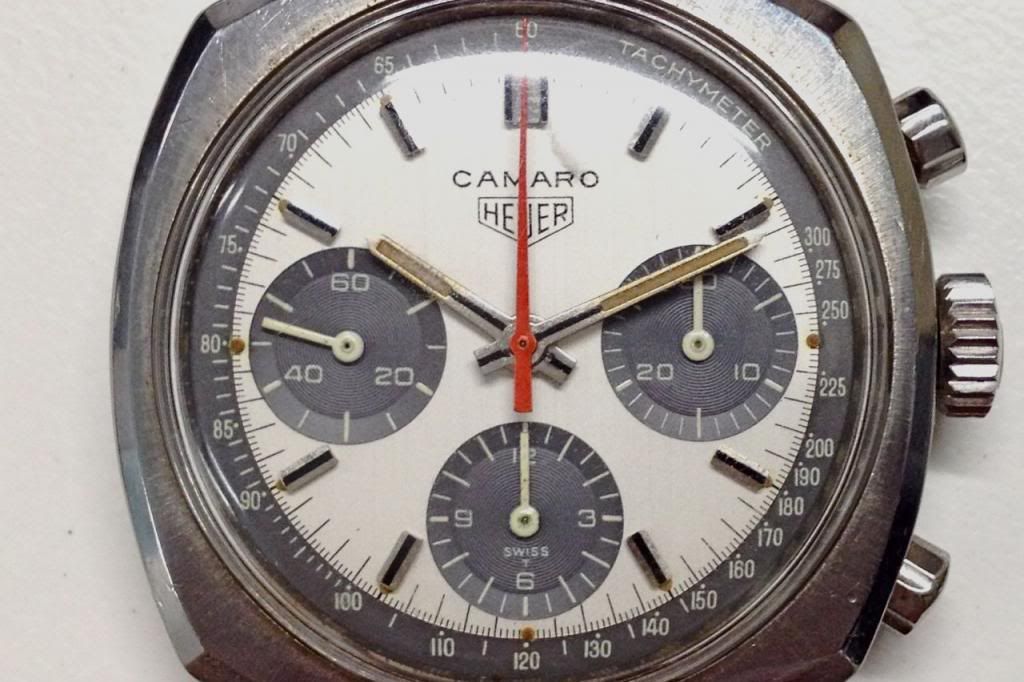
Recently I had the opportunity to have a close look at a rare gem- the Heuer Camaro. Up until now I've never seen one in person and having handled one now, it is much smaller than I thought. You can never tell the size from images on the Internet. This example even had what looks like the original strap fitted with the original buckle. Apparently it was never serviced either but it was still running. Seemingly relatively on time. 


The Camaro is powered by the venerable Valjoux manual wind chronograph movements and it's quite refreshing to know that these older movements were built tough if not pretty and designed to last. Of course the owner of the watch hasn't worn it in years which may have contributed to the great condition of the watch. It's unfortunate that the Camaro had a very short production run, phased out in 1971/72, having been introduced in 1968.

In the beginning they were fitted with Valjoux 72, but later on various 'newer' version s were fitted, including 92, 7730, 7733 and 7734. This latter movement is the same as the one fitted to the "poor man's Heuer, the LeJour chrono, seen here and here. The valjoux handwind movements were all very robust and reliable albeit not very pretty to look at, but this was before the modern see-through case back craze, so I guess that didn't really matter. The movements will all have signed "Heuer" on the bridge. 

Jack Heuer was the driving force behind the design and production of the Camaro, and the name was an excellent fit for a chronograph back then, as it was around the mid 60s that a new trend of "Muscle cars" hit the US car industry. The idea behind these Muscle cars were to fit massive engines into smallish cars, and to say the Ford Mustang was successful would be to say that the moon landing was no big deal. Chevrolet reacted very quickly, came up with the Camaro, and this model was also extremely popular. Wonder why Heuer didn't name the chronograph Mustang?


As Tag Heuer focuses on advancements in high accuracy mechanical timekeeping, it would be so great if they can divert a little attention to their history and the vast range of brilliant chronographs they have in the vault and offer re-editions. They've done it in the past with models such as the silverstone and the autavia. The Monaco and Carrera seems to be the only historically based model in continued production. You COULD argue that the Monza is a modern day tribute to the Camaro, given the similar cushion case shapes, but it's not really the same, is it? The Camaro is a beauty that deserves to be more widely recognized and that it is just one of many Heuers which, for the time being, regretfully consigned to the archives...

SPECS

Case size: 37mm x 37mm
Cushion shape with brushed finish and bevelled polished edges.
3 subdials for running seconds, 30min and 12 hour counters. Steel hour and minute hands with lum inserts, red centre chronograph seconds hand.
Movement: 17-Jewel Valjoux 72 manual wind movement. (I'm guess here, since I didn't open the case up)

Friday, August 23, 2013

LeJour Valjoux 7734 Chrono - 2 Years On...


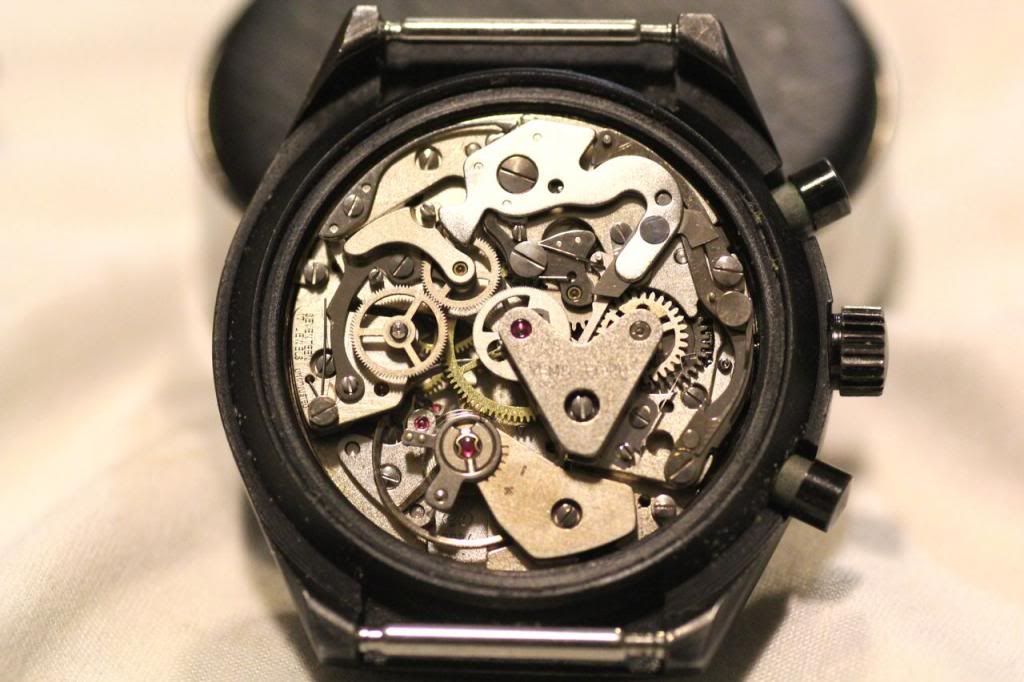
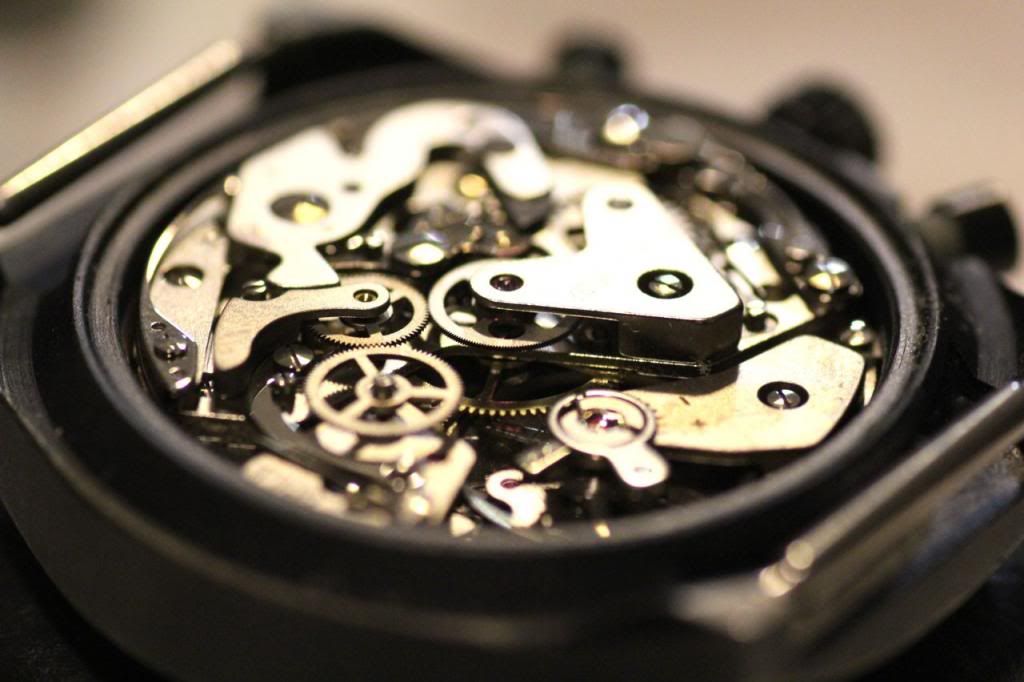
So I thought I'd open up the LeJour to see the Valjoux 7734 movement within. It's not the prettiest movement - far from it. but there's something quite honest about it. it's not pretending to be something it's not. Just an honest, workhorse of a movement that endeavours to provide relatively reliable timekeeping for many many years. It is surprisingly refreshing to see something like this after we've been spoilt by the glamourous sapphire crystal case back, bevelled edges, geneva stripes and blued screws. It's the basic white tee and jeans of movements.


The watch has been on rotation for the past 2 years. You can see the first post here. Opening the watch up wasn't my intention. I'd just wanted to change the strap but thought I might as well have a look at the movement while I was at it. I haven't worn this watch all that much, but I do still like it as much as the day I first acquired it. It has a certain charm and warmth that always brings a smile to my face when I see it. I still haven't bothered with checking its accuracy. To be honest there are only 2 hands so it's not like I'll notice any deviation (unless it's something like a minute a day).


Thanks to the shortish lugs the watch wears quite well on my wrist. It is tall, but not unmanageable. Having swapped it onto regular straps it is actually very comfortable.


I'm happy to report that in the two years under my care the watch has remained more or less in the same condition. The case back seal looks to have seen better days when I opened the watch up. I might get around to having the glass and back seal replaced one of these days, but that would be more to keep the dust out than making the watch water resistant. Other than that it was just a good excuse for me to practice my macro photography skills...


Friday, July 5, 2013

Espace Horloger- Great Watchmaking Museum in the Vallée de Joux

Espace Horloger - Vallée de Joux
Grand-Rue 2
1347 Le Sentier
T. +41 21 845 75 45
info@espacehorloger.ch


As a reader of this blog I'm sure you already know that in the Vallée de Joux  there lives a number of high end watchmaking manufactures. Audemars Piguet, Blancpain, Breguet and Jaeger-LeCoultre just to name a few. There are also numerous smaller maisons such as Daniel Roth, movement manufactures such as Dubois Depraz, and a number of parts makers such as Francois Golay. What you may not know is that there is also a very nice little watchmaking museum up in the mountains - Espace Horloger, believe it or not. And it's only a short stroll from Manufacture Jaeger-LeCoultre.


This was a surprising little gem, and apart from a permanent exhibition on watchmaking and the history of, there is also a section of temporary exhibition which as the name suggests, changes from time to time. The tour guide is well versed in multiple languages, is extremely knowledgeable and very humorous to boot. The building that houses the museum used to be a 'maison' for watchmaking and on the top floor, a section is preserved from back in the days when watchmaking activities were the norm. You get a first hand view on how things were like 200 years ago.


However, don't assume that just because there are a lot of history in the museum, it's all... well... historical. It also utilises some of the fanciest 21st century technology. Ok, the first one, a 3D movie about watchmaking in the Vallée de Joux isn't exactly breathtakingly high tech these days, but the next bit of technology comes almost straight out of the movie Minority Report. You have a huge touch screen table, with a number of 'discs' on the side. Place the disc on the touch screen and it comes alive, with a touch menu extending out of the disc and onto the screen. Choose from the menu and it takes you through a journey right there in front of you. Move the disc and the whole thing moves with it. Personally I didn't think this sort of technology was available to the public! There are also watchmaking lessons on the big touch screen, where you can 'virtually' build your own watch, then email the final product to yourself.


At the moment the temporary exhibition is all about the Audemars Piguet Royal Oak, and on exhibition is the extremely rare and sought after Royal Oak A series, amongst others. Over on the more permanent exhibition, there are items ranging from clocks, animatrons, watchmaking tools including an example of the millionometre as invented by Antoine LeCoultre, and various watches on display. I won't spoil it for you. The images here are just a small sample of what's on show. It is a definite must for all watch enthusiasts. Especially if you're already making the trek up the gorgeous sweeping mountain passes (no need for an Aston Martin, a Golf will do nicely) to the Vallée de Joux to visit the various Manufactures.


Oh, and if you prefer to read the old fashioned (proper) way, they also have a ton of various watch literature for sale.

Thanks to my contact in the Vallée de Joux for the images and the heads-up on this place!

Wednesday, May 8, 2013

Cartier's Jaeger-LeCoultre Duoplan Powered Watches - Antiquorum

This Cartier watch lot from the upcoming Antiquorum auction was brought to my attention courtesy of @horologium. It's an interesting lot seeing as you get a whole brief case of nice vintage Cartiers in one hit, most of which will most like need to be sent back to the service centre for a bit of TLC. The James Bond attache case is a nice touch.

Image from Antiquorum- Click on image to expand. The duoplan ones would be the rectangular shaped watches

What really caught my attention was the barely legible text engraved on the plate above each watch to identify it. I managed to make out the word "Duoplan" which struck a chord... what chord???


Well, back in the early 20s, Jaeger-LeCoultre came up with a radical method to shrink the watch movement in a quest to make everything smaller. They came up with the idea of putting the movement on 2 levels, so it's shaped like a brick, but by doing so shrinking the overall size and a brick shaped movement lent itself quite well to bracelet like jewellery watches. The name is literally that- Duoplan.


The Duoplan quickly evolved into the smallest mechanical movement ever made- the Calibre 101. One of the most famous watches made with this watch was the one worn by Queen Elizabeth II during her coronation back in 1953. The Calibre 101 consists of 98 parts, measuring 4.85mm by 14mm and weighs a massive 1 gram(!)


Watches with calibre 101 are still being produced today by Jaeger-LeCoultre, but the Duoplan is not. This might be quite the pick up if only for the Duoplan watches that aren't made by Jaeger-LeCoultre.

Calibre 101 fitted into a Reverso case
The auction is this Sunday, May 12th in Geneva, and the Cartier watches set is lot 340.

Thursday, June 7, 2012

"The Elephant and the Snake" - a 19th century Bovet pocket watch


 Photo from Antiquorum


Born in Fleurier, Switzerland, Edouard Bovet (1797–1849) was the son of the watchmaker Jean- Frédéric Bovet. He One of five brothers and a sister, he studied art with his father. In 1814, as a consequence of his stance against Neuchâtel's return to Prussian rule after the fall of Napoleon, he left, with his brothers Frédéric and Alphonse, for London to study watchmaking

After studying in London for a few years, his employer Magniac sent him to what was then Canton, China, in 1818. Almost as soon as he arrived he was able to sell four watches for the equivalent of USD 1 million in 2008 currency. 

Clearly he took to living in the port city; in 1822 he founded, with Alphonse and Frédéric (still in London) and Gustave, who was a watchmaker in Fleurier, a company for the express purpose of selling timepieces to the Chinese market. The company was based in London and production soon transferred back to Fleurier. 

Five changes of ownership after its birth, the current manifestation of Bovet is quite a different beast, but the occasional appearance of an early Bovet timepiece at auction is always a good reminder both of the history of the brand, and the fact that ‘the Chinese market’ is not a new one, horologically speaking.


 Photos from Antiquorum


Coming up at Antiquorum’s “Important Modern & Vintage Timepieces” auction on Tuesday June 12, 2012 in New York is one of Bovet’s beautiful pocket watches made for the Chinese market, from circa 1870. “The Elephant and the Snake”, contains an intricate and gloriously colourful enamel painting attributed to P.-Amédée Champod (1834-1913) who specialised in hunting scenes and was awarded a silver medal at the Paris Exhibition of 1900. The pocket watch is 62mm, gilt brass with painted on enamel back, pearl-set bezel, pendant and bow. The dial is white enamel with Roman numerals and Arabic numerals at each 15-minute marker. The hands are blued steel. The movement is described as “M. 54 mm, fully engraved gilt Chinese caliber, free-standing barrel, Jacot duplex escapement, three-arm steel balance with gold screws, blued steel fl at balance spring, index regulator” and both the case and movement are signed ‘Bovet’ in Chinese characters, with the movement signed Bovet Fleurier. 

Oh and yes, it has its key. 

Estimate: 20,000 USD - 30,000 USD.

Happy bidding. 


 [AP]

Thursday, May 17, 2012

A look at a rare Fifty Fathoms


Are there sounds in the sea
Fifty Fathoms deep?

Sea Music : W. J. Turner  (1884 – 1946)


In 1952, the French government created an elite team within the Navy called the ‘Nageurs de combat’ (combat swimmers). Headed by Captain Bob Maloubier, the new team’s missions included underwater intelligence, sabotage operations and clandestine port attacks.

Underwater diving was still in its infancy at this point, so Maloubier and his team had to design their diving equipment from scratch. This took two years, and involved new diving suits, fins, goggles, and a watch. The team was equipped with diving watches, but Maloubier was not satisfied, so in conjunction with Lieutenant Claude Riffaud, he set about designing a better one. Their design was first submitted to Lip, whose ambivalence was summarised by their comment that his design was "a portable clock without any future".

The irony of this decision by Lip was not too far away.

Undeterred, Maloubier and Riffaud convinced Jehan-Jacques Fiechter at Blancpain, himself a keen diver, to produce the watch, which they named the ‘Fifty Fathoms’. A fathom is a unit of length used as a depth measurement in English-speaking countries, corresponding to a depth of 1.829 metres. Fifty Fathoms equates to 91.45 metres, the depth one can reach with traditional diving equipment. Jehan-Jacques was the nephew of Betty Fiechter who, with André Leal, had purchased Blancpain in June 1933. Betty had assisted in running Blancpain since 1915, and under the Fiechters, the Manufacture flourished.

The final Fifty Fathoms that went into production was not the exact design that Maloubier and Riffaud had presented, as Fiechter used his own diving experience to make some adaptations. These included a screw-down caseback with a double ‘O-ring’ system, and a humidity indicator at 6 o’clock (blue if the air in the case was dry, pink if water had penetrated the watch case).

Blancpain were unable to sell their watches directly to the French navy, and had to make their way to the Nageurs de combat via Spirotechnique, who were the official suppliers of scuba diving equipment to the French armed forces. Established in 1946, La Spirotechnique, which later became ‘Aqua Lung’, had its origins in 1942-43, when Jacques Yves Cousteau and engineer Emille Gagnan, who was working for L'air Liquide, a French company specialising in compressed gas, created the first scuba regulator. 

Now we come to the (amusingly) ironic part. At the time, Lip was a dominant player in the French watch market. Blancpain was an unknown. This meant that Blancpain and Lip had to sign a marketing and distribution deal to get an foothold in the French market. In 1954 the Fifty Fathoms watches were launched, with both Lip and Blancpain markings on the dial. One wonders whether there were any animated discussions at this time at Lip about opportunities lost. 


Within a decade of its launch, Blancpain's Fifty Fathoms had been adopted by a few specialist oceanographic exploration and research organisations. Most famously, Jacques Cousteau selected the Fifty Fathoms as the dive watch of choice for his 1956 Cannes Film Festival Palme d'Or winning ‘Le monde du silence’ (The Silent World). 
  
From the early 1950s through the 1970s, the Fifty Fathoms became popular amongst the military, and used by the armed forces of Israel, Germany, Sweden, Norway, Denmark, Poland, Finland and the U.S. When the Americans were looking for a dive watch, there was a ‘Buy American’ policy, whereby American manufacturers were given a 25% price advantage over non-American competitors. Fortunately for Blancpain, Allen Tornek, who had met Jehan-Jacques Fiechter through their common interest in diving, took an interest in helping out. To get around the various restrictions, the Tornek-Rayville company took the Fifty Fathoms and rebranded it for the U.S. military under two names “Blancpain Tornek” and “Rayville Tornek” (‘Rayville’, a phonetic anagram of Villeret, was the name used by Fiechter for some of Blancpain’s production). About 1000 Tornek-Rayville Fifty Fathoms were produced, most of which were destroyed by the Navy at the end of the commission, so they are particularly sought after nowadays. 


To understand the history of Fifty Fathoms is arguably a lifetime’s worth of work given the list of companies involved, the number of iterations (estimated at around 100) of design/ movements/ size, and the fact that there have been both military and civilian versions.

In late 2010 and through to 2011, Blancpain launched a travelling worldwide exhibition of the history of the Fifty Fathoms. Starting at their boutique at Place Vendôme, Paris, it was a Fifty Fathoms/ dive watch enthusiasts’ dream, an incredible exhibition over sixty watches retracing its history and a truly once-in-a-lifetime chance to see such a group together.

Mostly consisting of historical models owned by collectors but also covering the latest models, this beauty, belonging to a distinguished collector friend of JPVFX’s, formed part of this important exhibition.


A rare early Fifty Fathoms Rotomatic Incabloc from 1954-1955 (possibly pre-dating the Rolex Submariner), this watch is 41mm with a thickness of 12mm. In a stainless steel case with a screw down case back, it is anti-magnetic and has a bi-directional bezel. The dial is a glossy gilt, and the indices and baton hands are radium-coated. The movement is Cal A. Schild 1361N, rhodium-plated with 17 jewels, line lever escapement, monometallic balance, shock-absorber and self-compensating flat balance-spring.


Invented in 1934 and manufactured by Incabloc S.A., the Incabloc shock protection system is the trade name for a spring-loaded mounting system for the jewel bearings that support the balance wheel in a mechanical watch, to protect the wheel's delicate pivots from damage in the event of physical shock.

The early Fifty Fathoms watches are very difficult to find nowadays, and poor condition is often an issue. There is really something particularly amazing about vintage tool watches like this one that somehow, after over half a century, manage to still have a brightness and clarity to them.

I admit that I’ve wanted a vintage Fifty Fathoms for little while. I really wouldn’t mind this one … 


 Yes you read correctly - a note signed for the 50 Fathoms owner by Captain Bob Maloubier himself


Call me old fashioned, but I’ve never managed to get my head around rose gold Fifty Fathoms, tourbillon Fifty Fathoms etc etc etc. I understand the desire to develop and innovate models that have become synonymous with your brand, but when a watch was created as a proudly utilitarian dive watch, I can’t help but think that something is lost when it is turned into an unnecessarily elaborate timepiece.   


[AP]

Tuesday, May 15, 2012

Hands-on with an unusual enamel & gold vein dialled Longines


As you know, we love our vintage watches, and today we have another rare horological beast for you. This one is particularly unusual. No, it’s not a Longines with a cracked dial which has had the cracks filled with gold. Meet the enamel and gold vein dialled Longines Flagship.


Launched in 1957, the Longines Flagship collection focused on classic slim cases, designed to be waterproof, and seen as a rival to Omega’s Seamaster at the time. This example is circa 1966. Measuring 35 x 39 mm (not including the crown), it has the original enamel dial with gold veins running through it, giving it a ‘cracked’ look. This is an intriguing and striking dress watch whose nuances are best viewed through a loupe; it is only then that you get the full effect of the gilt and enamel, and it's just stunning.


Interestingly, despite this being a 1960s model, the hands are Art Deco in style, and almost architectural. It’s an unusual combination, the veining with the hands, and it works.

The watch is signed on the dial, case (signed ‘Longines-Wittnauer') and crown, its movement a Longines calibre 285 manual wind with 17 jewels. The bezel is 14 K gold, as are the lug caps, but the back is stainless steel.


Owned by a collector of vintage Longines who has not seen another one like this before, if you have come across another one in your horological travels, please tell us, as he’d love to learn more about this watch.


Oh and just in case you’re wondering about the importance of the Flagship collection to Longines, their Heritage Collection, which honours the brand’s most iconic watches by recreating them anew, contains some Flagship models that hark back to the early days of the model line.


[AP]

Monday, May 7, 2012

A look at a 1939 Longines Lindbergh


In March, I wrote about a rare Longines Wittnauer Second Setting watch. Thanks to a distinguished collector friend of JPVFX, we now have a follow-up post of an even more well known and rare Longines aeronatical beast - the Longines Hour Angle watch, known as the 'Longines Lindbergh'. 

Designed by Longines and Lindbergh based on the Weems design, this was a continuation of Longines’ relationship with pilots; the brand was the official supplier of time instruments to the International Aeronautical Federation (IAF) from 1919. 

The Lindbergh Hour Angle Watch was designed by Col. Charles A. Lindbergh as a navigational aid for pilots and was, in fact, used by renowned aviators such as Amelia Earhart and Amy Johnson. Used in conjunction with a sextant, nautical almanac and a radio to receive a time signal, it made allowed for the calculation of the ‘Greenwich hour angle’ i.e. longitude.

So, what is an ‘hour angle’? 

From the aviation point of view, it is the angular distance west of the Greenwich meridian. The earth’s full rotation is 360° – an hour, therefore, is an ‘hour angle’ of 15°. This means that a 60° hour angle, for example, equates to 4 hours with respect to the Greenwich meridian. 

Here are some pages from the Longines website about the modern ‘heritage’ version of the Hour Angle that they released a few years ago, with an explanation of its use. Click on each screenshot to get a larger image.


This stunning example dates from 1939. A 47mm sized steel case with an onion crown, the main dial is white enamel with black Roman numerals. The revolving bezel is silver inlaid with enamel nu, the 15 degree intervals as mentioned above are on a rotating bezel. The crown at 2 o’clock turns the inner dial, which is calibrated for 60 seconds and 15 degrees.


The Lindbergh and the Weems actually came out with two movements. 

Firstly, the Cal.18.69N, which allows the time to be pin set by pressing the pin down and then rotate the crown to set the time, whilst when you pull the crown out, it rotates the central disc to offset the time. 

Secondly, it also came with the Cal. 37.9, which has a small wheel under the crown. The wheel rotates the central disc and the time set in the traditional way by pulling out the crown.

Inside this Lindbergh is the Cal. 18.69N movement. This calibre was produced by Longines from 1895 onwards. It has a nickel-finished lever movement, 15 jewels, bimetallic compensation balance, and hinged stainless steel cuvette. Cal 18.69N allows the time to be pin set (you press the pin down and then rotate the crown to set the time) while when you pull the crown out, it rotates the central disc to offset the time.

This Lindbergh is in remarkable condition. The enamel dial and Breguet-styled blued hands are bright, the numerals clear, the bezel showing the fabulous patina of its age but with the numbers still clearly visible. As is the case with the Second Setting watch, it sits comfortably on the wrist in spite of its size.


As mentioned above, the Longines Heritage line, along with producing a homage to the Weems Second Setting, also resurrected the Lindbergh Hour Angle Watch with similar faithfulness to the original, but with the added bonus of a caseback that opens to reveal the L699 automatic movement. 

The brand’s Heritage watches are very well received and to my mind, their best models. In some ways it’s interesting that designs which hark back to their past are so well regarded, but then again, it just proves the old adage about good design (I’ll spare you the ‘time’ pun). 


[AP]

Friday, April 13, 2012

Marking Time - 'The Clock' & a horological workshop


Following an AUD$53 million redevelopment, Sydney’s Museum of Contemporary Art re-opened, at the end of March, with a new exhibition called ‘Marking Time’. Featuring the work of eleven Australian and international artists, it shows the ways in which they visualise the conception and representation of time through the use of photography, painting, drawing, sculpture, installation, sound and light.

I’ve only spent a brief period looking at the exhibition so far, but intend to return soon. There are some hypnotic works there, but the two parts of ‘Marking Time’ that I’ve spent most time with so far have been a weekly ‘workshop’ run by the Sydney chapter of the National Association of Watch and Clock Collectors, and the Southern Hemisphere premiere of Christian Marclay’s remarkable 24-hour video work, ‘The Clock’, for which he was awarded the Golden Lion for best artist at the last year’s 54th Venice Biennale.

‘The Clock’ comprises of several thousand short extracts from cinema history, each suggesting or referencing a particular time of day or actual time, through the on-screen appearance of a watch or clock, or an utterance. Marclay has created a cinematic collage to form an amazing 24-hour sequence which is synchronised with the viewer’s time - I arrived at 6.30pm and this was the time referenced in the film as I sat down.

To have achieved this was a monumental enough effort on its own, but it is only after watching it for a while do you realise that the scenes were not randomly selected just to satisfy the requirement of a reference to the time in question, but that there are in fact narratives, and allusions to a previously featured film clip, or even a continuation of the clip. I have only managed a few hours so far, but hope to see as much of the entire film as I can. It is being played continuously during the MCA’s opening hours and every Thursday, for the duration of the exhibition, there is a 24-hour screening, with the museum’s café open throughout the night for those doing an overnighter. Last week, there were queues to get in during the late hours, and the cinema was at capacity (with an occasional queue) during my visit.

The free ‘workshop’, which is being held every Thursday evening for the duration of the exhibition, is called ‘Talk and Tinker’. The website describes it as a celebration of the history of time-keeping via an exhibition of clocks and watches, at which there is a master watchmaker for you to chat to, and perhaps show your own timepiece to.

As it turned out, it is not a workshop so much as a small exhibition run by the local members of the National Association of Watch and Clock Collectors, containing items from member collections. I didn’t get to meet the watchmaker, but I did get to chat to one of the volunteers, who told me that they have a very strong local membership, and that their monthly meetings routinely attract around a hundred people. We had a discussion about ‘watch’ versus ‘clock’ people, as it became evident that the focus of the NAWCC is more on the latter, and agreed that they are quite different breeds. He was a very welcoming, educational and friendly gentleman, and I enjoyed the exhibition, but alas my interests probably don’t overlap with theirs.

They were happy for photos to be taken, so without further ado, here are some of the items that are on display :


For more information about the exhibition, visit the MCA’s website here. It's well worth a visit.


[AP]