Friday, April 29, 2011

Sprout Dining

2 Honeysuckle Drive
Newcastle NSW 2300
02 4023 3565


Great weather in Newcastle

I have heard great things about the Newcastle food scene. There are great cafes, especially on Darby Street, and we can certainly vouch for that. Great atmosphere, great and friendly service, coupled with great weather, I could've hung out there all day, and just watch the nice cars, really really nice cars drive past. So you could say we had high hopes of the dinner scene, too.

Cafes on Darby

And perhaps there is a great dinner scene. Perhaps just not the night we went. To be fair, it certainly wasn't all bad. But I think that was mostly due to the company. Almost everything else left a sour after taste…

Wednesday, April 27, 2011

Xia Fei Shanghainese Restaurant

Xia Fei
Shop 26-7, B2
K11 Mall
18 Hanoi Rd
Tsim Sha Tsui
Hong Kong
Ph : +852 2801 6111


Before arriving in Hong Kong I'd gone trawling online for places to try. Xia Fei, a relatively new restaurant at the time, ended up on the list, but I can't seem to recall the whys and wheres of it. The name "Xia Fei" comes from the road of the same name back in the era of foreign concessions in old Shanghai - Avenue Joffre (now called Huai Hai Lu).


And so it was that I found myself at this restaurant, which is situated at the end of one of the myriad of corridors in the K11 mall.

Sunday, April 24, 2011

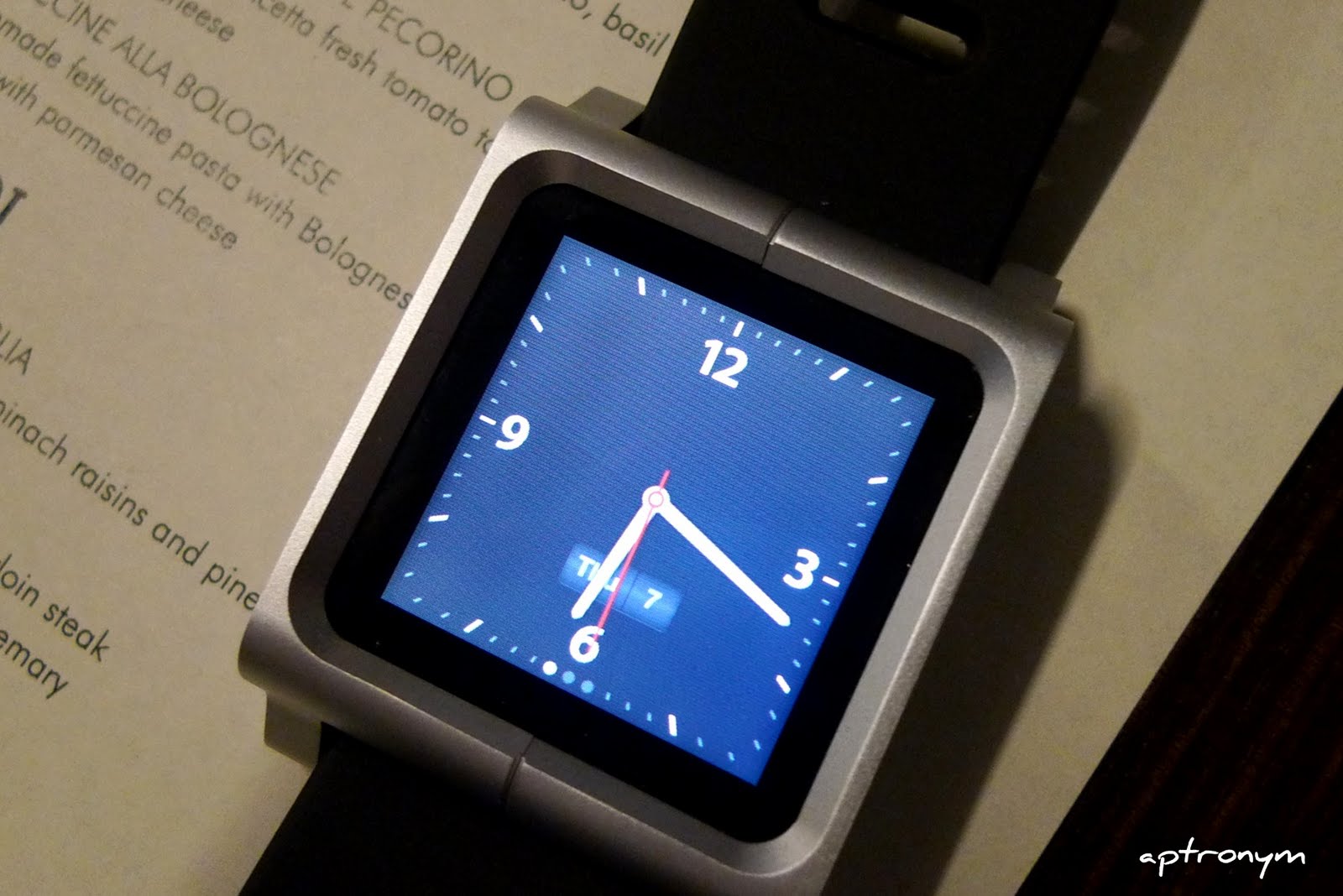
A review of the iPod LunaTik


One of the coolest horological products to reach the market recently is the LunaTik, a conversion kit that turns the latest touch-screen Apple iPod Nano into a wrist watch. This is clearly not haute horlogerie, but nevertheless it is interesting, funky and great fun to wear.


Stop reading now if you think that any time-piece that isn’t mechanical is not worthy of consideration. My personal view is that anything that tells the time is grist to the horological mill and if it satisfies my sense of aesthetics then it matters little to me how the time-telling is achieved.

The design was a concept of Chicago-based MINIMAL design studio that was brought to fruition by the Kickstarter project.  Kickstarter asked people to become backers by pledging various amounts of money in return for some of the products should the funding goal of $15,000 be reached. This initiative was wildly successful, 13,512 backers pledged over $940,000 for the project.

The LunaTik consists of a two-piece case  forged from Aerospace Grade Aluminum and then machined via CNC (Computer Numerical Control) into its final form into which the Nano slides. The two pieces are held together with stainless steel bolts which are secured with a pair of Allen keys supplied with the kit. It measures 46x41mm without the lugs.


It is easy to put together and once assembled, it is secured to the wrist with a strap made from high grade silicone rubber. There are cut-outs along the length of the strap which enables adjustment of the small aluminium keeper which secures the strap end. It also has the added benefit of keeping your wrist cooler than it might be were it to be a normal strap.


The case has been designed so that the charging port, earphone port and the controls are readily accessible, so you could listen to music via earphones while it’s on (or off) your wrist. Bluetooth would be handy should Apple ever decide to incorporate it into a future version of the Nano, and this would then avoid the possibility of ripping the 'phones from your ears should you move your arm suddenly.


One the minus side, to see the time display you need to press a button on the side, and it does go to sleep after a short period, so that the time is not continuously displayed. It is not the only watch I have that requires this, so I don’t find this a difficulty, though it might be a problem for some and could take a little getting used to if unfamiliar.

I find the LunaTik, with its mostly-dark screen, mysterious and “phantom-like”. The dark screen stands out and is noticed and it reminds me somewhat of the appearance of the Bell & Ross Phantom.


It is not small, so may not be suitable if you have a small wrist. Though it is marginally smaller than the Bell & Ross BR-01 series of watches, it is of course much lighter, so its easy to wear, and the silicone rubber strap is extremely comfortable. You almost forget its presence, so easily does it cling to the wrist.

The aluminium used in the construction of the LunaTik, though of Aerospace Grade, is strong but relatively soft, and may need to be worn carefully to avoid being “dinged”. That’s not an aspect I intend to test!


The Nano, even though it is affixed to the LunaTik strap, still has full functionality for music, radio and photos, and can also of course work as a timer and stopwatch, as well as having a pedometer function.

If you want to use it only as a dedicated watch, the battery lasts at least a week before recharging.


The silver version is pictured here, but it is also available in black and anodised red. There is another simpler snap-in version called the TikTok, made of polycarbonate, which is available in black or white, and this is probably more suitable if you intend to use the full functionality of the Nano, though to my mind it doesn’t cut it the way the LunaTik does.


It has a minimalist look in tune with modern design aesthetics and though it won’t replace your Patek or Rolex, it is great to wear on appropriate occasions.


[PT]

Saturday, April 23, 2011

An interview with Dirk Dornblüth


The origins of Dornblüth watches go back several decades, and start with a dream born of a special kinship with a pocket watch. In 1959, Dieter Dornblüth became rather attached to a sterling silver pocket watch that he’d been repairing. So attached, in fact, that when its owner picked it up, he decided to design a watch movement based on that of the pocket watch.

The design had just been finished, the movement itself barely started, when fate took a turn and he ended up in Kalbe, Saxony-Anhalt, to take over an abandoned watchmaker business, and the movement disappeared into the mists of time (no pun intended).

It wasn’t until his 60th birthday in 1999, when his son Dirk presented him with a self-made watch that the dream of 1959 was revived, and thus, Dornblüth & Sohn was born.

Recently, Dirk Dornblüth kindly found the time to answer a few questions.


1. D. Dornblüth & Sohn have been making watches since 1999. It is still very much a family business, with a limited number of watches made per year. How many are you now producing annually, and are you planning to increase these numbers?

The only change we have made during this time is the location. We are still a family business and will soon have 6 employees. Our oldest colleague Roswitha will retire in about 2 years, so we have been very lucky to find a young watchmaker to take over her tasks. He will start within the next weeks and learn from her until Roswitha leaves our team. The annual production has not increased, it is still 120 pieces. Output is limited by the traditional way of watchmaking which we utilise in our Manufacture every day.

Thursday, April 21, 2011

George Tyler 'clock watch' presented by Queen Anne to the Earl of Cromarty


I have already blogged about one interesting 'watch' that is up for auction at Heritage Auctions. Here is another item from the same collection. It could not be more different to the spy watch, but it is also historically interesting, albeit in a completely different (and definitely more horological) way.

The description of the lot is as follows :

"LOT 60222

George Tyler London Rare and Unique Gold Clock Watch Presented by Queen Anne to the Earl of Cromarty, circa 1702

Case: 58 mm, pierced 20k gold outer, inscribed on the back “The gift of Anne Stuart Queen of Great Britain and Ireland to the Earl of Cromarty,” outer case with makers mark of WI, five profile repoussé figures on the back, five raised cherubs around the bezel, five piece side box hinge, gilt inner case (tests low karat in content), inner steel bell, inner case pierced with star shapes, silent - strike lever positioned near ten o’clock, bulls eye glass crystal.

Dial: white enamel with Roman hour numerals, black minute track, outer five minute numerals, gold heart shaped hands.

Movement: fire gilt pinned full plate, verge escapement and fusee, one hour strike on steel bell, winged single footed pierced and masked cock, pierced Egyptian pillars, tapered cylindrical pillars near the clock strike train, silver disc regulator, engraved clock spring barrel, leaf engraving around the dial plate.

Signed: George Tyler London on the movement.

George Tyler is listed as having apprenticed in 1692, becoming a master in the Clockmaker Company from 1699 to 1723.

Anne was crowned Queen on April 23, 1702 after the death of William III. George Mackenzie was viscount, tarbat and the first Earl of Cromarty. He was born in 1624. He was clerk of the privy council and a senator in the college of justice. James II also made him a baron and viscount. Queen Anne appointed him as secretary of state and the Earl of Cromarty. He died in 1714 at the age of eighty-eight. He was a highly learned nobleman and the author of a “Vindication of Robert III, the King of Scotland from the charge of bastardy.” He also wrote the Synopsis Apocalyptica and an explication of the Revelations."


The Heritage catalogue notes that this watch was left un-numbered by the maker, since it was a specially commissioned piece by the Queen.

The Clockmakers’ Company is an active City of London craft guild, founded under a Royal Charter of King Charles I in 1631. Its original purpose was to regulate and encourage watch and clock making and its related skills such as engraving, sundial making and mathematical instrument making. The Company took particular interest in quality control, training (through apprenticeships) and the welfare of its members.

In theory at least, no-one could make, buy or sell clocks or watches or any part of them within the City unless they first became a freeman of the Company. This was achieved through apprenticeship to a free Clockmaker, through redemption (purchase) or patrimony (the right of a child to follow a parent into the Company).

Interestingly, whilst trying to find out more about Tyler I found this list of apprentices who were bound in the Worshipful Company of Clockmakers to George Tyler and his wife Lucy :

5 Jan 1714/15 Mary Darby
28 April 1716 Rebeckah Fisher
3 April 1718 Eleanor Mosely
5 Jan 1719/20 Catherine Jackson
5 June 1722 Hannah Campleshon
4 June 1725 Elizabeth Newton

Sources: London Guildhall (hereafter LG): The Company of Clockmakers' Register of Apprentices 1631-1931, compiled by C.E. Atkins, London, 1931, and LG: AHS Pam 51, Female Apprentices in the London Clockmakers' Company; LG: Ms 2711/5, Clockmakers' Company Rough Minute Book, 1719-31. 

Eleanor Moseley (sometimes appearing in records as “Elinor Mosely”) seems to have been significant enough to appear in a number of papers and specialist works relating to women watchmakers. The daughter of a prosperous York apothecary, she was seventeen years old when she was bound as an apprentice in London to George Tyler and his wife, Lucy, who was a milliner. Her indenture was registered with the Worshipful Company of Clockmakers, of which George was a freeman. 

In 1726, Eleanor took the freedom of the Clockmakers' Company and her first apprentice: her fifteen year old sister, Catherine Mosley. She took on a further apprentice, Mary Bate, the same year, followed by Katherine Capon in 1737, Mary Newton in 1732, and Elizabeth Askell in 1734.

Sixty seven women were listed as having been apprenticed in the clock making trade in the period of the mid seventeenth to late eighteenth century (p.81, All men and both sexes: gender, politics, and the false universal in England, 1640-1832 by Hilda L. Smith, Penn State Press, 2002) but there seems to be some confusion as to whether some of these women, like Moseley herself, were in fact  actually clockmakers or milliners. Louise Erickson states that in fact Moseley was the latter, and that she must have been in training with George’s wife Lucy.

I found it rather fascinating to learn that there were women watchmakers during that period, I had no idea, regardless of whether or not some of the recorded female watchmakers were in fact as such, or in fact milliners.


The estimate for this elegant 'piece unique' with its beautifully decorated caseback is: $30,000-$40,000, with a reserve price of $20,000. You can now bid online for it here as an absentee bid. Absentee Bidding Ends: May 2, 2011 at 10:00 PM CT (U.S.)


[AP]

Wednesday, April 20, 2011

A Special Watch Night

Arriving at a special edition of Thursday's weekly 'Tarts' in honour of the visiting AndrewD, Purists Mod, there were already quite a few watches on the table. But what immediately caught my eye is something that wasn't set out to be a watch in the first place...

It was the "Luna-tik" equipped iPod Nano!

My eyes lit up when I saw it. Certainly, the photos did it no justice as it is a stunner in real life!


And now a few words from your sponsor...well no, it's just me now (AP) rather than onomatopia. Heh.

The pressure was on to bring something interesting or at least worthy of being with Andrew's Journes, which he had brought up from Melbourne for the occasion. I shall let the photos speak for themselves. We had an eclectic range, but then again, if you'd seen photos of our watches on this blog, you know that we cover quite a broad range of tastes, not all of which appeared on this night.


Monday, April 18, 2011

The Protana - the original ‘spy watch’


Who isn’t intrigued by even the mere mention of spy and espionage devices? Whether we’re talking about the over-the-top comedy of Maxwell Smart’s shoe phone, the reality of miniature cameras hidden in cigarette packets, or even the poison tipped umbrella used by the Bulgarian secret services, spy gadgetry and methodology is eternally fascinating. Last year’s publication of MI6: The History of the Secret Intelligence Service 1909-1949 by Prof. Keith Jeffery revealed that during the First World War (1915, to be exact) Walter Kirke, deputy head of military intelligence at GHQ France, wrote in his diary that Mansfield Cumming, the first chief (or "C") of the SIS was "making enquiries for invisible inks at the London University" and that,several months later, C notified Kirke that the best invisible ink is semen, as it did not react to the main methods of detection (especially iodine vapour) and would be easy to obtain.

But I digress.

A very desirable and rare Cold War spy artefact has come up for auction – a Protana Watch Spy Recording Device, which comes with the complete set of Minifon surveillance accessories that it came with when they were first sold in the 1950s for US$350.

The Minifon, developed in the 1950s by Monske GMBH, was an miniaturised battery operated magnetic recording device. It could not (initially at least) record a full range of sounds and was thus limited to voice recording, but it did offer a portability that had hitherto been unavailable.

Although not originally intended as such (it was meant to be a dictation machine), it became popular for surveillance work. It had a recording time of one hour, and weighed three pounds, costing US$289.50.

The one being auctioned is the Minifon Pocket Wire P-55 kit, a special wire recorder marketed directly to espionage and intelligence organisations, police departments and private detectives. 


This updated recorder was smaller than the other versions of the Minifon and designed for covert use. However, you could not play back anything that had been recorded. The kit consisted of the P-55 Pocket Wire Recorder, a regular Minifon for playback and several covert mics, one of which was made to look like a watch, although it did not function as one.